
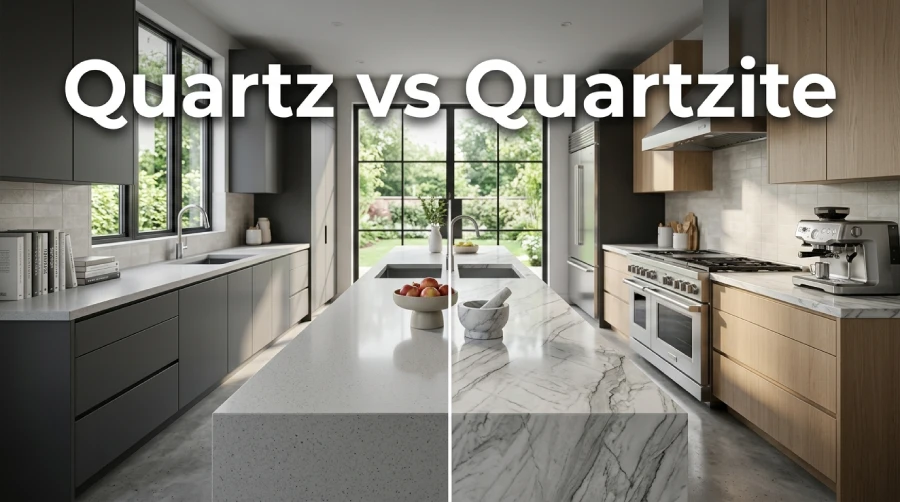
The core difference is how they are made. Quartz is an engineered surface crafted from real quartz crystals mixed with synthetic resins, giving you zero porosity and no maintenance. Quartzite is a 100% natural metamorphic rock sliced straight from the earth, offering superior heat protection but requiring regular chemical sealing to prevent tough stains.
Don’t let the similar names fool you. Picking the wrong surface can ruin your kitchen remodel and drain your wallet. While both stones look spectacular under kitchen lights, they behave like complete opposites under a hot pan or a spilled glass of red wine. This deep-dive comparison breaks down the raw facts regarding quartz vs quartzite, helping you select the perfect slab for your home’s daily routine.
What is Quartz? The Engineered Marvel

To understand engineered quartz, you have to look at it as an advanced manufacturing achievement rather than a raw mineral block. It does not come out of the earth in solid sheets. Instead, manufacturers take loose, raw quartz crystals—which are abundant in the earth’s crust—and pulverize them into various particle sizes.
[93% Raw Quartz Crystals] + [7% Resins & Pigments] --(Vacuum Pressing)--> [Non-Porous Quartz Slab]
These loose minerals are mixed with high-quality polyester resins, binding agents, and specific color pigments. The slurry is poured into a massive mold, compacted under an intense vacuum system, and cured in automated ovens. This heavy industrial pressing eliminates every microscopic air bubble inside the material. As a result, the finished product is entirely non-porous, perfectly uniform, and highly resilient against everyday kitchen accidents.
What is Quartzite? Nature’s Time-Baked Stone

Quartzite is a raw, unadulterated product of tectonic history. Its journey begins as simple quartz sandstone found in ancient geological layers. Over millions of years, tectonic plate movements push this sandstone deep into the earth’s crust, where it encounters blistering subterranean heat and immense pressures.
During this metamorphic event, the individual sand grains undergo a process called recrystallization. The heat melts the silica slightly, and the pressure fuses the grains together into an incredibly tight, interlocking mosaic of quartz crystals. When miners quarry these blocks from the earth, they are cutting into a solid, heavy rock that is structurally tougher than granite. Every swirl, dramatic vein, and color shift across a quartzite slab is a permanent record of the earth’s natural movements.
Quartz vs Quartzite: Hardness and Scratch Resistance Tested
When it comes to resisting surface scratches from stray knives, keys, or heavy pots, both materials are incredibly tough, but nature takes the lead. Mineral hardness is measured using the Mohs scale, which ranks materials from 1 (soft talc) to 10 (hard diamond).
-
Natural Quartzite: Ranks at an impressive 7 to 7.5 on the Mohs scale. Because it is nearly pure crystalline silica, it is extremely difficult to scratch. In fact, running a steel kitchen knife directly across a raw quartzite slab will often leave a metal mark on the stone because the stone wears down the knife’s steel.
-
Engineered Quartz: Typically sits right at a 7 on the scale. While the quartz minerals inside are highly scratch-resistant, the synthetic resin holding those minerals together is much softer. If you slide heavy, abrasive ceramic bowls or rough cast-iron pans across quartz with enough force, you can leave fine scratches in the resin finish.
Quartz vs Quartzite: The Burning Truth About Heat Resistance

The single biggest operational difference between these two surfaces shows up when you cook. Homeowners who love to move screaming-hot pans directly from the stove onto their countertops must pay close attention to how these materials conduct heat.
Quartzite handles heat beautifully. Because it was created at temperatures of thousands of degrees, it can easily handle hot pans, baking sheets, and boiling water without structural damage or discoloration.
Engineered quartz cannot handle direct heat. The polyester resins used to bind the stone particles together are essentially a specialized form of plastic. When exposed to temperatures above 150°C (300°F), these resins will suffer from thermal shock. The heat will scorch the plastic polymers, leaving permanent yellow or brown ring marks on your pristine white countertop. If you choose quartz, using protective trivets or hot pads under your cookware is mandatory rule.
Quartz vs Quartzite: Sealing and Maintenance Routines Compared
Your daily cleanup routine and long-term maintenance will vary dramatically depending on which material you install.
| Performance Feature | Engineered Quartz | Natural Quartzite |
| Material Composition | 90-95% Quartz, 5-10% Resin | 100% Metamorphic Rock |
| Porosity Level | 100% Non-Porous | Porous (Microscopic Channels) |
| Chemical Sealing | Never Required | Required 1-2 Times Per Year |
| Acid Sensitivity | Immune to Household Acids | Can Etch if Mislabeled or Low Quality |
| Daily Cleaning | Warm Water & Mild Soap | pH-Balanced Cleaners Only |
Because engineered quartz is bound with resin, it features zero porosity. Liquid cannot sink beneath the surface. You can leave a pool of spilled coffee, lemon juice, or red wine on a quartz counter overnight, and it will wipe clean with plain soap and water the next morning.
Quartzite retains the natural pore structure of the original sandstone. If left bare, dark liquids or cooking oils will seep deep into the stone, creating dark, permanent stains that require a messy chemical poultice paste to pull out. To prevent this, you must apply a high-quality impregnating sealer to quartzite countertops at least once or twice every year.
Quartz vs Quartzite: Fabrication, Slabs, and Installation Expenses
Buying a slab is only part of your budget; turning that raw stone into finished kitchen countertops requires intensive labor, which alters the final price tag.
Quartz Project:   [Standard Cutting Tools] ---> [Easy Edging] --------> [Moderate Cost]
Quartzite Project: [Advanced Diamond Blades] -> [Slow, Careful Cuts] -> [Premium Cost]
Quartzite is notoriously difficult for fabricators to cut and shape. Because the stone is so hard, it destroys standard cutting blades quickly. Fabricators must run their computer-controlled saws at much slower speeds and use specialized diamond-tipped blades kept constantly wet with water. The stone is also heavy and prone to natural fracturing along its vein lines during transport. This high risk and slow fabrication process pushes installation costs to a premium, often ranging from $95 to $225 per square foot.
Engineered quartz slabs are far more predictable. Because they are manufactured in precise, uniform blanks with a consistent thickness, they are easy to cut, route, and seam together. The predictable nature of the material keeps fabrication costs lower, with total installation costs usually landing between $105 and $185 per square foot, depending on the design complexity.
Top Searched Questions on Stone Selection
Is quartz or quartzite more expensive?
Quartzite is generally more expensive than quartz. While budget-tier quartzites exist, premium slabs with distinct, marble-like veining require intricate quarry extraction and specialized, high-wear diamond tools to cut, which drives up labor and material costs significantly compared to manufactured quartz.
Does quartz look cheap compared to quartzite?
High-quality modern quartz does not look cheap, but it does look uniform. Quartzite possesses a natural depth, mineral translucency, and sweeping organic variations that engineered quartz cannot perfectly duplicate. If you look closely at quartz, you can see the pattern repeats, whereas quartzite is completely distinct across every square inch.
Can you use Clorox wipes on engineered quartz?
No, you should avoid using harsh chemical wipes like Clorox on engineered quartz. The strong bleaching agents and high acidity can chemically degrade the synthetic resins over time, dulling the polished sheen and leaving a cloudy, permanent haze on the surface. Warm water and mild dish soap are all you need.
How often do you really have to seal quartzite?
Most quartzite surfaces require sealing every 6 to 12 months. A quick way to test your seal is the water droplet test: pour a few drops of water onto the stone. If the water beads up permanently, your seal is good. If the water darkens the stone and sinks in within 10 minutes, it is time to apply a new coat of sealer.
Is quartzite prone to cracking or chipping?
Quartzite is highly resistant to scratching, but because it is a rigid, natural stone with existing tectonic fault lines and fissures, it can chip or crack if hit hard on the edges with a heavy cast-iron skillet. Engineered quartz has a slight advantage here, as the flexible resin matrix helps absorb impacts better.
Final Strategy for Smart Homeowners
Choosing between these two premium surfaces comes down to a direct look at your lifestyle and design goals. If you want a zero-maintenance kitchen where you can spill ingredients without a second thought and prefer a clean, uniform look, engineered quartz is your best choice.
However, if you are drawn to the wild, artistic beauty of real stone, value total heat protection, and do not mind sealing your counters a couple of times a year, natural quartzite will give you an irreplaceable centerpiece that elevates your home’s long-term value. Assess your daily habits honestly before visiting the slab yard to ensure you choose the surface that works with you, not against you.


Comments are closed.