
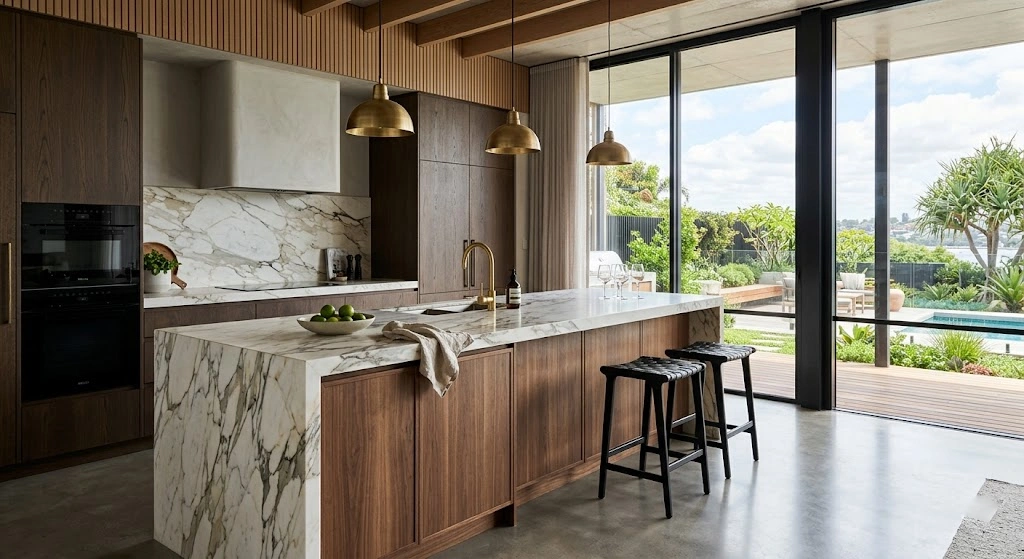
Australia’s property market rewards homes that feel considered. Buyers walk through dozens of listings before committing, and somewhere between the third and fourth open inspection, the finishes start to blur. What stays in the memory is texture, weight, and craftsmanship. The cool, honest surface of a marble island. The veined movement of a stone splashback catching afternoon light. These are the moments that translate into offers above the price guide, and they are the moments that quiet renderings and laminate look-alikes simply cannot replicate.
For homeowners planning a future sale, premium stone specification is one of the most consistent levers available for influencing resale value. It is not the only factor, of course. Location, layout, and the broader condition of the home all matter. But within the controllable variables, the choice of stone in kitchens, bathrooms, and feature areas plays a disproportionate role in how buyers perceive quality, longevity, and the overall investment grade of the property.
Why Stone Specification Matters More Than Ever
The Australian buyer has become more discerning. A decade ago, a renovated kitchen with a generic engineered surface was considered a strong selling point. Today, with social media exposing buyers to high-end interiors from Melbourne to the Mediterranean, expectations have shifted. Natural stone, once considered the domain of trophy homes, is now expected in any property positioning itself in the upper bracket of its suburb.
This is partly aesthetic and partly practical. Stone carries an honesty that synthetic materials cannot fake. The fossil traces in Calacatta, the soft warmth of travertine, the dramatic flow of a book-matched slab, these are not pattern repeats printed onto resin. They are geological signatures, formed over millions of years, and a serious buyer recognises that distinction immediately.
There is also a longevity argument. Premium stone, properly sealed and maintained, can outlast multiple owners. Buyers who are paying for a forever home, or even a long-hold investment, factor in the cost of future replacement. A property already specified with high-quality stone removes a future renovation from the buyer’s mental ledger, and that perceived saving translates directly into higher offers.
The Kitchen as the Primary Value Driver
If there is one room where stone specification produces measurable returns, it is the kitchen. Real estate professionals consistently rank the kitchen as the single most influential space in a buyer’s decision, and the benchtop is the kitchen’s centrepiece. A poorly chosen surface undermines an otherwise excellent design. A well chosen one elevates everything around it.
Sydney’s market is particularly sensitive to this. In suburbs across the Eastern Suburbs, the Lower North Shore, and the Inner West, buyers expect to see marble benchtops Sydney homeowners have come to associate with quality renovation. The same property with engineered stone will often sell, but it will sell at the lower end of its range. The same property with a thoughtfully selected marble or limestone benchtop tends to attract competing offers, particularly when the slab choice complements the architectural language of the home.
The specification details matter. Edge profiles, slab thickness, the decision between honed or polished finishes, and the way the stone meets adjacent materials all signal craftsmanship. Buyers may not articulate these details consciously, but they register them. A waterfall edge with seamless veining tells a story about budget, attention, and care. A clumsy join or a mismatched seam tells a different story, and it is one that buyers carry with them into their valuation discussions.
Bathrooms, Fireplaces, and Feature Walls
Beyond the kitchen, stone specification continues to shape value across the home. Bathrooms benefit enormously from stone vanities, shower niches, and floor inlays. The principal bathroom, in particular, is increasingly evaluated through a hotel-quality lens, and natural stone is the material that delivers that perception most reliably.
Feature applications also matter. A stone fireplace surround, a clad island, a freestanding bath plinth, or a bespoke entry threshold can shift a home from generic to memorable. These touches are often photographed for the marketing campaign, which means they work twice, once in the listing imagery and again when buyers attend in person. Properties that photograph well attract more inspections, and more inspections mean more competition at the offer stage.
For sellers planning a renovation specifically to lift resale value, the choice of natural stone kitchen benchtops over composite alternatives can be the single most consequential decision in the project. The cost differential, when amortised against the typical uplift in sale price, is usually modest, and the impact on buyer psychology is significant.
Buyer Psychology and Perceived Value
There is a useful piece of behavioural economics at play in property sales. Buyers anchor their valuations on the most expressive surfaces in a home. A premium stone benchtop, visible from the entrance and the living area, becomes the visual reference point against which the rest of the home is assessed. When the anchor is high, the entire property reads as premium. When the anchor is lower, even excellent features in other rooms struggle to lift the perception.
This is why stone specification produces a multiplier effect. It is not simply that the stone itself adds a measurable amount to the sale price. It is that the stone changes how buyers evaluate everything else, from the joinery to the flooring to the outdoor area. A property that feels considered in its primary surfaces is forgiven for minor imperfections elsewhere. A property that feels compromised in its primary surfaces invites scrutiny in every other corner.
Return on Investment Across Australian Markets
The financial case varies by market, but the pattern is consistent. In premium Sydney suburbs, agents regularly report that homes with natural stone kitchens transact at five to ten percent above comparable homes finished in engineered alternatives. In Melbourne, the differential is similar, particularly in the inner east and bayside corridors. In Brisbane and Perth, where the market has historically been more price-sensitive, the differential is narrower but still positive, and it widens as the property’s overall positioning moves upmarket.
For properties above the median price point in their suburb, the return on premium stone specification almost always exceeds the cost of the upgrade. For properties at the very top of their suburb, premium stone is effectively a requirement rather than an option. Buyers in that bracket are not asking whether the home has stone, they are asking which stone, from where, and finished how.
Specification Choices That Hold Their Value
Not every stone choice ages equally well. Trend-driven selections, particularly heavily figured varieties chosen at the peak of their popularity, can date a property within a few years. The selections that hold their value tend to share three qualities. They have classical proportions and movement. They are paired with timeless joinery and hardware. And they are installed to a standard that respects the material.
Working with suppliers and stonemasons who specialise in premium stone is the surest way to protect that investment. Slab selection, template accuracy, and finishing quality are not areas where shortcuts pay off. The difference between a competent installation and an exceptional one is often imperceptible during the build, but it becomes obvious during the open inspection, when the light hits the surface and the buyer reaches out to touch it.
A Quiet but Powerful Lever
Premium stone specification is one of those interventions that does not announce itself loudly in a campaign, yet quietly shapes every conversation that follows the first inspection. It tells buyers that the home has been considered, that the owners have invested in quality, and that the property is worth competing for. In a market where competition at the top end is fierce and at the middle is increasingly informed, the right stone, specified and installed with care, remains one of the most reliable ways to lift a property above its peers and into a stronger resale position.


Comments are closed.