
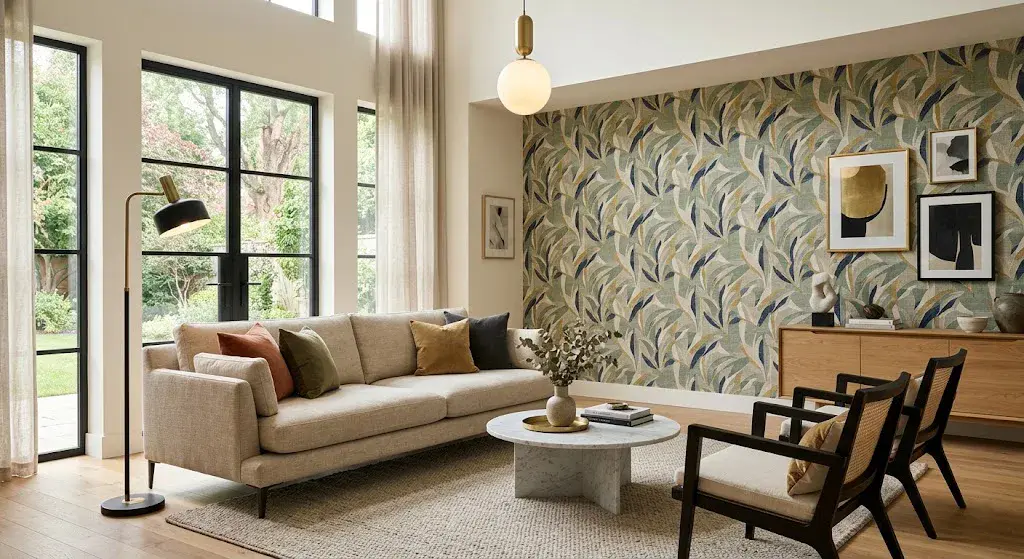
Living room wallpaper decor has moved far beyond dated florals and stuffy Victorian prints. Today, it is one of the most effective tools in interior design. The right wallpaper can define a room’s mood, shift its proportions, and reflect your personal style. From textured wallpaper to bold mural wallpaper, this guide covers everything you need to choose, plan, and install with confidence.
The Renaissance of Wallpaper in Modern Homes
Wallpaper sales in the UK and US have surged consistently since 2020. The global wall coverings market was valued at over $30 billion in 2023, with residential living spaces driving a significant share of that demand. People stopped seeing wallpaper as a permanent commitment and started treating it as a design choice, one that can evolve with their taste.
The living room carries the most visual weight in any home. It is the first space guests see, and the one where most daily life happens. Getting the walls right in this room shapes how the entire home feels.
Defining Your Aesthetic: Choosing the Right Style
Choosing a wallpaper style starts with knowing the mood you want to create. There is no single right answer, but there are clear categories that make the decision easier.
Minimalist and Scandi styles work around quiet luxury. Think subtle linen textures, soft warm whites, and barely-there geometric patterns. These choices let your furniture do the talking while the wall adds quiet depth. Brands like Farrow and Ball and Sandberg have built strong reputations in this space.

Maximalist and eclectic living room wallpaper decor goes the other direction entirely. Botanical prints, animal motifs, jewel-toned geometric patterns, and clashing colours define this style. The key is committing fully, because a timid version of maximalism never works.

Biophilic design has grown sharply in popularity since 2021. Forest mural wallpaper, leafy botanical prints, and organic grasscloth wallpaper textures all bring a grounded, calming quality to the living room. Studies from the University of Exeter link nature-based interior choices to reduced stress levels.

Vintage and heritage styles are also back in a serious way. Art Deco gold on black, Mid-Century Modern starburst repeats, and traditional damasks have all returned in updated colourways. These styles add architectural character to new-build homes that often lack it.
Material Matters: Beyond the Pattern
The pattern gets all the attention, but the material determines how your living room wallpaper decor performs over time. Choosing the wrong substrate is one of the most common and costly mistakes.
Non-woven wallpaper is the go-to choice for most DIY installations today. It is dimensionally stable, meaning it does not expand when wet with paste. You can paste the wall rather than the paper, which makes hanging significantly easier and reduces the risk of tearing.
Vinyl wallpaper is the most practical option for high-traffic living areas with children or pets. It is wipeable, moisture-resistant, and holds up against knocks and scuffs. Solid vinyl is the most durable, while vinyl-coated paper offers a middle ground between durability and breathability.
Grasscloth and natural fibre wallpapers add real tactile depth that no printed pattern can replicate. Seagrass, jute, and sisal are woven onto a paper backing and create a warm, organic surface. These materials are less tolerant of moisture and are best suited to rooms with stable humidity.
Peel-and-stick wallpaper has genuinely improved in quality since its early reputation for peeling corners and air bubbles. Modern removable wallpaper from brands like Tempaper and Chasing Paper adheres cleanly to prepared surfaces and removes without damaging paint. It is ideal for renters and for anyone testing a bold pattern before committing.
Strategic Placement: Where to Hang Living Room Wallpaper
Placement strategy matters as much as the pattern itself. Not every room needs four wallpapered walls to make an impact.
The statement accent wall remains the most widely used approach. Hanging wallpaper on the wall behind your sofa or fireplace immediately creates a focal point. It draws the eye, anchors the seating arrangement, and lets you use a bold pattern without overwhelming the space. This is also the most cost-effective option for larger rooms.
The ceiling is one of the most underused surfaces in living room wallpaper decor. Treating the ceiling as a “fifth wall” with a repeating geometric or delicate floral pattern creates unexpected drama. It works particularly well in rooms with high ceilings where the overhead expanse can feel cold or empty.
Framed wallpaper panels treat the material as fine art. Cut sections of wallpaper are mounted within decorative picture frames or wall moulding and hung like oversized prints. This approach works beautifully with scenic or hand-printed designs and gives you the look of expensive art at a fraction of the cost.
Full-room immersion is the bravest choice and, when done well, the most impressive. Wrapping all four walls in the same pattern creates a cocoon-like atmosphere that works especially well with moody dark papers or complex scenic murals. The key is balancing the wallpaper with restraint elsewhere, keeping furniture and accessories simple.
Color Psychology in the Living Room
Colour is where living room wallpaper decor moves from decorative to psychological. The colours on your walls directly influence how people feel in the room.
Cool tones, particularly blues and sage greens, slow the heart rate and lower perceived stress. A botanical wallpaper in soft muted greens or a geometric feature wall in dusty blue makes a living room feel genuinely restful. These palettes are well-suited to rooms used primarily for unwinding rather than entertaining.
Warm tones create social energy. Terracotta, ochre, warm coral, and deep amber on a statement wall encourage conversation and make a room feel welcoming. Interior designers consistently recommend warm-toned wallpaper patterns for living rooms that serve as gathering spaces for family and guests.
Dark and moody palettes use charcoal, navy, forest green, and burgundy to create depth and sophistication. These shades absorb light rather than reflecting it, which makes a room feel enclosed in a good way. Dark wallpaper ideas work best in rooms with strong artificial lighting or where a dramatic, evening-focused atmosphere is the goal.
Mastering Scale and Proportion
Scale is one of the most misunderstood elements of wallpaper ideas for living rooms. Getting it wrong can make a large room feel chaotic or a small room feel suffocating.
Large-scale prints and mural wallpaper actually work well in small rooms when used on a single wall. They push the eye backward, creating a sense of depth that smaller repeat patterns do not. Small, busy repeats in a compact room tend to read as visual noise rather than decoration.
Vertical stripes draw the eye upward and make ceilings appear higher. This is useful in modern homes with standard 8-foot ceilings that feel low. Horizontal stripe wallpaper works the opposite way, widening a narrow room by pulling the eye across the wall rather than up.
Furniture coordination is critical. If your sofa fabric features a strong pattern, choose a textured plain or subtle geometric wallpaper for the wall behind it. If your upholstery is solid and minimal, a bold botanical print or large-scale pattern can carry the visual interest. The goal is balance, not competition.
Technical Insights: Preparation and Longevity
Preparation determines how long your wallpaper lasts and how good it looks on day one. Skipping preparation steps is the main reason wallpaper fails early.
Wall assessment comes first. Check for moisture, existing cracks, and heavy texture before buying anything. Highly textured walls show through lightweight papers and ruin the finished look. Sand down rough patches and fill any cracks with filler, then sand smooth once dry.
Priming is non-negotiable. A dedicated wallpaper primer or size seals the wall surface, prevents the paste from soaking in unevenly, and makes the paper easier to slide into position. Hanging directly onto unprimed paint is the single most common cause of lifting edges and bubbling seams.
Lighting changes how wallpaper looks significantly. Metallic textured wallpaper in a room with south-facing windows will catch the light beautifully in the morning and look flat under artificial light at night. Test a large sample in your actual room across different times of day before committing to a full roll order.
Sustainability and the Future of Wall Coverings
Sustainable living room wallpaper decor is no longer a niche request. It is becoming the default expectation among younger buyers and renovation clients.
Water-based inks produce significantly lower VOC emissions than solvent-based alternatives. Look for wallpapers certified by the Forest Stewardship Council (FSC) or those carrying the PEFC mark, which guarantee responsible sourcing. Brands like Cole and Son and Graham and Brown have both expanded their eco-conscious collections in recent years.
Recycled substrates are entering the mainstream. Papers made from post-consumer waste and non-woven backings from recycled fibres perform just as well as virgin materials and carry a lower environmental footprint. Some manufacturers now offer take-back schemes where used wallpaper is returned and recycled after removal.
Smart wallpapers are an emerging category worth watching. Acoustic-dampening wallpaper panels reduce echo in hard-surfaced living rooms without requiring dedicated soundproofing. Air-purifying wallpapers, which use mineral-based coatings to absorb VOCs from indoor air, are already commercially available in Japan and entering the European market.
Conclusion: The Full Picture
Your wallpaper choice sets the tone for everything else in the room. Once your walls are done, choose lighting that complements the paper’s colour temperature, layer in rugs that echo the palette without copying it, and hang art that feels at home against the backdrop rather than competing with it.
Bold design choices in the living room pay off. The rooms people remember are the ones that show a clear point of view. Living room wallpaper decor is one of the most direct ways to express that.
Start with one wall. Live with a large sample for a week. Then commit. The result will be a room that feels genuinely considered.


Comments are closed.