
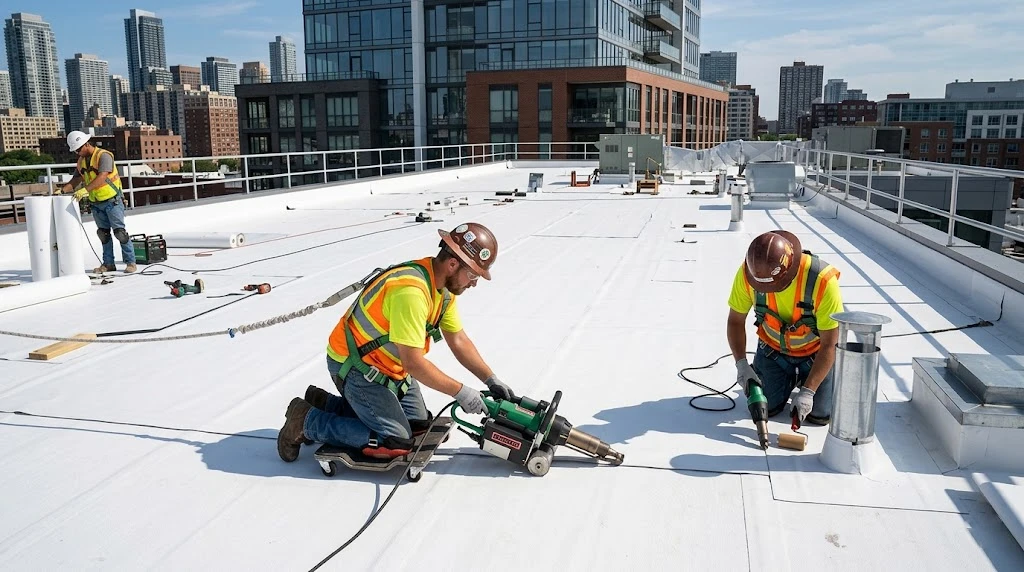
TPO roofing installation involves preparing the roof deck, adding insulation boards, rolling out the thermoplastic membrane, and heat-welding every seam. The process takes one to two weeks for average commercial roofs. Total installed costs typically run $7 to $14 per square foot, depending on membrane thickness and attachment method.
If you manage or own a commercial building, you’ve probably heard the term TPO roofing tossed around a lot. And honestly, there’s a good reason for that. TPO — which stands for Thermoplastic Polyolefin — has become one of the most popular flat roofing choices in North America. It’s tough, it reflects heat well, and it costs less than many alternatives.
But here’s the thing: even the best roofing material in the world won’t perform the way you expect if it’s installed wrong. The membrane is only part of the equation. How it goes down — every sheet, every seam, every flashing detail — is what actually determines how long your roof lasts.
This guide walks you through the entire TPO roofing installation process so you know exactly what to expect.
What Is TPO Roofing and Why Does It Matter?
TPO is a single-ply, white reflective membrane made from a blend of rubber and plastic. It’s designed to resist ultraviolet light, heat, and chemical exposure. You’ll find it covering warehouses, retail centers, schools, hospitals, and even some homes with low-slope roofs.
TPO is a lightweight material that’s easy to maneuver around on roof surfaces. This reduces installation time and labor costs. Wider sheets also reduce the number of seams that must be welded, which shortens the overall installation process.
The reflective white surface is one of its biggest selling points. On hot summer days, a dark roof absorbs heat and pushes your cooling costs up. A TPO roof bounces that heat back, which helps your HVAC system work less.
How Long Does TPO Roofing Installation Take?
Time matters when you’re running a business or managing a property. You want to know the disruption window before you commit.
For an average-size commercial roof of around 20,000 square feet, installing a TPO system typically takes no longer than one to two weeks. However, if the existing substrate and insulation must be torn off and replaced, the process can take considerably longer. Factors like roof size, complexity, number of penetrations, installation method, and weather all affect total duration.
Smaller residential or light commercial jobs can often wrap up in two to four days. Larger, more complex roofs with multiple HVAC curbs, drains, and penetrations naturally take longer to detail properly.
The Step-by-Step TPO Roofing Installation Process
Step 1 — Roof Deck Preparation

Every quality TPO installation starts with the deck, not the membrane. Before diving into installation, the roof deck must be clean, dry, and free of debris. Damaged areas need repair, and appropriate insulation and cover boards must be installed as needed.
A contractor may also use a thermal scan to check for hidden moisture in the existing roof. This helps determine whether a full tear-off is needed or whether the TPO membrane can be installed over the existing substrate. Skipping this step is one of the most common reasons new roofs fail within just a few years.
Step 2 — Install the Insulation Layer

Once the deck is ready, insulation boards go down. Insulation provides TPO roofing systems with greater thermal resistance, measured as R-value — the measure of how well a material resists heat flow.
The three main types of insulation used under TPO membranes are polyisocyanurate, expanded polystyrene, and extruded polystyrene. Polyiso is the most common choice for commercial roofs because it delivers the highest R-value per inch of thickness. Your contractor will help you choose based on your energy goals, local building codes, and budget.
Step 3 — Roll Out the TPO Membrane

With insulation secured, the crew rolls out large sheets of TPO membrane across the roof surface. Sheets are unrolled perpendicular to the roof deck and allowed to relax for approximately 30 minutes to reduce wrinkles. Wrinkles that get locked into place during installation create stress points that can eventually lead to cracking or water pooling.
TPO membranes come in a variety of widths and roll sizes. A typical sheet size for large ballasted and fully adhered installations is 10 feet by 100 feet, while 6 feet by 100 feet is more common with mechanically attached systems.
Step 4 — Attach the Membrane Using the Right Method
This is where the three main installation methods come into play: mechanically attached, fully adhered, and ballasted. Each method has different cost, performance, and application considerations. More on those in the next section.
Step 5 — Heat-Weld Every Seam

This is the most critical step in the entire process. Heat-welding the seams creates a strong and watertight bond between adjoining membrane sheets, ensuring protection against leaks and water infiltration. A trained technician uses a hot-air welding machine that runs along the seam and fuses the two sheets of TPO together at extremely high temperatures.
A properly welded seam actually becomes stronger than the membrane itself. An improperly welded seam is where most TPO roof failures begin.
Step 6 — Flash Around Penetrations and Edges
Vents, chimneys, and other protrusions need special care. Flashing prevents water from penetrating the membrane and causing damage throughout the building. Every space where three membranes overlap requires T-joints.
Edge metal goes around the perimeter to hold the membrane tight and guide water into the drainage system. The trailing edges are securely fastened into the roof decking, and the membrane is properly installed around side walls and penetrations to prevent leaks and extend the roof’s life.
Step 7 — Final Inspection
Once everything is in place, a thorough inspection follows. The contractor walks the entire surface, checks every seam with a probe, verifies all flashings, and confirms proper drainage flow. This step is not optional — it’s the quality check that separates a roof that performs for 20 years from one that leaks in year three.
The Three TPO Installation Methods Explained
You have three options for how the membrane gets secured to the roof. Each one comes with trade-offs.
Mechanically Attached is the most common method, especially on large commercial roofs. The membrane gets secured with screws and metal plates at set intervals. This method is quicker and typically costs $2 to $3 per square foot for labor, though it may have lower wind resistance than other methods.
Fully Adhered means the membrane is glued directly to the insulation across its entire surface. This method bonds the TPO membrane directly to the insulation and provides excellent wind resistance, making it ideal for areas with extreme weather conditions. It’s the most expensive option, running $2.75 to $3.50 per square foot for labor. It also tends to produce the longest-lasting results.
Ballasted systems use gravel or pavers laid on top of the loose membrane to hold it in place. This method may not suit all buildings due to potential drainage issues and is generally more affordable, between $1.50 and $2.50 per square foot. You also need to confirm your building’s structure can handle the added weight.
TPO Membrane Thickness — Why It Matters
TPO membranes are available in various thicknesses, typically starting at 45 mils and going up to 80 mils. Thicker membranes have increased longevity, making them an excellent choice for areas prone to severe weather conditions.
A 45-mil membrane is the minimum most manufacturers recommend. A 60-mil is the most common commercial choice. An 80-mil membrane costs more upfront but holds up far better against foot traffic, weather extremes, and the general wear that comes with rooftop HVAC maintenance visits.
How Much Does TPO Roofing Installation Cost?
Cost is usually the first question anyone asks. In 2025, most homeowners and building owners can expect professionally installed TPO roofing to fall in the range of $7 to $14 per square foot for typical installations.
Labor alone costs $2.50 to $4.50 per square foot. Old roof removal adds another $1 to $2 per square foot. Insulation adds $0.50 to $3.00 per square foot, and flashing repair or installation typically runs $200 to $500.
The total varies based on your roof’s size, how accessible it is, how many penetrations exist, and which membrane thickness you choose. A straightforward rectangular roof with minimal features will always cost less than a complex roof full of HVAC curbs, skylights, and drains.
Common Mistakes That Shorten a TPO Roof’s Life
Poor seam welding is the number one cause of TPO roof failure. Seams that aren’t fully fused allow water to creep in at the edges. Over time, that moisture causes insulation to deteriorate and eventually damages the deck itself.
Installing over a wet substrate is the second major mistake. Any moisture trapped under a new membrane will migrate, create bubbles, and accelerate membrane breakdown from beneath. A thermal scan before installation helps catch this problem early.
Excessive heat on TPO membranes can cause seams and flashings to pull apart and cracks to form within the material. It can also cause the laminated top layer to deteriorate prematurely, making the membrane far more susceptible to damage. Always work with a contractor who knows the correct weld temperature settings for the specific membrane brand being used.
Should You Hire a Professional or DIY?
When you need a new roof, it’s always best to work with an experienced professional. If something goes wrong during a DIY roof installation, insurance likely won’t cover it, and you can face costly repairs.
TPO installation requires hot-air welding equipment, proper training, and hands-on experience to get the seams right. It’s not like painting a fence. One improperly sealed seam can mean thousands of dollars in water damage repairs down the road.
Hire a licensed commercial roofing contractor with verifiable TPO installation experience. Ask to see previous projects, check reviews, and confirm they carry proper liability insurance. A quality installation today will protect your building for 15 to 25 years — and that’s worth doing right the first time.


Comments are closed.