
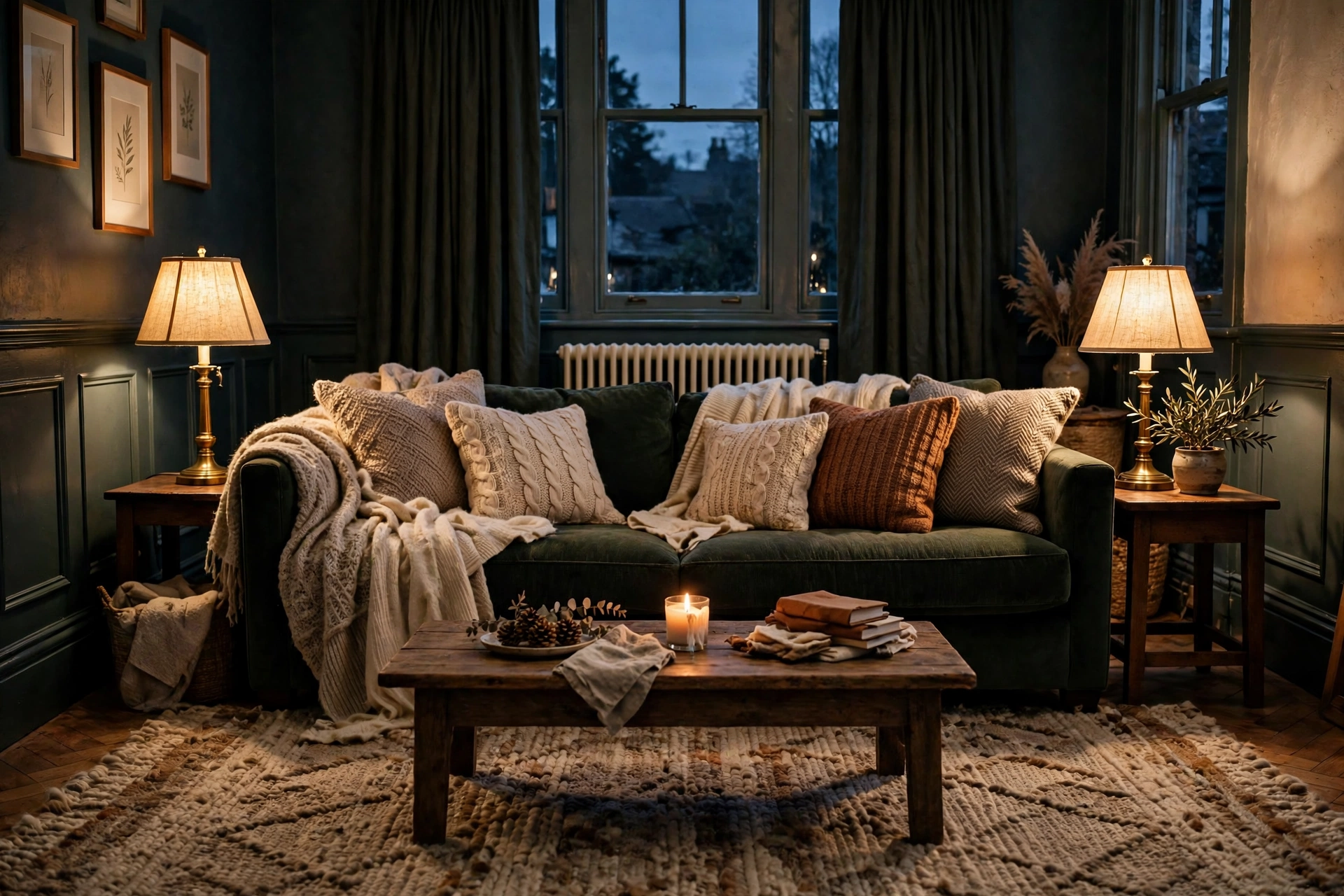
You don’t need a bigger sofa or a showroom to make a living room feel cosy through a British winter. What you need is warmer light, smarter textiles, sealed gaps and a layout that stops the draught from undoing everything else. These six ideas are aimed at real UK homes — Victorian terraces, 1930s semis, new-builds — and they work whether you rent or own. These cozy winter living room ideas UK homeowners and renters can use are aimed at real British homes.
1. Layer Your Lighting: Warm, Low and Plentiful
The fastest way to make a living room feel cosier is to change the light. A single overhead “big light” at full blast kills atmosphere; pools of warm light at different heights create it.
Aim for warm white bulbs around 2700K–3000K — candle-like and flattering, never clinical. Use three layers: a table or floor lamp for reading corners, wall or picture lights for the walls, and something low and flickery — candles, a flameless lantern — for evenings.
LEDs are the sensible upgrade. According to the Energy Saving Trust, LEDs use up to 80% less power than halogen bulbs and last around five times longer; swapping just one bulb can save around £15 a year. That means three or four lamps can run for less than one old halogen cost. And any new wired fittings must comply with Part P of the Building Regulations: use a qualified electrician.
2. Layer Textiles Like You Mean It
A bare living room leaks warmth visually as well as physically. The formula is simple: soft underfoot, heavy at the window, textured on the sofa.
Start with a large rug on hard floors — big enough that the sofa’s front legs sit on it — and the room instantly feels warmer and quieter. Add throws and cushions in natural textures: wool, boucle, chunky knits, draped so people actually use them. At the window, thermally lined curtains are one of the best pound-for-pound upgrades in a draughty room: they cut heat loss through glass far better than standard curtains and look luxurious even in a modest flat.
Renters take note: none of this needs a drill. Command-style hooks, tension rods and a good curtain behind a draughty door do more for comfort than most gadgets.

3. Kill the Draughts: The Cheapest Cosiness Upgrade
No amount of throws compensates for cold air moving across the room. Draught-proofing is unglamorous, but it makes every other idea here feel stronger.
Typical professional costs, from Checkatrade’s 2026 cost guide (May 2026): around £50 per window for strips or sealant, around £100 per external door (stormguard seal plus letterbox and keyhole excluders), around £100 for floorboard and skirting gaps across three average rooms, and £50 for a chimney draught excluder on an unused fireplace. The Energy Saving Trust puts professional whole-house draught-proofing of windows and doors at around £250, saving around £55 a year in Great Britain — with an unused chimney saving a further £45 a year.
Afternoon DIY wins: self-adhesive foam strips on window frames, a brush seal on the front door, a heavy curtain over a rarely used internal door, and a chimney balloon in any fireplace you don’t light. Just don’t block intentional ventilation — trickle vents, air bricks and extractor vents must stay open to control damp.

4. Be Honest About Heating: Winter 2026 Reality
Cosiness isn’t only decoration — it’s the room holding its temperature. With heating bills at 2026 levels, most of us are deliberate about which rooms earn the heat, and the living room is usually the one that does.
The practical approach: zone your heating so the living room is genuinely warm in the evenings while spare rooms tick over lower. Thermostatic radiator valves do this without any tech. A room thermometer is revealing: a living room at 18–20°C feels cosy when the draughts are gone, while 22°C with a cold floor can still feel uncomfortable.
Bleed your radiators before winter sets in — a cold patch at the top means trapped air and less heat reaching the room. And keep furniture a few centimetres off radiators; a sofa jammed against one forces warm air behind it instead of into the room. If you’re planning bigger efficiency moves, the UK Home Buyers Toolkit has calculators that help you budget for them alongside the mortgage reality.
5. Rearrange for Warmth: Layout Tricks That Cost Nothing
Pull your main seating away from external walls — even 10–15cm creates an air gap that feels warmer than shoulders against cold brick or plaster. If your sofa sits under the biggest window in the house, consider swapping it with an armchair and bookcase; windows are the coldest surface in the room.
Angle seating toward the room’s warm core rather than lining everything against walls. A reading chair near a lamp and a radiator beats one near the patio doors every time. In open-plan spaces, a rug and the back of a sofa act as a divide that stops the living area feeling like an extension of the draughty hallway.
6. Small-Room Cosiness: When Compact Is an Advantage
Small living rooms are easier to make cosy than big ones — less heat, less light and fewer textiles needed to fill the space. Lean into it.
Choose one warm base colour for the walls — deep greens, warm rusts, rich taupes — and keep ceiling and woodwork lighter so it doesn’t close in. One oversized artwork or large mirror beats lots of small frames; fewer, bigger objects make small rooms feel intentional. A mirror opposite the window bounces daylight around by day and doubles lamplight in the evening.
Frequently Asked Questions
What’s the cheapest way to make a living room cosier for winter?
Kill the draughts first — DIY window strips and door seals cost very little and make everything else feel stronger. After that: warm-white LED bulbs (2700K–3000K) in two or three lamps, a rug on hard floors and a heavy curtain at the window. The Energy Saving Trust notes LEDs use up to 80% less power than halogen, so running extra lamps costs far less than people assume.
Should I block up my chimney to keep the room warm?
Only if it’s genuinely unused — and never with anything permanent without checking ventilation. A removable chimney draught excluder (around £50 professionally fitted, per Checkatrade’s 2026 figures) or a chimney balloon is the safe option, and can save around £45 a year on heating, according to the Energy Saving Trust. If the chimney is in use, or the room relies on it for ventilation, leave it alone and hang a heavy curtain in front of the fireplace instead.

Comments are closed.