
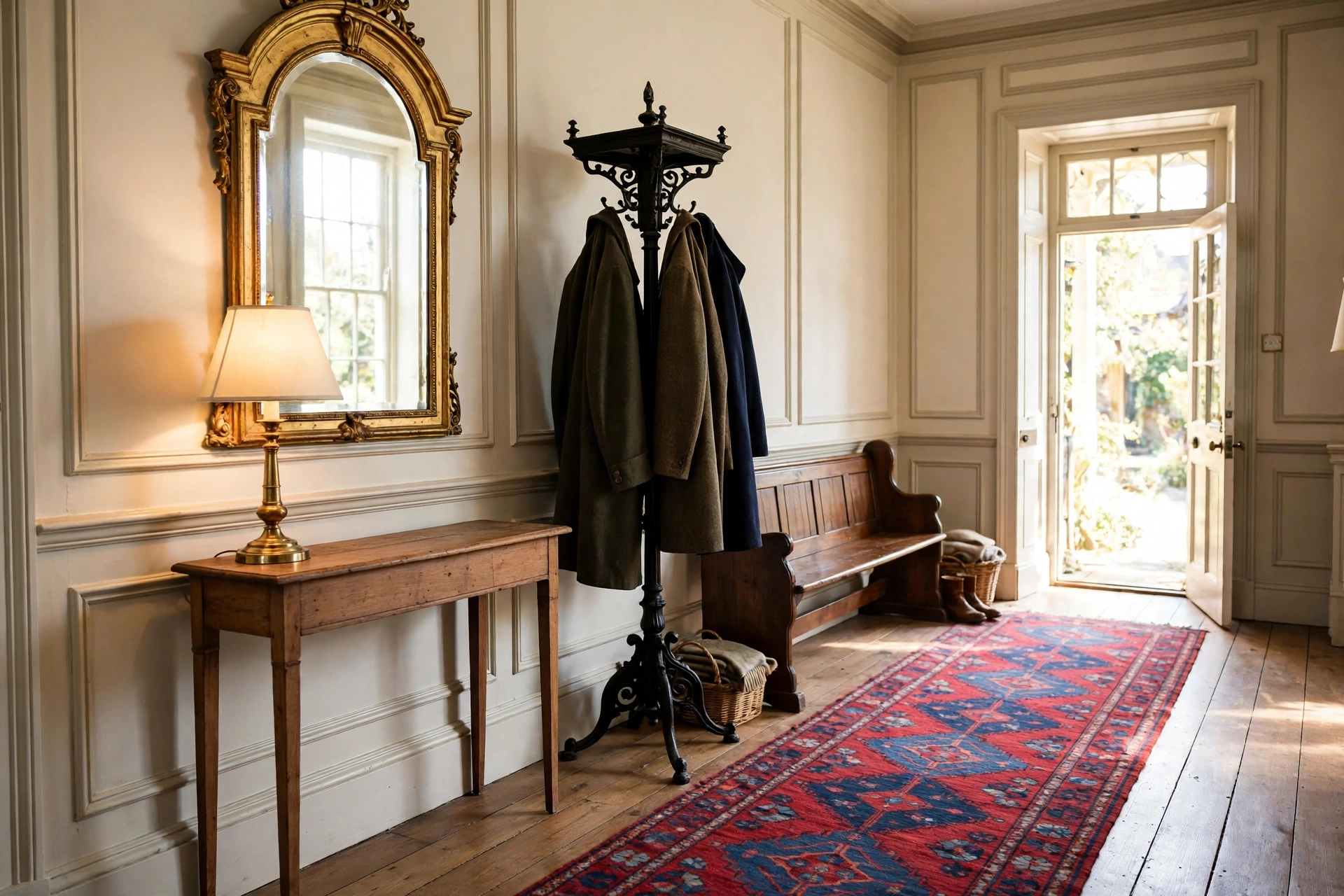
The hallway is the first room anyone sees, and it is also the hardest-working: coats, shoes, keys, post and umbrellas all need a home. Vintage and second-hand furniture suits the job beautifully. Old pieces were built for entrance halls — solid wood, slim profiles, and details like turned legs and cast-iron hooks that new flat-pack furniture rarely matches.
Buying second-hand also keeps costs down and keeps good furniture out of landfill. The ideas below all work in a typical UK hallway, from a narrow Victorian terrace passage to a wider Edwardian entrance. Prices are typical second-hand asking prices from UK listings checked on 18 November 2026, so treat them as a guide — condition, size and maker move prices up and down.
1. A slim vintage console table
A console table is the classic hallway anchor: somewhere for keys, post and a lamp, without blocking the walkway. Vintage examples are often slimmer than new ones, because they were made for narrow halls. Look for turned or cabriole legs, a single drawer, and a depth of around 25–30cm so the table hugs the wall.

Pine and oak consoles from the mid-20th century are the easiest to find and the cheapest to buy. Painted Victorian examples cost more, especially with their original marble tops, so check for chips and wobbles before you commit. If the top is scratched, a light sand and a coat of wax usually revives it.
Typical cost: £65–£350 second-hand on eBay UK (asking prices checked 18 November 2026); painted Victorian examples at the top of the range.
2. A cast-iron coat stand
Nothing says “old hallway” like a freestanding coat stand. Victorian cast-iron hall stands combine coat hooks, a drip tray for umbrellas and often a small mirror, all in one heavy, stable piece. Bentwood stands from the 1930s are lighter and suit smaller halls, while Edwardian wooden hall trees add a bench-like base.

Cast iron is heavy — often 15kg or more — so check delivery costs before buying online, and make sure the base is stable. Look for missing hooks, cracked drip trays and rust at the joints. A stand with its original hooks and tray intact is worth paying more for, because replacements are hard to match.
Typical cost: £150–£450 second-hand on eBay UK and at auction (asking prices checked 18 November 2026); dealer-sold Victorian cast-iron stands on Vinterior reach £895.
3. A church pew or monk’s bench
A short church pew or a monk’s bench gives you somewhere to sit while putting shoes on, and the space underneath swallows shoes and bags. Reclaimed pews from chapels and churches are usually solid pine or oak, often 1.2–1.8 metres long, and their worn patina suits a hallway far better than a new bench.

Monk’s benches are the cleverer buy for small halls: the back folds down to form a table top, and many have a storage chest under the seat. Measure carefully — pews are deep, and a long pew can overwhelm a narrow hall. Check the joints are solid and look underneath for woodworm holes before you buy.
Typical cost: £150–£400 second-hand on eBay UK (asking prices checked 18 November 2026); very long reclaimed pews cost more.
4. A gilt arched mirror
Hallways are often dark, and a mirror is the cheapest way to bounce light around. A gilt arched mirror — French Louis Philippe style is the most common — adds instant character above a console table, and the arched top softens a boxy hall. Smaller mirrors around 70–90cm tall suit most UK hallways.

Expect foxing (small dark spots) on the original glass of a 19th-century mirror; many buyers like the aged look, but heavy foxing reduces the reflection. Check the frame for loose gesso and cracked corners, and hang from two fixings — old mirrors with their original backboards are heavier than they look.
Typical cost: £285–£700 for smaller vintage gilt mirrors on Vinterior (asking prices checked 18 November 2026); large restored overmantel mirrors cost far more.
5. A vintage shoe cabinet or ottoman
Shoes are the hallway’s biggest mess, and a vintage cabinet hides them far more gracefully than a plastic rack. Victorian mahogany shoe cabinets — often converted from box commodes, with a lift-up lid — double as a seat. Georgian-style cupboards with shelves inside work just as well and are easier to find.

Measure your tallest boots before buying: many old cabinets are shallow, and a pair of wellingtons will not fit. Check the lid hinges and that the interior is clean and dry — a musty smell can mean damp storage. A cabinet with a flat top also gives you a surface for post and keys.
Typical cost: £80–£175 second-hand (asking prices checked 18 November 2026), including a Victorian mahogany shoe cabinet ottoman at £175.50 on Vinterior.
6. A wall-mounted coat rack or peg rail
If floor space is tight, take coats to the wall. A solid oak board with cast-iron hooks, or a Shaker-style peg rail, holds a surprising number of coats in very little space. Genuine antique school coat racks — oak boards with numbered iron hooks — turn up on vintage sites and bring real history to a hall.

Fit the rail at a height that keeps long coats off the floor — around 1.7 metres from the floor to the rail suits most adults — and fix into studs or solid masonry, not just plasterboard, because a rail full of winter coats is heavy. Leave a hook free for guests, and add a small shelf above for hats and gloves.
Typical cost: £15–£90 for handmade oak-and-iron coat rails on eBay UK (asking prices checked 18 November 2026); genuine antique school coat racks from around £273 on Vinterior.
7. A pine chest or storage trunk
A pine kist, blanket chest or old travelling trunk is the hallway’s hardest-working storage box: hats, gloves, scarves, dog leads and spare shoes all disappear inside, and the lid doubles as a seat or a surface for a lamp. Victorian pine chests are common and affordable; carved oak coffers cost more and suit larger halls.

Check the lid stays open safely — old hinges can fail, and a heavy lid is a finger trap. Look inside for damp, mould and woodworm, and sniff for mustiness. Camphor-wood chests smell strongly and can taint fabrics, so keep them for outdoor gear rather than knitwear.
Typical cost: £100–£250 for pine chests and vintage trunks on eBay UK (asking prices checked 18 November 2026); carved antique oak coffers cost more.
8. A vintage wool runner rug
A runner protects hallway floors, muffles footsteps and adds pattern to a plain passage. Vintage hand-knotted wool runners — Persian and Oriental designs are the most common — are tougher than most new rugs and improve with age. Look for runners around 60–80cm wide, which fit most UK hallways without curling at the edges.

Check the ends and edges for fraying, and hold the rug up to the light to spot thin patches or repairs. A rug pad underneath stops slipping on wooden floors and adds cushioning. Machine-made vintage runners cost less than hand-knotted ones and are a sensible buy for a high-traffic hall with muddy boots.
Typical cost: £120–£175 for vintage wool hall runners from UK eBay sellers (asking prices checked 18 November 2026).
9. A brass table lamp
Hallways rarely get good ceiling light, and a small table lamp on a console or chest makes the space feel welcoming the moment the front door opens. Vintage brass lamps — candlestick styles, banker’s lamps and mid-century designs — are plentiful second-hand and suit both traditional and modern halls.

Always check the wiring before use: old flex, cracked plugs and loose switches are common, and a rewire by an electrician is worth the cost. If the lamp has no shade, a simple linen drum shade finishes it off. Keep the lamp away from the front door swing, and use a warm-toned bulb for a cosy glow.
Typical cost: £25–£60 for ordinary vintage brass table lamps on eBay UK (asking prices checked 18 November 2026); rare industrial and Art Deco lamps cost far more.
10. A cast-iron or brass umbrella stand
Wet umbrellas ruin hallway floors, and a proper stand is the fix. Victorian cast-iron stick stands, with their drip trays and divided sections, were made for exactly this job. Hammered brass stands from the mid-20th century are lighter, cheaper and just as useful, and they polish up beautifully.

Check the drip tray is present and intact — it is the part most often missing. Cast-iron stands can rust if left standing in water, so empty the tray regularly. A half-round (demi-lune) stand sits neatly against a wall and is a good choice for narrow halls.
Typical cost: £40–£75 for second-hand brass and cast-iron umbrella stands on eBay UK (asking prices checked 18 November 2026); restored Victorian dealer pieces reach £350–£515 on Vinterior.
Frequently asked questions
How do I check vintage furniture for woodworm?
Look for small round flight holes, usually 1–2mm across, and fine powdery dust (frass) around them or on the floor beneath. Fresh dust suggests active woodworm; old holes with no dust usually mean the infestation is long dead. Ask the seller whether the piece has been treated, and isolate a suspect piece from other wooden furniture until you are sure. Serious infestations need professional treatment, so walk away from pieces with crumbling wood or heavy tunnelling.
How do I measure a narrow hallway for entryway furniture?
Measure the narrowest point of the hall, including skirting boards and any radiators, then subtract the space you need to walk through comfortably — aim to keep a clear passage wide enough for two people to pass, or at least enough room to carry shopping bags without brushing the furniture. Check door swings: a console table behind an opening front door will get knocked. For wall rails, measure the wall length and mark the rail height with painter’s tape before drilling.
Where is the best place to buy vintage entryway furniture in the UK?
eBay UK and Facebook Marketplace have the widest choice and the lowest prices, especially for collection-only pieces. Vinterior and Etsy UK suit dealer-quality pieces with delivery included. Charity furniture shops, such as British Heart Foundation Furniture & Electrical stores, and local reclamation yards are worth visiting in person, because you can check condition and joints before buying. Vintage fairs are good for smaller pieces like mirrors, lamps and umbrella stands.
Is it worth restoring a damaged vintage piece?
It depends on the damage. Loose joints, scratched tops and tarnished brass are usually cheap fixes — wood glue, wax and brass polish go a long way. Missing parts, cracked cast iron and heavy woodworm damage are expensive or impossible to fix well, so factor the repair cost into the price before you buy. If a piece is structurally sound but cosmetically tired, it is usually a bargain.
A hallway furnished with vintage pieces has a character that new furniture takes years to build — and every scratch and worn edge tells a story. Start with one anchor piece, such as a console table or a coat stand, and add the rest over time as you find pieces you love. If you are planning a move or a bigger renovation, the UK Home Buyer Toolkit can help you work out what your budget allows.

Comments are closed.