
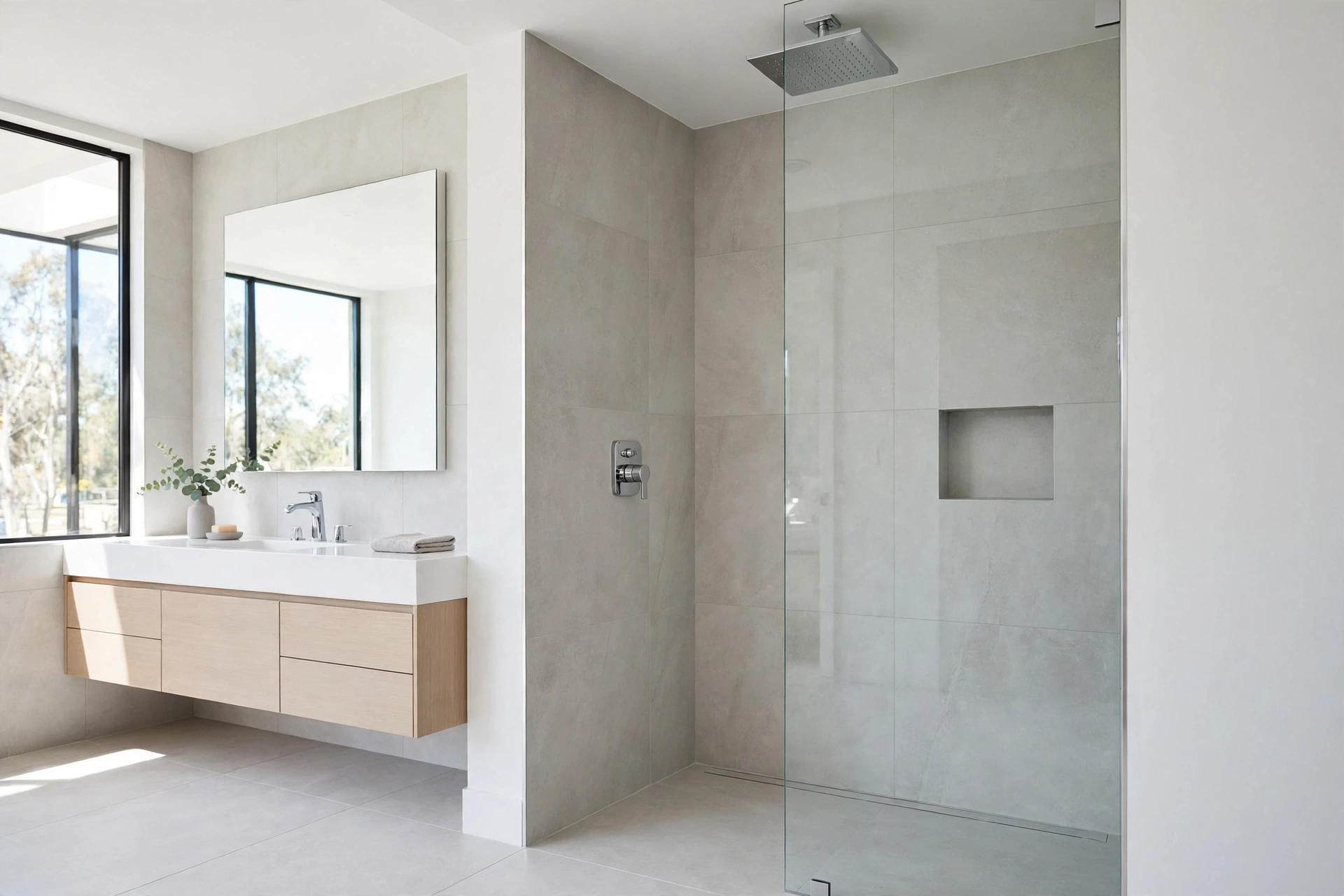
A walk-in shower is one of the most popular bathroom upgrades in UK homes right now, and it is easy to see why. There is no door to wrestle with, no high tray to step over, and a single sheet of glass makes even a small bathroom feel bigger and brighter. Done well, it looks like something from a boutique hotel — and it is practical too, especially if you plan to stay in your home as you get older. A walk-in shower is a showering area with no door that you simply walk into — usually a fixed glass panel with an open gap. It is built one of two ways: a low-profile tray that contains the water, or a wet-room floor, tiled throughout, sloped to a drain and waterproofed underneath (known as tanking). The wet-room look is sleeker but costs more, and the tanking must be done properly or leaks will follow.
Size matters more than style here. A workable minimum is around 900 x 900mm, but most bathroom specialists recommend 1200 x 800mm or 1200 x 900mm: long enough for a fixed glass panel plus a comfortable opening of around 500–600mm, so spray stays inside. Anything shorter than about 1200mm struggles to contain water in a doorless layout. Standard UK tray sizes run from 800 x 800mm up to 1700 x 900mm — but always measure the finished space before ordering.
Prices in this guide are typical UK ranges, checked in November 2026. You do not need to do everything on this list — pick the ideas that suit your room and budget.
1. Go Frameless with a Rainfall Head
The classic hotel look: a single frameless glass panel, a big rainfall shower head overhead, and nothing else to distract. Frameless panels use thicker glass — typically 8mm or 10mm — held by a wall profile and a support arm, so there is almost no visible frame.
A frameless wet-room screen typically costs £210–£600 depending on size and brand — Victorian Plumbing lists 8mm screens from around £210, with premium names such as Merlyn and Mira at £460–£620. A complete thermostatic rainfall set with a 400mm head typically costs from around £150 at Plumbworld.
2. Choose a Level-Access Wet-Room Floor
If you want the truly seamless look, skip the tray altogether. A wet-room floor is tiled throughout, with a pre-formed former underneath creating the gentle slope to the drain. There is no step at all, which makes it ideal for anyone with limited mobility.
Wet-room former kits typically cost £340–£580 (Victorian Plumbing lists kits with waste and tanking membrane from £339.95), and a tanking kit adds around £80–£200 in materials. But the full job costs more: a fully tiled wet-room-style walk-in typically runs £3,500–£7,000+ fitted, against £1,500–£3,500 for a standard tray-and-screen walk-in. Do not cut corners on tanking — remedial work after a failed waterproofing job can cost thousands.
3. Add a Black-Framed Industrial Screen
Black-framed, Crittall-style screens are the statement choice of the moment. The grid of slim black lines breaks up a large sheet of glass, hides water spots better than clear frameless glass, and pairs beautifully with matt black taps and fittings.
Black-framed wet-room screens are surprisingly affordable: Victorian Plumbing lists the Osaka matt black screen from £209.95 and the Arezzo mesh-glass industrial screen from £239.95. Match the finish across your shower valve, towel rail and handles for a joined-up look.
4. Try Fluted Glass for Privacy
If your walk-in shower sits in an en-suite or a bathroom shared with the bedroom, fluted (reeded) glass gives you privacy without losing light. The vertical ridges blur the view while still letting daylight through, and the texture adds a layer of interest that plain glass cannot match.
Fluted wet-room screens typically cost around £280–£300 — Victorian Plumbing lists the Arezzo 8mm fluted screen from £279.95. Fluted glass needs a little more cleaning effort than flat glass, as limescale can settle in the grooves.

5. Use Large-Format Tiles Floor to Ceiling
Big tiles mean fewer grout lines, and fewer grout lines mean a calmer, more spacious-looking shower. Large-format porcelain tiles — 600 x 1200mm and larger — run from floor to ceiling in one sweep, and continuing the same tile from the shower across the bathroom floor makes the room read as one space.
Porcelain tiles typically cost £30–£70 per m², and large-format tiling labour runs £40–£80 per m², against £25–£50 per m² for standard wall tiles, because big tiles are heavier and harder to level. Supplied and fitted, bathroom tiling typically costs £65–£120 per m² overall. Choose rectified tiles with tight grout joints for the most seamless finish, and a matt finish underfoot for grip.
6. Squeeze a Walk-in into a Small Bathroom
A walk-in shower can actually save space in a small bathroom, because there is no door swing to allow for. A compact 900 x 900mm corner layout with a single fixed panel and a 500mm opening works in rooms that could never fit a bath and a separate enclosure. Keep the glass clear, the tiles pale and the fittings wall-mounted, and the room will feel larger than it is.
A straightforward tray-and-screen walk-in typically costs £1,500–£2,800 fitted, and a low-profile tray alone costs around £100–£400. If you can stretch to 1200 x 800mm, the shower will be far more comfortable and far less splashy.
7. Double Up with Twin Shower Heads
If two of you shower at the same time — or you just like space — a double walk-in shower with two heads is the luxury option. It needs a longer showering area, typically 1400mm or more, with a head at each end and a screen long enough to contain spray from both.
Budget for the extra plumbing: a premium walk-in with a frameless screen, large-format tiles and a dual-outlet valve typically costs £3,000–£5,000 fitted. Check your water pressure and flow rate first — two rainfall heads running at once demand a lot of hot water, and a gravity-fed system may need a pump or an upgrade to cope.
8. Make a Statement Feature Wall
One wall of patterned, mosaic or textured tiles turns a plain walk-in shower into the focal point of the bathroom. Moroccan-style patterned tiles, herringbone metro tiles and small-format mosaics all work, and because the area is small, you can afford a tile you would never use across a whole room.
Mosaic sheets typically cost £40–£100 per m², and mosaic labour runs £60–£100 per m² because the small format is fiddly to lay. Keep the other walls plain and pale so the feature wall does the talking.

9. Build in Niches and a Bench
A recessed niche keeps shampoo and soap off the floor and out of sight, and a tiled bench gives you somewhere to sit, shave your legs or rest a foot. Both are built into the wall and floor structure before tiling, so they need to be planned at the start — they cannot be added afterwards without retiling.
Allow roughly a day of extra tiling labour for niches and a bench — tilers typically charge £200–£350 a day in 2026 — plus the extra tiles and a waterproof backer board. Slope niche shelves very slightly forward so water drains off.
10. Warm It Up with Brushed Brass
Chrome is the default, but brushed brass and warm gold finishes bring instant warmth to a walk-in shower. A brass rainfall set, matching valve and brass-framed screen against deep green or navy tiles is a combination that photographs beautifully.
Brushed brass shower sets are no longer a premium-only choice: Plumbworld lists a complete thermostatic brass rainfall set from £149.95. Brass-framed screens cost a little more — Victorian Plumbing lists a brushed brass framed wet-room screen from £339.95.
11. Swap the Bath for a Walk-in Shower
Removing the bath and putting a walk-in shower in its place is one of the most common bathroom projects in the UK. A standard 1700mm bath footprint gives you a generous showering area, and the existing plumbing is usually close enough to reuse, which keeps costs down.
A straightforward bath-to-shower swap typically costs £1,500–£4,000, rising to £4,000–£7,000+ for a fully tiled wet-room-style conversion. One thing to think about first: a home with no bath at all can put off some buyers, particularly families with young children — if this is your only bathroom, weigh the resale question before you remove the bath for good.
12. Create a Spa Feel with Stone and Soft Light
The spa look is about materials and light rather than gadgets: stone-look porcelain or natural stone tiles, a timber-look bench, a rainfall head and warm, dimmable lighting, including a low-level light in the shower niche.
Natural stone tiles typically cost £50–£120 per m², against £30–£70 per m² for porcelain, and stone needs sealing and more careful maintenance. Stone-effect porcelain gives you most of the look at a lower price and with none of the sealing. Keep lighting warm white (2700K) and IP-rated for the shower zone, and put it on a dimmer so you can turn the brightness down in the evening.
Planning Your Walk-in Shower: Drainage, Pressure and Budget
Before you fall in love with a look, check the practicalities. Drainage is the first: a walk-in shower needs a reliable fall to the drain, whether that is a tray waste or a linear drain in a wet-room floor, and the waste pipe must be able to carry the flow from a rainfall head. On a timber first floor, the joists may need notching or the floor building up — ask your fitter to check before you order anything. Water pressure is the second check: rainfall heads need good flow as well as pressure, and older gravity-fed systems may need a shower pump. A thermostatic mixer valve — typically £250–£900 alone, or from around £150 as part of a complete set — keeps the temperature steady if someone flushes a toilet elsewhere in the house.
On budget, a realistic all-in range for a walk-in shower in 2026 is £1,500–£4,000 for a tray-and-screen job and £3,500–£7,000+ for a fully tiled wet-room-style finish, with London and the South East typically 20–30% higher. Get at least two or three itemised quotes, check whether VAT is included, and confirm exactly what the tanking covers — the waterproofing is the part you will never see, and the part that matters most. If you are budgeting for a bigger renovation, our UK Home Buyer Toolkit has calculators to help you work out what you can afford.
Conclusion
A walk-in shower suits almost any UK bathroom — the trick is matching the size, the floor build-up and the glass to the room you actually have. Start with the measurements, be honest about your water pressure and spend properly on tanking. Even one or two of the ideas above can turn an ordinary bathroom into a space you look forward to using every day.

Comments are closed.