
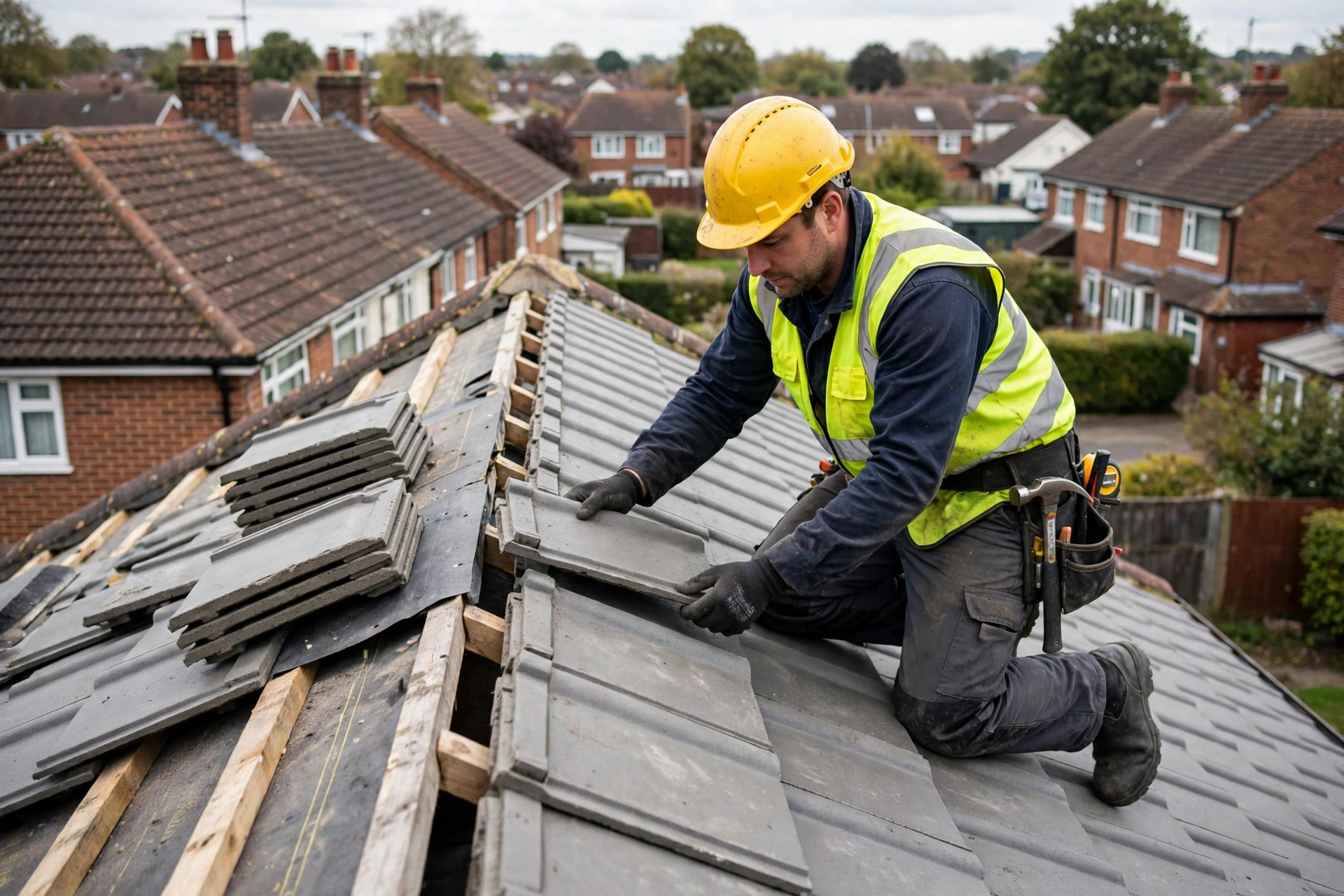
A new roof is one of the biggest single bills most homeowners will ever face. In 2026, the average cost of a roof replacement in the UK is around £8,000, according to Checkatrade’s roof replacement guide (October 2026), with most homeowners spending between £4,000 and £19,000. The range reflects the size and shape of your roof, the material you choose, where you live, and whether scaffolding and VAT are included in the quote.
This guide breaks down 2026 UK new roof costs by material, roof size and house type, plus scaffolding, labour, VAT and building regulations. All figures are guide ranges from published UK cost guides, not quotations.
New roof cost by material
Material choice is the single biggest lever on price. Checkatrade’s roof installation guide (October 2026) gives these supply-and-fit rates per square metre, including stripping, membrane, battens, covering and labour:
| Material | Supply and fit per m² | Typical lifespan |
|---|---|---|
| Concrete tiles | £120–£230 | 40–60 years |
| Clay tiles | £160–£275 | 40–60 years |
| Natural slate | £160–£275 | 100+ years |
| Flat roof (all systems) | £50–£110 | 15–30 years |
| Bitumen felt (flat roof) | £50–£80 | 15–20 years |
| EPDM rubber (flat roof) | £80–£100 | 20–30 years |
Concrete tiles are the cheapest mainstream pitched-roof option and the default on most post-war UK homes. Clay tiles hold their colour better and suit period properties, but cost more to buy and lay. Natural slate is the premium choice: the most expensive per square metre, but also the longest-lived covering by a wide margin, with Checkatrade noting slate roofs may last over 100 years.
For flat roofs, felt is cheapest but shortest-lived, at around 15–20 years. EPDM rubber costs more — Checkatrade’s rubber roofing guide (September 2026) puts it at £80–£100 per m², averaging £90 — but GreenSpec gives it an expected service life of 20–30 years, which often makes it cheaper over the life of the roof. Other guides publish lower per-m² figures because they measure different things, so always check what a rate includes before comparing it with another.

New roof cost by roof size
Roofers usually price by the square metre of roof area, not the floor area of the house. A steeply pitched roof has more surface area than a shallow one over the same footprint, which is why two similar-looking houses can get very different quotes.
The table below shows what Checkatrade’s gable-roof rate of £110–£260 per m² (October 2026) means for common roof sizes. These are worked estimates, calculated from the published per-m² range, excluding VAT and scaffolding.
| Roof area | Worked estimate (gable roof) |
|---|---|
| 50 m² (small terrace) | £5,500–£13,000 |
| 65 m² (typical 3-bed semi) | £7,150–£16,900 |
| 80 m² (larger semi / small detached) | £8,800–£20,800 |
| 100 m² (large detached) | £11,000–£26,000 |
Slate or clay pushes costs towards the top of these bands and beyond, and a complex roof with hips, valleys, dormers or multiple chimneys costs more per square metre than a simple two-slope gable roof.
New roof cost by roof shape and house type
A hipped roof — where all sides slope down to the eaves — needs more cutting, more ridge and hip fixings, and more labour than a gable roof of the same area. Checkatrade (October 2026) gives these whole-job ranges, plus VAT: gable roof £7,000–£16,250; hip roof £9,250–£18,000; flat roof £2,800–£7,500.
MyBuilder’s new roof cost guide (updated 21 August 2026) gives lower typical bands — £5,000–£8,000 for a gable roof and £8,000–£12,000 for a hipped roof on a typical semi, with full replacements overall typically £5,000–£12,000, and terraced houses typically £4,000–£7,000. The guides assume different roof sizes and inclusions, which is why itemised quotes matter.
Scaffolding costs
Scaffolding is essential for a full re-roof — working at height rules require proper edge protection and safe access — and it is often quoted separately. Checkatrade (October 2026) estimates scaffolding for a new roof at £700–£1,300, while MyBuilder’s 2026 guide reports a typical figure of around £1,125.
For a full wrap around a two-storey semi-detached house, BestBuilders’ 2026 scaffolding guide puts the first payment — erect, dismantle, transport and the included hire period — at £1,500–£2,600, with extension weeks at £80–£160 if the job overruns the included hire period, commonly six to eight weeks. Costs rise for three-storey houses, awkward access and scaffold on a public pavement, which usually needs a council licence. Always ask whether scaffolding is included in a quote, how many weeks of hire are covered, and what extra weeks cost.

Labour vs materials: where the money goes
Most quotes bundle labour and materials, so the split is rarely spelled out. MyBuilder (August 2026) puts roofing labour at £50–£130 per m², with day rates typically £250–£300 and hourly rates of £20–£45. Checkatrade puts average roofing labour at around £130 per m².
The materials bill covers more than the tiles you can see: stripping and disposing of the old covering, a new breathable membrane, treated battens, ridge and hip fixings, leadwork around chimneys and valleys, and fascia and gutter work where needed. Timber repairs are the wild card — rotten battens or rafters only reveal themselves once the old covering comes off — so ask how repairs will be priced and get it agreed in writing before work starts.
Regional variation: London costs more
Where you live makes a real difference. QuoteSmith’s 2026 guide notes London and the South East are typically 15–20% more expensive than national averages, while BestBuilders puts London and the South East at 20–30% above northern rates for scaffolding, partly because highway licences and congestion charges are more likely to apply. In the North, the Midlands, Scotland, Wales or Northern Ireland, expect quotes towards the lower end of the national ranges.
VAT on a new roof
VAT is the detail most likely to cause a nasty surprise. The standard rate is 20%, and it applies to most roofing work on an existing home when the firm is VAT-registered, under HMRC’s VAT Notice 708. Checkatrade’s headline ranges are marked plus VAT, so a £10,000 quote excluding VAT becomes £12,000 once VAT is added.
Two exceptions are worth knowing:
- Energy-saving materials: installing insulation for roofs or lofts is zero-rated for VAT for installations between 1 May 2023 and 31 March 2027, reverting to the 5% reduced rate from 1 April 2027, under HMRC VAT Notice 708/6. This covers the insulation element only — tiles, labour and scaffolding stay at 20% — so ask your roofer to confirm the VAT treatment in writing.
- Small firms: a roofer whose taxable turnover is below the £90,000 VAT registration threshold does not have to register for VAT and may not charge it. Check what is included and whether the firm offers an insurance-backed guarantee.
A 5% reduced rate can also apply when renovating a home empty for two years or more. If any of these situations applies to you, check the current HMRC guidance before relying on it.
Building regulations and planning permission
Planning permission: for most houses, re-roofing that does not materially change the external appearance is permitted development and needs no application. The Planning Portal’s limits: the work must not exceed the height of the existing highest part of the roof, and must not project more than 150mm beyond the existing roof slope. Changing the roof’s shape or height, or using a very different material, usually needs permission — and listed buildings and conservation areas face tighter controls.
Building Regulations: approval is separate, and it catches many homeowners out. The Planning Portal says no building control application is normally needed only when less than 25% of the total building envelope (walls, floor, roof, windows and doors) is affected and less than 50% of the roof is affected. A full re-roof crosses those thresholds, so approval is normally needed.
When approval is triggered, the roof’s insulation usually has to be brought up to current standards — Approved Document L sets a target U-value of 0.16 W/m²K for a renovated pitched roof insulated at ceiling level. Approval is also needed whatever the size of the job if the new covering increases the roof’s weight by 15% or more, common when concrete tiles replace slate. Your roofer may be able to self-certify through a competent person scheme such as CompetentRoofer or NAPIT; otherwise apply to local authority building control, which charges a fee. Keep the completion certificate — you will need it when you sell.
How long does a new roof last?
Lifespan is where the cheapest option is not always the best value — the lifespans in the materials table above show why. Felt lasts 15–20 years and EPDM 20–30, while tiles last 40–60 years and slate over 100. These are typical spans, not promises. Do not confuse a guarantee with a lifespan: ask what guarantee is offered, whether it is insurance-backed, and what it covers.
How to get a fair quote
- Get at least three written quotes from local roofers, itemised so you can compare like with like.
- Check whether VAT is included. A quote excluding VAT is 20% more than it looks.
- Check whether scaffolding is included, how many weeks of hire are covered, and the cost of extra weeks.
- Ask what is included — stripping, membrane, battens, ridge and hip fixings, leadwork, waste disposal and making good.
- Ask about timber repairs — how rotten battens or rafters will be priced if found once the old roof comes off.
- Check credentials and guarantees — trade body membership, a competent person scheme for Building Regulations sign-off, and an insurance-backed guarantee.
- Never pay the full amount upfront. A deposit with staged payments tied to completed work is normal; full payment before work starts is a red flag.
If you are buying a home that needs a new roof, factor the cost into your offer and overall budget — our affordability calculator can help you work out what you can borrow before you commit.
Is a new roof worth the cost?
A new roof is expensive, but a failing roof costs more: water damage, damp and damaged timbers all get worse the longer they are left, and surveyors flag roof defects quickly when you sell. Budget using the ranges in this guide, get three itemised quotes, and check the VAT, scaffolding and Building Regulations position before you sign anything. For help planning the wider costs of buying or improving a home, our UK Home Buyer Toolkit brings together the calculators you need, from affordability to stamp duty.

Comments are closed.