
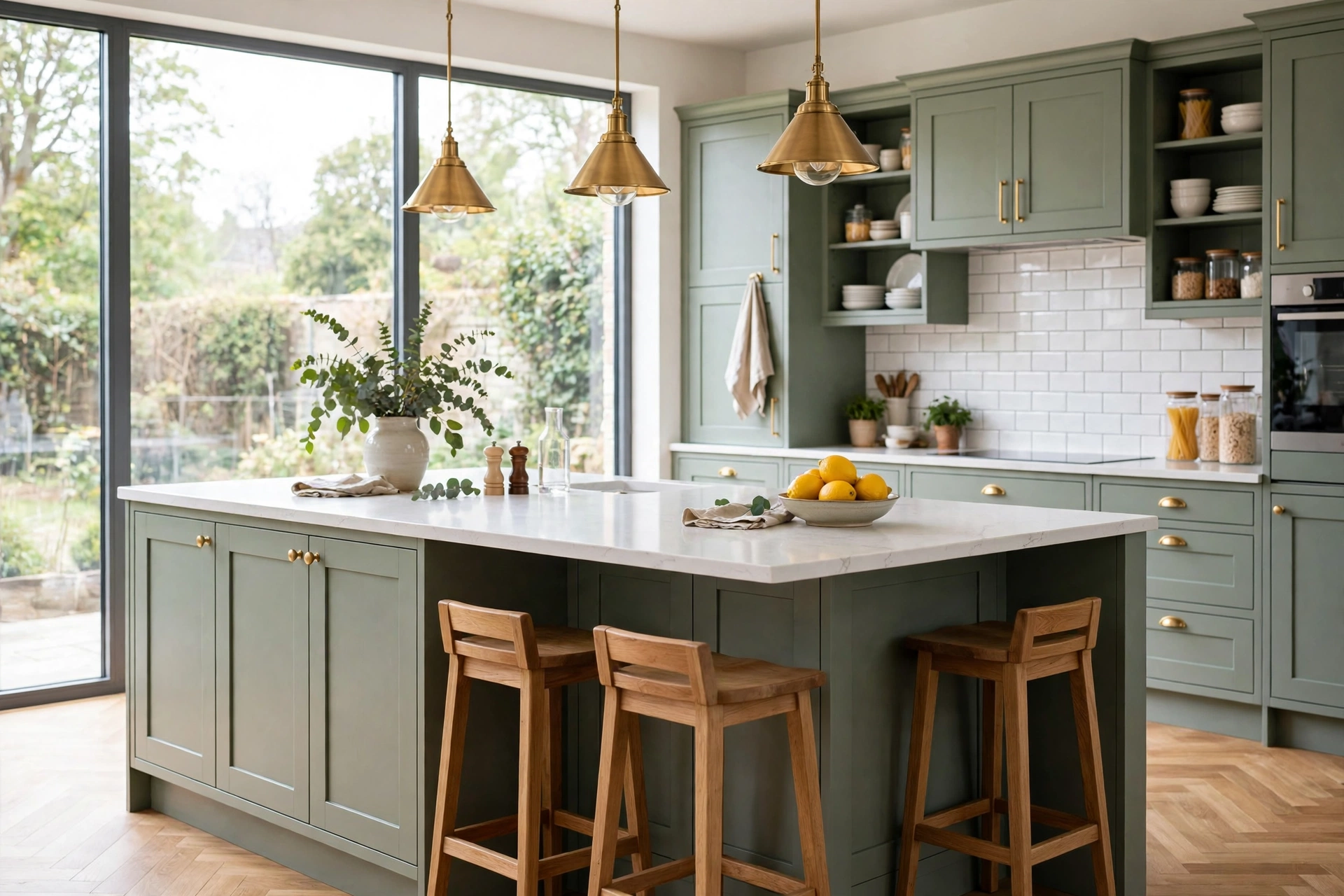
A kitchen island is the hardest-working piece of furniture in the modern home: extra worktop, extra storage, a breakfast bar, a homework desk and the spot where everyone gathers at a party, all in one. The good news is that you do not need a huge open-plan extension to have one. From a £249 freestanding unit to a bespoke fitted island with a waterfall quartz top, there is an option for almost every kitchen and budget.
Below are 12 kitchen island ideas, from compact movable islands to statement islands for large open-plan spaces. Prices are typical UK ranges checked in November 2026.
Before you choose: the sizing rules that matter
There is no single standard island size, but UK kitchen designers work to a consistent set of measurements. The average UK island is around 1,000mm deep by 2,000mm long, according to Homebuilding & Renovating, and most experts advise against going smaller than 1,000mm x 1,000mm for a fixed island. Standard worktop height is 900mm, and an island is usually built to match the rest of the kitchen.
The number that matters most is the walkway around it. Allow at least 1,000mm of clear floor between the island and any run of units, rising to 1,200mm where two people cook together or where an oven, dishwasher or drawer opens towards the island. Below 900mm, two people cannot pass and appliance doors start to clash. As a rough rule, a kitchen needs to be at least 3.6 to 4 metres wide before a permanent island earns its place. For seating, allow 600mm of worktop length per person and around 300mm of knee space under the overhang.
If your kitchen cannot give you those clearances, do not force a fixed island. A slim movable unit or a peninsula attached to one wall gives you most of the benefit without the squeeze.
1. The classic Shaker island with seating
A painted Shaker-style island with a breakfast-bar overhang is the look most UK buyers picture first, and it suits almost any kitchen. Keep the island one colour — sage green, navy or soft grey are enduring favourites — and let the worktop do the talking.

Typical cost: a fitted Shaker-style island with a laminate or wood top starts at around £770 for a basic carcass plus worktop, according to Checkatrade’s October 2026 cost guide, with mid-range fitted islands running £2,000–£5,000 all-in.
2. The movable butcher-block island
Short on space or renting? A compact island on castors with a thick butcher-block top gives you a proper prep surface that can be wheeled against the wall when you need the floor back. Look for lockable wheels, a lower shelf for baskets, and a solid wood top you can sand and re-oil as it wears. It doubles as a serving station when friends come over.

Typical cost: small kitchen trolleys and butcher-block units typically start from around £150, with larger freestanding butcher-block islands running to around £400.
3. The freestanding furniture island
A freestanding island that looks like furniture rather than fitted cabinetry is the fastest way to get island living without a renovation. No plumber, no electrician, no disruption: it arrives, you position it, and it works. Dunelm’s Francis Compact Kitchen Island costs £249 and the full-size Francis £349, while IKEA’s VADHOLMA range runs from £429 for the small 79cm version to £649 with the overhead rack (prices checked November 2026).

Typical cost: £249–£649 for a ready-made freestanding island, plus delivery.
4. The waterfall worktop island
A waterfall edge — where the worktop material flows down the side of the island to the floor — is the single most effective way to make an island look expensive. It works best in quartz or porcelain, where the pattern can run continuously over the edge. Keep the cabinetry simple and handleless so the stone is the star, and choose a pale, lightly veined surface to keep the look bright rather than heavy.

Typical cost: quartz worktops cost around £150–£300 per linear metre fitted, or £380–£550 per square metre, and a waterfall end adds fabrication cost, so budget £2,000–£5,000+ for a fitted island with a waterfall top.
5. The island with a hob and downdraft extractor
Putting the hob in the island turns the cook from facing a wall to facing the room, which is why this layout dominates open-plan kitchens. A downdraft extractor that rises from the worktop — or a venting hob with extraction built in — removes steam without a bulky hood blocking the view. This is a job for the professionals: electrics, and possibly ducting, need planning before the floor goes down.

Typical cost: a downdraft or recirculating extractor costs £600–£2,500, on top of a fitted island budget of £2,000–£5,000, with Checkatrade putting an island with electrics, plumbing and a sink at around £3,650.
6. The island with a prep sink
A small prep sink in the island separates the messy jobs — washing vegetables, filling pans — from the main sink, and makes the island a genuine second workstation for two cooks. Keep it compact, and remember that plumbing under a concrete floor costs more than under timber, so get the pipe runs quoted early.

Typical cost: adding a sink and plumbing to a fitted island typically takes the all-in cost to around £3,650, according to Checkatrade, before the cost of the tap itself.
7. The slimline island for narrow kitchens
A standard island is 900mm to 1,200mm deep, but a slim unit of 400mm to 500mm deep and 900mm to 1,200mm long can work in a galley kitchen where a full island never would. Use it for prep and a single stool, keep the walkway at 900mm minimum, and check that drawers and appliance doors on the fixed run still open fully. A slimline island on legs, rather than a solid plinth, keeps the floor visible and the room feeling larger.

Typical cost: a custom slimline island costs around £1,050 on average, according to Checkatrade, or from around £250 for a ready-made compact freestanding unit.
8. The two-tier island
A raised section at bar height (around 1,060mm) on one side of the island hides kitchen clutter from the dining area and creates a natural perch for guests with a glass of wine, while the 900mm side stays at working height. It suits open-plan kitchens where the island is the boundary between cooking and living, and it gives taller household members a more comfortable leaning height.

Typical cost: a two-tier design adds joinery complexity to a fitted island, so budget within the mid-range band of £2,000–£5,000, plus bar-height stools at around £60–£130 each.
9. The bold-coloured island
Painting just the island in a strong colour — deep green, inky blue, terracotta or even black — is the cheapest dramatic change in kitchen design. The rest of the kitchen stays calm and neutral, so the colour never overwhelms, and repainting an island is a weekend job if you tire of it. Match the stool upholstery or a splashback accent to the island colour to tie the scheme together.

Typical cost: repainting an existing island costs little more than a tin of specialist cabinet paint and a weekend; a new painted fitted island sits in the £2,000–£5,000 mid-range band.
10. The curved-end island
Rounded or curved ends soften the hard lines of a kitchen, improve the flow around the island in a busy family room, and remove the sharp corners that small children walk into. A curved breakfast-bar end also seats more people comfortably than a square corner. This is a bespoke joinery job, so expect a longer lead time and a higher price than a straight-edged unit.

Typical cost: bespoke curved islands sit at the top of the range, with large bespoke islands costing £6,000–£12,000+ all-in, according to 2026 UK cost guides.
11. The island with open shelving and display
Open shelves on the living-room side of the island turn storage into display: cookbooks, ceramics, baskets and a trailing plant or two. Keep the working side closed with deep drawers for pans, and the display side tidy with a few large pieces rather than clutter.

Typical cost: open shelving adds little to the cost of a fitted island; a freestanding island with open shelves costs £249–£649 ready-made, and deep pan drawers are standard in mid-range fitted units at £2,000–£5,000.
12. The island dressed with statement lighting
Three pendants hung in a row above the island are the finishing touch that makes the whole kitchen look designed rather than assembled. Hang the bottom of each shade 75cm to 90cm above the worktop, spaced 60cm to 75cm apart centre to centre, and size each shade to around a quarter to a third of the island’s width. Warm-white bulbs (2,700–3,000K) keep the island inviting in the evening.

Typical cost: pendant shades cost from around £25–£60 each at high-street retailers such as Dunelm, with designer fittings from around £100–£250 each; allow for an electrician if new wiring is needed.
Planning and budgeting your island
Start with the measurements, not the catalogue. Tape the island outline on the floor, live with it for a few days, and check the walkways with the dishwasher door open and two people in the kitchen. Decide early whether the island needs power or water: sockets for a stand mixer and phone charging are cheap to add during a build and expensive afterwards.
Then set the budget honestly. A ready-made freestanding island can transform a kitchen for £249–£649, a fitted island with a decent worktop typically runs £2,000–£5,000, and a large bespoke island with stone, appliances and extraction can pass £6,000. Worktop choice drives much of the difference: laminate costs around £60–£120 per linear metre fitted, solid wood £95–£230, quartz £150–£300 and granite £180–£330, based on November 2026 UK pricing. If you are weighing up a kitchen project alongside a move or a remortgage, our UK Home Buyer Toolkit brings together the calculators that help you budget the whole picture, from affordability to stamp duty.
Finally, get at least two quotes for fitted work, and ask each fitter to confirm exactly what is included — templating, cut-outs for a sink or hob and delivery are often quoted separately on stone worktops.
Conclusion
The best kitchen island is the one that fits your room, your cooking habits and your budget — not the biggest one in the showroom. Measure the walkways, choose the worktop with the total cost in mind, and do not overlook the simple options: a £249 freestanding island or a movable butcher block can change how a kitchen works just as surely as a £6,000 bespoke build. Pick the idea that suits your space, price it properly, and the island will earn its place in the middle of the room for years.
Comments are closed.