
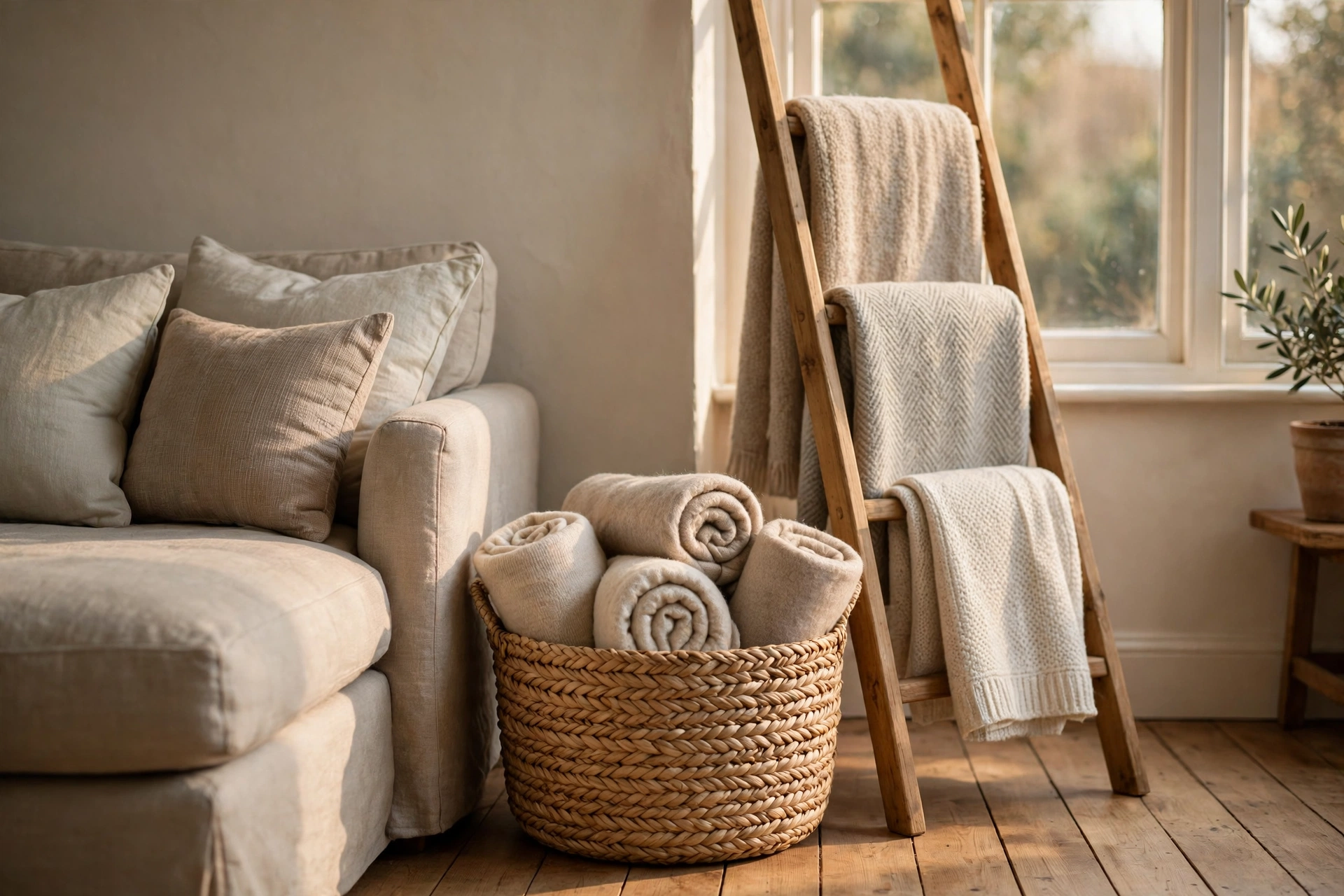
Blankets and throws have a habit of multiplying. There is the sofa throw, the spare duvet for guests, the chunky winter blanket that only comes out from November to February, and the lightweight cotton one for summer evenings. Left to their own devices, they end up draped over chair backs, stuffed into the bottom of the wardrobe, or piled on the spare bed.
The good news is that blanket storage does not need a spare room or a big budget. From a simple basket beside the sofa to an ottoman that earns its floor space twice over, these ten ideas keep blankets tidy, accessible and looking good — with real UK prices checked in November 2026.
1. A woven basket beside the sofa
The simplest blanket storage solution is also the most used: a large, sturdy basket parked next to the sofa or armchair, holding two or three throws ready to grab on a cold evening. Rolled blankets look tidier than folded ones in an open basket, and rolling also makes it easy to see what is there at a glance.

Seagrass and wicker suit most living rooms because the natural texture reads as decor rather than clutter. Choose a basket tall enough that the blankets sit proud of the rim rather than spilling over it, and lined if you want to protect delicate knits from snagging on rough weave. Argos sells a 26-litre seagrass basket for £12, while a lined pack of two larger seagrass baskets from its Habitat range costs £35.
Typical cost: £12–£35 (Argos, November 2026).
2. A blanket ladder against the wall
A leaning ladder turns throws into a display. Drape one folded blanket over each rung, alternating colours and textures, and the ladder becomes part of the room rather than something to hide. It takes up almost no floor space, which makes it a good fit for small living rooms and bedrooms where a chest would crowd the room.

Ladders work best for the blankets you reach for most often, since everything stays visible and aired. Keep heavier blankets on the lower rungs so the ladder stays stable, and lean it against the wall at a slight angle on a flat floor. Five- and six-tier wooden ladders are widely sold online, with popular models from HOOBRO and COSTWAY listed on Amazon UK and Debenhams.
Typical cost: £27–£33 (Amazon UK / Debenhams, November 2026).
3. A storage ottoman that doubles as seating
An ottoman with a lift-up lid is two pieces of furniture in one: a footrest or extra seat by day, and a blanket box the rest of the time. It is the neatest option for living rooms, because the blankets are completely hidden yet only a lid-lift away when the temperature drops in the evening.

Fabric ottomans in neutral linen-look covers blend into most schemes, and a rectangular shape fits neatly against a sofa arm or under a window. Check the internal depth before buying — a shallow ottoman will only take one folded throw, while a deeper one can hold three or four. Dunelm’s faux linen bed ottoman costs £40 and comes in a range of colours.
Typical cost: from £40 (Dunelm, November 2026).
4. A blanket box at the foot of the bed
The foot of the bed is often wasted space, and a blanket box fills it perfectly. Spare bedding, the winter duvet in summer, and the extra blankets for guests all fit inside, keeping the wardrobe free for clothes. An upholstered box also works as a perch for getting dressed or laying out tomorrow’s clothes.

Upholstered blanket boxes range from simple linen-covered chests to deep-buttoned chenille designs that look like proper bedroom furniture. Dunelm’s range includes the Lynton blanket box at £179, the Sorrento linen blanket box at £209, and the Ravello chenille blanket box at £229 — all with lift-up lids and room for out-of-season bedding.
Typical cost: £179–£229 (Dunelm, November 2026).
5. Under-bed storage cases for spare bedding
Under the bed is the largest unused storage area in most bedrooms, and low fabric cases slide in and out without scratching the floor. This is the right home for the blankets you only need occasionally: the guest bedding, the heavy winter blanket in summer, and the spare duvet.

Look for cases with a handle and a clear panel or label so you can find the right one without pulling them all out. IKEA’s SKUBB storage cases are made for exactly this — the range runs from £6 for the 43 × 53 × 19 cm case to £9 for the 90 × 53 × 19 cm size, in white or dark grey, and the fabric is at least 90% recycled polyester.
Typical cost: £6–£9 per case (IKEA, November 2026).
6. Open cube shelving with folded stacks
A cube shelving unit gives every blanket its own compartment, which makes it easy to keep different weights and seasons separate — chunky knits in one cube, lightweight cotton throws in another, guest bedding in a third. Folded stacks look smart on open shelves, and you can see everything without rummaging.

For a calmer look, mix open cubes of folded blankets with fabric boxes in the remaining cubes to hide the less photogenic items. IKEA’s KALLAX 77 × 77 cm shelving unit costs £29, and its DRÖNA fabric boxes, sized to fit the cubes, cost £3 each — with a 4-for-3 offer running until 20 December 2026.
Typical cost: £29 for the unit, £3 per fabric box (IKEA, November 2026).
7. A lidded seagrass trunk in the hallway or living room
A lidded trunk keeps blankets dust-free while looking like a deliberate piece of decor. Seagrass trunks work well in hallways, at the end of a landing, or beside a fireplace, where a fabric box would look out of place and a wooden chest might feel too heavy.

Because the lid closes, a trunk is a better choice than an open basket for blankets that sit unused for weeks at a time — less dust settles, and moths have a harder time getting in. Dunelm’s seagrass storage trunk, described by the retailer as ideal for blankets and cushions, costs £25.
Typical cost: £25 (Dunelm, November 2026).
8. Vacuum storage bags for out-of-season blankets
When space is genuinely tight, vacuum bags shrink bulky blankets down to a fraction of their size. Fold the blanket, seal the bag, draw the air out with a vacuum cleaner, and the flat pack slides onto a high wardrobe shelf, into a suitcase, or under the bed. It is the cheapest way to store a whole season’s worth of bedding in a small flat.

Lakeland’s Shrink & Store range is designed for bedding: a pack of two large vacuum bags costs £7.99, a pack of two cube bags that fit a double duvet and two pillows costs £9.99, and a mixed pack of six bags costs £14.99. Always wash and fully dry blankets before sealing them away, and check the care label first.
Typical cost: £7.99–£14.99 (Lakeland, November 2026).
9. A peg rail for everyday throws
A row of wooden pegs on the wall keeps the one or two throws you use every day within arm’s reach and off the furniture. Hang throws folded over the pegs in the living room, or use a rail inside the bedroom door for the blanket you kick off in the night.

Peg rails suit narrow walls and awkward corners where nothing else fits, and they cost very little for the tidiness they buy. Dunelm sells the Umbra Cubiko five-hook wall-mounted coat rack for £34 and the five-hook Umbra Picket rail in pine for £43 — both with hardware included. Solid oak Shaker-style peg rails are also available from British makers from around £20.
Typical cost: £34–£43 (Dunelm, November 2026).
10. Labelled baskets on linen cupboard shelves
The linen cupboard — or airing cupboard, if you have one — is the natural home for the blankets you rotate through the year. The trick is to stop it becoming a jumble: give each shelf a basket or box, one per category, and label it. Guest bedding in one, winter blankets in another, throws in a third.

Shallow baskets work best on cupboard shelves because you can pull them out like drawers. Dunelm’s seagrass storage basket, 36 × 30 × 25 cm with a 27-litre capacity, costs £12 and fits a standard cupboard shelf. Keep the cupboard door ajar occasionally or leave a gap for air, since blankets stored damp will smell musty when you bring them out again.
Typical cost: £12 per basket (Dunelm, November 2026).
Frequently asked questions
How do I keep blankets fresh in storage?
Wash or air blankets and make sure they are completely dry before packing them away — dampness trapped in storage is what causes musty smells. Add a lavender sachet or cedar block for scent, and take stored blankets out for an airing every couple of months if they are sitting for a whole season.
How do I protect wool blankets from moths?
Clothes moth larvae feed on natural fibres, and they favour dark, undisturbed storage. Store wool blankets clean — moths are drawn to soiled fibres — in sealed containers such as vacuum bags or boxes with tight-fitting lids, following English Heritage guidance. Lavender and cedar act as deterrents rather than cures, and freezing affected items at −18°C for at least two weeks kills adults, eggs and larvae.
Can I store blankets in vacuum bags long term?
Yes, vacuum bags are designed for bulky bedding and blankets, and Lakeland describes its cube vacuum bags as fitting a double duvet plus two pillows. Wash and dry blankets first, check the care label, and refold and air them when you bring them back into use so the fibres recover their loft.
What is the best blanket storage for a small flat?
Use the space you already have: under-bed cases for spare bedding, a blanket ladder or peg rail for everyday throws, and an ottoman that doubles as seating. Vacuum bags handle the out-of-season bulk, so a small flat can hold a full set of blankets without a dedicated cupboard.
Blanket storage works best when it matches how you actually live: the everyday throws stay out and easy to grab, the seasonal bedding stays clean and sealed until you need it, and nothing ends up draped over the back of a chair. Start with one basket or one under-bed case and build from there — even a single tidy spot changes how a room feels. If you are weighing up a move to a home with more storage space, the UK Home Buyer Toolkit can help you work out what you can afford.


Comments are closed.