
Understanding Plasterboard and Cavity Wall Basics
What is plasterboard and drywall?
Plasterboard, also called drywall, forms interior wall surfaces using a gypsum core bonded between paper layers. Builders install it over studs, which create a cavity wall structure behind the surface.
Plasterboard has a hollow and lightweight structure, which limits its load-bearing ability. Studs provide stronger support than drywall because they carry structural loads. Fixings support weight on plasterboard by spreading force across a wider area.
Why are fixings essential in hollow walls?
Fixings allow you to securely attach objects to hollow walls where direct grip is weak, and this is where cavity wall fixings become essential for safe installation. Anchors, wall plugs, screws, and bolts all improve load distribution and holding strength.
Load capacity determines how much weight a fixing supports, while grip strength defines stability over time. Wall thickness affects compatibility. Anchors secure fixtures to hollow walls. Load limits determine fixing choice.
Types of Cavity Wall Fixings Explained
How do wall plugs and basic anchors work?
Wall plugs expand inside a drilled hole, creating friction against the plasterboard as you drive a screw into them. This expansion increases grip and prevents the screw from loosening.
Users drill holes for wall plugs, then insert and tighten screws to secure lightweight items. Lightweight fixings suit small fixtures such as picture frames, clocks, or cable clips.
What are toggle bolts and molly bolts?
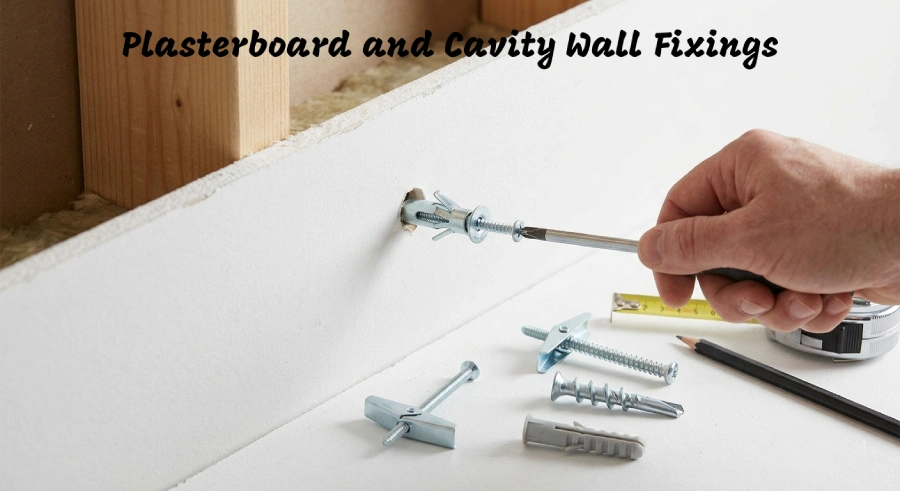
Toggle bolts use spring-loaded wings that open behind the wall, creating a strong anchor point across a larger surface area. Molly bolts expand within the cavity and press firmly against the inner wall.
Toggle bolts expand behind walls and often handle heavier loads. Molly bolts grip cavity surfaces and provide consistent support. Both options suit medium to heavy fixtures, including shelving and televisions.
How do you choose the right fixing type?
You choose a fixing by matching it to the weight of the object and the wall structure. Heavier loads require expansion-based fixings or direct stud mounting, while lighter loads suit basic anchors.
Incorrect fixings cause wall damage because they fail under pressure. Appropriate fixings ensure stability and long-term performance. For TV mounting, heavy-duty anchors or studs provide the most reliable support.
Tools and Preparation for Installation
What tools do you need for plasterboard fixings?
You need a drill, correct drill bits, a screwdriver or driver, measuring tools, and suitable brackets. Each tool contributes to accuracy and secure installation.
Proper tools ensure secure installation and reduce errors during drilling. Correct bit size prevents oversized holes, which weaken grip. Using the wrong equipment increases the risk of damage and poor alignment.
Do you need to find a stud before drilling?
You do not always need a stud, but using one significantly increases load capacity and stability. A stud finder helps locate solid timber or metal framing behind the plasterboard.
Measure before you drill to avoid mistakes. Studs provide stronger support for heavy fixtures. When no stud is available, cavity fixings distribute the load across the hollow section safely.
How to Install Fixings in Plasterboard
What is the step-by-step installation process?
You install fixings by following a controlled sequence that ensures alignment and proper grip. Each stage affects the final strength of the installation.
- Measure and mark the exact position
- Drill a hole with the correct diameter
- Insert the chosen fixing or anchor
- Position the fixture or bracket
- Tighten the screw until it sits flush
Users install fixings carefully to avoid weakening the wall. Proper installation ensures stability and reduces long-term wear.
How do you secure fixtures safely?
You secure fixtures by ensuring the fixing holds firm and the load spreads evenly. Brackets help distribute weight across multiple points, which reduces stress on a single fixing.
Fixings support weight on plasterboard, but only within their rated limits. Secure fixtures prevent failure and movement over time. Even tightening and correct positioning improve overall safety.
Common Mistakes and How to Avoid Them
What happens when you use incorrect fixings?
Incorrect fixings fail because they do not match the load or wall type, which leads to poor grip and potential damage. This mismatch often causes fixings to loosen or pull out.
Incorrect fixings cause wall damage and reduce overall strength. Using a plastic plug for a heavy shelf often results in failure. Correct selection ensures proper load handling and stability.
How much weight can plasterboard hold?
Plasterboard holds limited weight on its own, typically around 5–10 kg with basic fixings, although stronger anchors can support significantly more when installed correctly.
Overloading weakens fixings and stresses the wall structure. Improper installation reduces durability even further. Load capacity depends on fixing type, wall condition, and how well the fixing is installed.
Best Practices for Strong and Reliable Results
How do you match fixings to weight and material?
You match fixings by evaluating both the object weight and the wall structure before installation. Builders prioritise load ratings, while DIY users often prioritise ease and speed.
Load limits determine fixing choice, but material compatibility also plays a key role. Strong fixings ensure reliability and reduce the risk of failure under load.
How do you ensure long-term stability and safety?
You ensure stability by installing fixings correctly and checking them periodically, especially for heavier items. Over time, movement or vibration can reduce grip strength.
Secure installation ensures durability and consistent performance. Stable fixings support fixtures without shifting or loosening. Reinforced anchors and regular checks reduce the risk of sudden failure.


Comments are closed.