
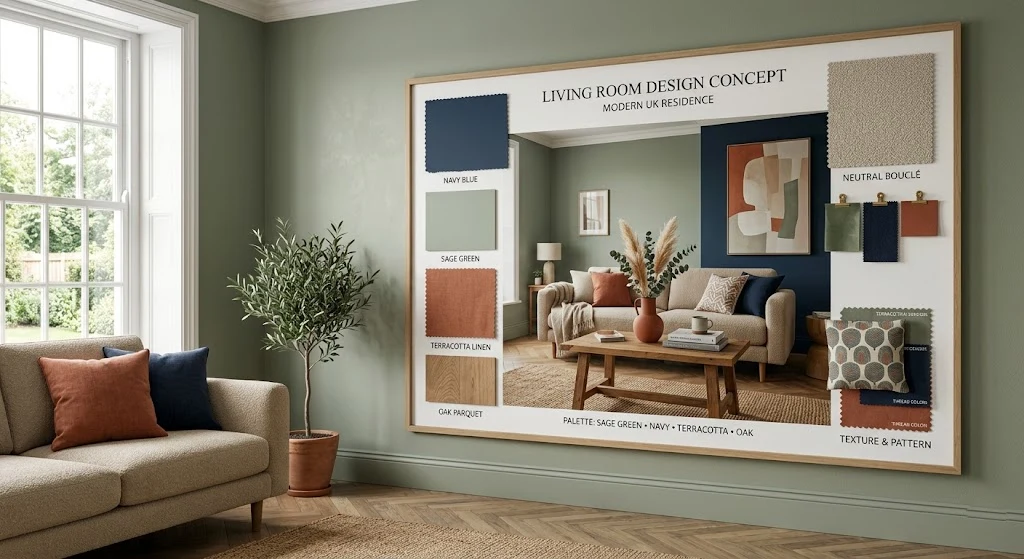
The right living room colour scheme changes everything — from how big the room feels to how relaxed you actually are inside it. Here are the combinations that genuinely work in real homes.
Living Room Colour Schemes: 12 Ideas That Actually Work in 2026
Choosing the right living room colour schemes can feel overwhelming, but it does not have to be. The colours you pick affect mood, perceived space, natural light, and how the whole home feels. This guide covers the most effective colour combinations for living rooms in 2026, from calming neutrals to bold statement walls, with practical advice for every budget and home style.
Why Colour Choice Matters More Than Furniture
Most homeowners spend thousands on sofas and coffee tables before thinking seriously about colour. That is a mistake. Colour sets the emotional tone of a room before anyone sits down.
Warm tones like terracotta, amber, and burnt sienna make a room feel intimate and cosy. Cool tones like sage green, pale blue, and slate create a sense of calm and space. Neutral palettes give you flexibility and stay timeless for longer.
A poorly chosen colour can make a bright room feel gloomy or a large space feel chaotic. Getting it right from the start saves money, time, and redecorating regret.
The 12 Best Living Room Colour Schemes Right Now

Here is a breakdown of the top performing colour combinations for living rooms in 2026, organised by style and effect.
| Colour Scheme | Best For | Mood Created |
|---|---|---|
| Warm White and Soft Sage | Small or north-facing rooms | Fresh, airy, calm |
| Charcoal and Warm Brass | Modern or industrial spaces | Sophisticated, dramatic |
| Terracotta and Cream | Period or eclectic homes | Earthy, welcoming |
| Navy and Natural Linen | Traditional or coastal homes | Timeless, grounded |
| Dusty Pink and Stone Grey | Contemporary or Scandi spaces | Soft, elegant |
| Forest Green and Oak | Biophilic or rustic interiors | Natural, warm |
| Off White and Deep Teal | Open plan or large rooms | Bold, striking |
| Pale Blue and Warm Timber | Family homes | Relaxed, bright |
| Mushroom Taupe and Rust | Neutral with personality | Earthy, layered |
| Black and White with Tan | Minimalist spaces | Crisp, timeless |
| Blush and Burnt Orange | Bohemian or artistic homes | Vibrant, energetic |
| Lavender and Soft Grey | Bedrooms converted or dual use | Peaceful, refined |
How to Build a Colour Scheme From Scratch
You do not need a designer to put together a living room palette that works. Follow this process and the result will feel intentional rather than accidental.
- Start with your fixed elements. Your flooring, ceiling height, and any existing furniture you are keeping should guide your base colour.
- Choose a dominant colour for 60% of the room. This is usually the walls.
- Choose a secondary colour for 30%. This applies to larger furniture pieces like sofas and shelving.
- Add an accent colour for the remaining 10%. Think cushions, artwork, plant pots, and trims.
- Test with large swatches before committing. A small paint tester on white card is misleading. Paint a section at least A3 size and live with it for two days.
- Observe the colour at different times. Morning light, afternoon sun, and evening lamps all change how a colour reads on a wall.
This 60-30-10 method is used by professional interior designers worldwide and is the most reliable way to avoid a colour mismatch.
Best Colour Schemes for Small Living Rooms
A small living room does not have to feel cramped. The right colour choices can make it feel significantly larger and more open.
Light reflects space. Colours with a Light Reflectance Value (LRV) above 70 bounce light around the room and push walls back visually. Farrow and Ball’s Wimborne White (LRV 84) and Dulux Mineral Mist are both strong choices.
Top picks for small living rooms:
- Warm white paired with natural wood tones
- Pale sage green with off-white ceilings and skirting
- Soft stone with warm lighting and layered textiles
- Light greige (grey-beige blend) with brass hardware accents
- Powder blue with white trim and rattan furniture
Avoid very dark feature walls in rooms under 15 square metres unless you have strong artificial lighting to compensate.
Colour Schemes That Work in North-Facing Rooms
North-facing living rooms in the UK receive cool, indirect light throughout the day. This makes certain colours look flat, grey, or cold even when they looked warm in the shop.
The key is to choose colours with warm undertones rather than cool or blue bases.
Colours that work well in north-facing rooms:
- Warm cream rather than stark white (try Little Greene’s Joanna or Dulux Natural Hessian)
- Terracotta in muted or dusty tones
- Caramel and honey yellows in low saturation
- Soft olive green which reads warm in cool light
- Pale peach with natural linen textures
Colours to avoid in north-facing rooms:
- Cool greys with blue or purple undertones
- Bright white (will appear stark and cold)
- Pale lavender (turns washed out and clinical)
- Bright teal without warm accents to balance it
A north-facing room needs a colour that works hard in flat light. Always test in the actual room.
Feature Walls: Do They Still Work in 2026?
The feature wall has been declared dead by design commentators for years. And yet, done well, it still works.
The difference between a feature wall that elevates a room and one that dates it comes down to three things: the colour chosen, the wall selected, and the materials used.
What makes a feature wall work:
- Choosing the chimney breast or alcove wall rather than a random wall
- Using limewash paint, panelling, or textured plaster instead of flat emulsion
- Keeping the feature colour within the room’s wider palette rather than contrasting it completely
- Committing fully so the feature wall is genuinely bold rather than timid
Colours that work well as feature walls:
- Deep forest green behind a sofa or fireplace
- Warm charcoal in a room with natural wood floors
- Dusty navy in a period home with ceiling roses and coving
- Burnt terracotta with white walls on three sides
The worst feature wall mistakes are choosing a colour purely because it was trending, or using it on a wall that receives no focal attention.
Paint Brands Worth Knowing in 2026
Not all paint is equal. The pigment quality, coverage, and durability vary significantly across price points.
| Brand | Price Per 2.5L | Known For |
|---|---|---|
| Farrow and Ball | £65 approx | Rich pigment, chalky finish, heritage tones |
| Little Greene | £55 approx | Historical accuracy, high coverage |
| Dulux | £18 to £25 | Reliable coverage, wide range, accessible |
| Johnstone’s | £16 to £22 | Trade quality, durable finish |
| Annie Sloan | £30 approx | Chalk paint, furniture and walls |
| Earthborn | £35 approx | Clay-based, low VOC, eco-conscious |
For living rooms specifically, a matt or flat finish works best on walls as it absorbs light and hides imperfections. Use eggshell on woodwork for a subtle sheen that is also easier to clean.
How Lighting Changes Every Colour Scheme
You can choose a perfect colour combination and still have it look wrong if the lighting is not considered.
Natural daylight shows colour most accurately. Incandescent bulbs add warmth and amber tones. LED bulbs vary widely: choose bulbs with a colour temperature between 2700K and 3000K for warm, residential living rooms. Anything above 4000K will push colours into a cooler, more clinical direction.
Practical lighting tips for colour accuracy:
- Use warm white LED bulbs as a baseline throughout
- Add floor lamps and table lamps to remove harsh shadows
- Consider dimmer switches so you can control the intensity at night
- Mirror placement near windows maximises natural light and enhances lighter palettes
- Test your chosen wall colour under both natural and artificial light before painting the full room
Mistakes to Avoid With Living Room Colour
Even experienced decorators make these errors. Knowing them in advance saves money and frustration.
- Matching everything too closely. A room where the sofa, cushions, rug, and walls are all the same tone looks flat and lacks personality.
- Using more than four colours. Beyond four, the room starts to feel unsettled. Pick a palette and stay within it.
- Forgetting the ceiling. A ceiling painted a slightly warmer or darker tone than the walls adds depth and draws the eye up. Plain white ceilings are not always the best option.
- Ignoring the floor. Your flooring is a colour too. A warm oak floor changes how a grey wall reads. A dark charcoal floor makes pale walls look lighter.
- Following trends blindly. Colour trends cycle every two to three years. Build around a timeless base and add trend colours through accessories instead.
FAQs About Living Room Colour Schemes
What is the most popular living room colour in the UK right now?
Sage green and warm off-white tones dominate UK interiors in 2026. Both work across a wide range of home styles and pair well with natural materials.
What colours make a living room look bigger?
Light, warm neutrals with a high LRV such as soft white, pale stone, and warm cream visually expand a room. Keeping the ceiling the same tone or slightly lighter than the walls also helps.
Can I use dark colours in a small living room?
Yes, but strategically. A single dark feature wall with light surrounding walls and strong lighting can create depth without making the room feel smaller. Avoid dark on all four walls in compact spaces.
How many colours should a living room have?
A maximum of three to four colours works best. Use the 60-30-10 rule: one dominant, one secondary, one accent. A fourth can be introduced through metallic finishes or natural materials.
What colour goes with grey in a living room?
Warm grey pairs well with mustard yellow, blush pink, navy, and natural wood tones. Cool grey works with white, pale blue, and silver accents. Always check the undertone of your specific grey before choosing accompanying colours.
Is white a good colour for a living room?
White works well when it has a warm undertone and is paired with texture and layering. Pure bright white can feel cold and clinical. Look at options like Dulux Jasmine White or Farrow and Ball All White.
What is the best colour for a north-facing living room?
Warm cream, muted terracotta, soft olive, and dusty yellow work best in north-facing rooms. Avoid cool greys, stark white, or blue-based tones which will amplify the coldness of indirect light.
Your Next Step Starts With One Wall
Getting your living room colour right does not require a full renovation or a big budget. Start with the wall that receives the most attention. Apply a large swatch of your chosen colour and observe it for 48 hours across different lighting conditions.
The colour combinations in this guide are proven to work across a range of UK homes, room sizes, and lighting conditions. Whether you want a calm retreat, a bold entertaining space, or a family room that stays looking good for years, there is a palette here that fits.
Pick your base colour. Test it properly. Then commit.
This article was produced by the editorial team at HousingMarketNews.co.uk — your trusted source for UK home improvement advice, interior design trends, and property market insight. For more guides on decorating, renovation, and styling your home, explore our latest articles.


Comments are closed.