
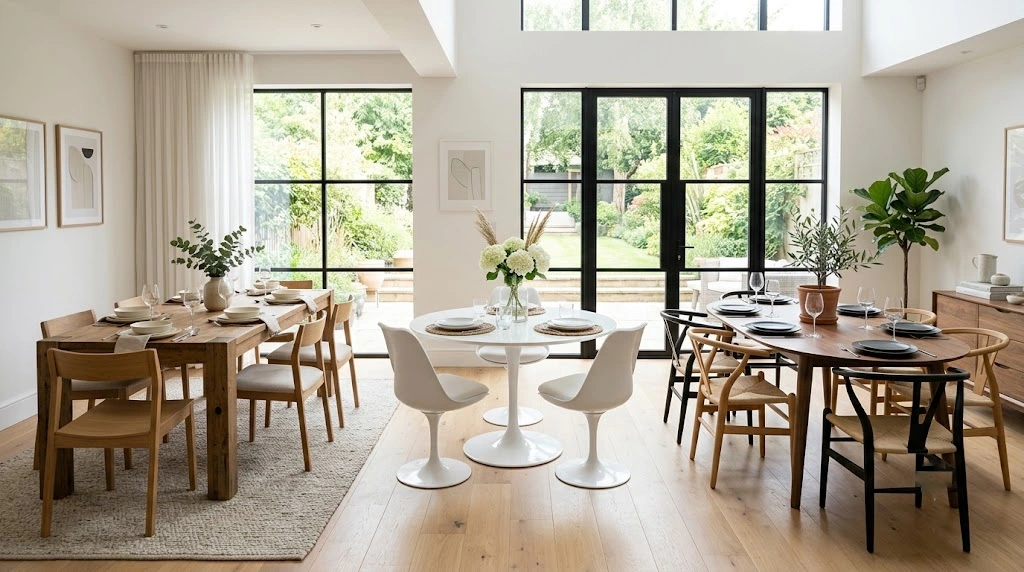
A standard dining table stands 28 to 30 inches tall. Width usually falls between 36 and 40 inches. Length depends on seating: 48 inches fits four people, 72 inches fits six, and 96 inches or more fits eight to ten guests comfortably.
Buying a dining table sounds simple until you actually stand in the store. Suddenly there are ten shapes, five heights, and a dozen lengths staring back at you. You start wondering if your dining room can even hold the thing.
Here’s the good news. Dining tables follow a small set of standard sizes. Once you know them, shopping gets a lot easier. This guide walks you through every measurement that matters, from height to width to length, broken down by shape and seat count.
Standard Dining Table Height

Most dining tables measure between 28 and 30 inches tall. This height works with almost every standard dining chair on the market. Your feet rest flat on the floor, your elbows sit at a natural angle, and your knees have room to move.
Some brands round up to 31 inches. That extra inch rarely causes problems, but it’s worth checking your chair height before you buy. A mismatch between table and chair height turns dinner into an awkward experience fast.
Not every table sticks to this range. Counter height tables run around 36 inches, matching a kitchen island or breakfast bar. Bar height tables climb even higher, usually 41 to 42 inches. These taller options work well for casual entertaining spaces, but they need taller stools, not standard chairs.
Standard Dining Table Width
Width stays fairly consistent no matter how long your table is. Most rectangular and oval tables measure 36 to 40 inches wide. This gives enough room for plates, glasses, and serving dishes down the center without diners feeling boxed in.
Smaller widths, closer to 36 inches, suit tighter dining rooms or apartments. Larger widths, closer to 40 inches or beyond, work better in spacious rooms where you want room for centerpieces or family-style serving. A table under 36 inches wide can start to feel cramped once food and drinks are on it, so try to avoid going smaller unless your space truly demands it.
Standard Length by Seating Capacity
Length is where things get more specific, since it depends entirely on how many people you want to seat. The general rule is to allow about 24 inches of space per person. Here’s how that plays out in real numbers.
A table for four people typically measures 48 inches long. This size fits neatly into small dining rooms, breakfast nooks, or apartment kitchens. Two people sit on each long side, with no one needed at the ends.
A table for six people usually runs 72 inches long. This is the most common size sold today, and it works for most family dining rooms. Some six-seat tables stretch to 78 or 80 inches if you want extra elbow room or plan to seat someone at each end.
A table for eight people generally measures between 92 and 96 inches long. At this length, you’re looking at a dedicated dining room rather than a casual eat-in kitchen, since the table itself takes up serious floor space.
For ten people, expect a length of 96 to 120 inches. Tables this long often come with extension leaves, so you can shrink the table down for everyday meals and stretch it out when guests arrive.
Round Table Sizes
Round tables are measured by diameter instead of length and width. They work especially well in smaller rooms since there are no corners eating up floor space, and everyone can see each other easily during conversation.
A 42-inch round table seats four people comfortably. Try to squeeze in six, and elbows will start colliding, so it’s best to stick with four on this size.
A 48-inch round table also seats four, with slightly more breathing room. It can handle five in a pinch, which makes it a flexible choice for smaller households that occasionally host an extra guest.
A 54-inch round table is the sweet spot for six people. This size gives each person distinct space without pushing the table’s footprint too far into the room.
For larger gatherings, a 60 to 72-inch round table can seat six to eight people. Anything beyond 72 inches starts to blur the line between a large round table and a full oval, and reaching across the middle becomes difficult.
Square Table Sizes
Square tables are less common but work great for smaller spaces and intimate meals. Most square tables measure between 36 and 44 inches wide, and they typically seat four people, one on each side.
Some square tables also come in counter height, running 34 to 36 inches tall instead of the standard 28 to 30 inches. These work well next to a kitchen island or in a casual dining nook where you want a slightly more relaxed setup.
Oval Table Sizes
Oval tables combine the flow of a round table with the extra length of a rectangle. They’re a good option if you want to seat more people without sharp corners bumping into walkways.
A six to eight-seat oval table usually measures 72 to 96 inches long and 36 to 42 inches wide. For eight to ten guests, look for an oval between 96 and 120 inches long, staying within that same 36 to 42-inch width range.
How Much Clearance You Need
Picking the right table size isn’t just about the tabletop. The space around it matters just as much for daily comfort.
Leave at least 36 inches between the edge of your table and any wall or nearby furniture. This gives people room to walk behind seated diners without squeezing past. If you have the space, 42 to 48 inches is even better, especially in a room you use often.
Chairs also need pull-out room. Plan for 18 to 24 inches of space behind each chair so people can sit down and stand up without bumping into a wall or hutch. Near doorways, aim for 48 inches of clearance so foot traffic doesn’t collide with your dining setup.
Common Mistakes to Avoid
A lot of buyers focus only on how many chairs fit around a table, then forget to check how the table interacts with the rest of the room. Here are a few slip-ups that come up again and again.
Buying a table that’s too wide for the room is one of the most common mistakes. A table might look fine on paper, but once it’s sitting in your dining room, it can block walking paths or crowd nearby furniture like a sideboard or hutch. Always measure the full width of your room, not just the spot where the table will sit.
Ignoring chair arms is another easy mistake. Armchairs add several inches of width on each side, which means a table that fits four regular chairs might only fit four armchairs with a much tighter squeeze. If you plan to use chairs with arms, add a couple of extra inches to your table width calculations.
Skipping the rug measurement trips people up too. A rug that’s too small looks awkward and doesn’t give chairs enough room to slide out without catching on the edge. As a general guideline, your rug should extend at least 24 inches beyond each side of the table, so chairs stay on the rug even when pulled back.
Choosing the Right Size for Your Space
Start by measuring your dining room with a tape measure, noting both length and width. Then think about how many people you feed on a typical night, plus how often you host larger groups.
If your headcount changes often, an extendable table solves that problem well. You get a smaller footprint for everyday meals and extra length when family or friends come over. If your space is small but you love hosting, a round or oval table can make the room feel more open while still fitting extra seats when needed.
Match your table’s shape to the shape of your room, too. Long, narrow rooms usually suit rectangular tables. Square or nearly square rooms often look better with round or square tables, since they don’t fight the room’s natural proportions.
Final Thoughts
Standard dining table sizes exist for good reason. They match up with standard chairs, standard rugs, and standard room layouts, which makes shopping far less stressful once you know the numbers.
Measure your room, count your regular seats, and pick a shape that fits how your family actually uses the space. Get those three things right, and your new table will feel like it was made for your dining room, because in every way that matters, it will be.
Ready to measure your space? Grab a tape measure, jot down your room’s dimensions, and use the sizes above to shop with confidence.


Comments are closed.