
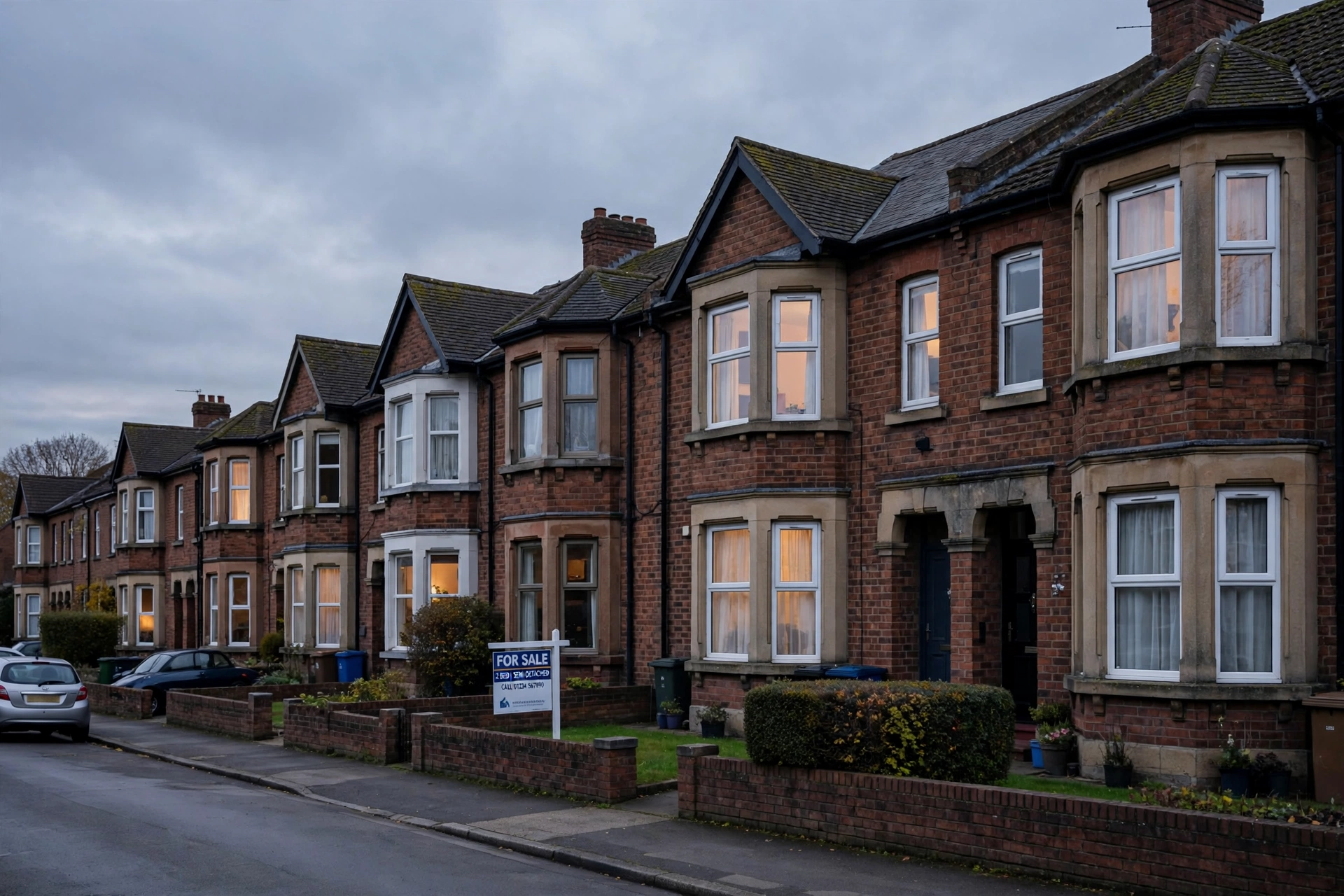
UK house price growth has slowed to its weakest pace since January 2024, according to the latest figures from Nationwide Building Society, as rising mortgage costs and expectations of a Bank of England rate rise weigh on buyer demand.
Annual house price growth fell to just 0.5% in October, down from 0.8% in September and 1.6% in August. Prices were essentially flat on a seasonally adjusted monthly basis, following a downwardly revised 0.3% fall in September — a better result than the small monthly decline economists had expected. The average UK house price stood at £273,566 in October, down from £274,251 the previous month.
It is worth noting how Nationwide builds its index: it tracks prices on its own mortgage approvals rather than every property transaction, so it captures activity with a lag and can differ from the Office for National Statistics’ official figures. Even so, the direction of travel is consistent across every major measure right now — the market is losing momentum.
The numbers at a glance
| Measure | October 2026 | September 2026 |
|---|---|---|
| Annual growth | 0.5% | 0.8% |
| Monthly change (seasonally adjusted) | 0.0% | −0.3% (revised) |
| Average house price | £273,566 | £274,251 |
The slowdown has been steady rather than sudden. Growth has eased from 1.6% in August to 0.8% in September and now 0.5% in October — a clear cooling trend through the autumn.
Why is the market slowing?

Nationwide’s chief economist Robert Gardner attributed the weakening to an uncertain economic outlook, pressure from energy prices and expectations that borrowing costs could rise further. The war in the Middle East has fed inflation concerns, which in turn have pushed up bond market yields — and with them, the swap rates that determine fixed mortgage pricing.
That is the crucial point for buyers to understand: mortgage rates are rising even though the Bank of England base rate has not moved since last December and remains at 3.75%. Lenders price fixed-rate deals off financial markets, not the base rate. The average five-year fixed mortgage rate stood at 5.99% on 30 October according to Moneyfacts, with the average two-year rate at 5.97% — the five-year has touched the 6% barrier for the first time in three years.
Adding to the pressure, the Monetary Policy Committee meets on Thursday 5 November. A Reuters poll of 63 economists in mid-October found 54 expecting the Bank to raise its rate to 4% — the first increase in three years. Markets are now treating a hike as close to certain, and some are pricing in as many as four further rises before next summer.
The Budget, delivered on 28 October, did little to change this picture. Tom Bill, head of UK residential research at Knight Frank, said the impact of rising mortgage costs “eclipses any support measure announced in this week’s budget”. The chancellor did confirm the £4.7bn Your First Home scheme — a 20% equity loan aimed at first-time buyers — but support measures take time to feed through, and affordability pressure is immediate.
Other official data tells the same story. HM Revenue & Customs reported that residential transactions were 4% lower in September than a year earlier, at around 94,800, and Bank of England data showed mortgage approvals for house purchase dropping to 53,443 in September — the lowest since December 2023.
What does this mean for buyers?
First, the honest framing: flat prices are neither a crash nor a boom. An average price of £273,566 means the market is essentially treading water while borrowing costs rise — which, in real terms, is a gentle squeeze rather than a shock.
For would-be buyers, the practical question is not whether to try to time the market bottom — that is unknowable — but how to handle affordability at today’s rates. A few things are worth doing now:
- Check your numbers at current rates. A five-year fix at 5.99% is a materially different monthly payment from the same deal at 4.5%. Run the figures before falling in love with a property.
- Sellers are negotiating. With stock at around 764,000 homes on 1 October — up from 752,000 a year earlier — and asking prices sitting roughly 17.5% above agreed sale prices, this is a buyer’s market in most areas. Offers below asking are being accepted.
- Don’t ignore the schemes. The Your First Home scheme confirmed in the Budget offers a 20% government equity loan with a deposit from 2.5%, income caps of £110,000 (£140,000 in London), and local price caps — pre-registration opens by the end of December 2026. For some buyers it changes the maths entirely.
If you are trying to work out what you can realistically afford at rates near 6%, the Affordability Calculator lets you model monthly payments against your income and deposit. And the UK Home Buyer Toolkit brings together all the calculators — affordability, overpayments, moving costs — in one place for a full moving budget.
What to watch next

The immediate focus is the Bank of England’s decision on Thursday 5 November. A hike to 4% would almost certainly feed through to mortgage pricing, particularly two- and five-year fixes. A hold would bring a short breather — but markets are already pricing further rises, so buyers should not bank on cheaper deals returning soon.
Beyond that, watch December’s data for the direction of travel on buyer enquiries — Nationwide’s Robert Gardner noted that surveyors report new buyer enquiries remain weak, and other indicators point to further softness in house prices in the immediate future.
We will update this analysis as new data lands. In the meantime, the lesson from October’s numbers is simple: the market is cooling, sellers know it, and buyers who do their homework — on rates, on affordability, and on the schemes available — are in the strongest position.

Comments are closed.