
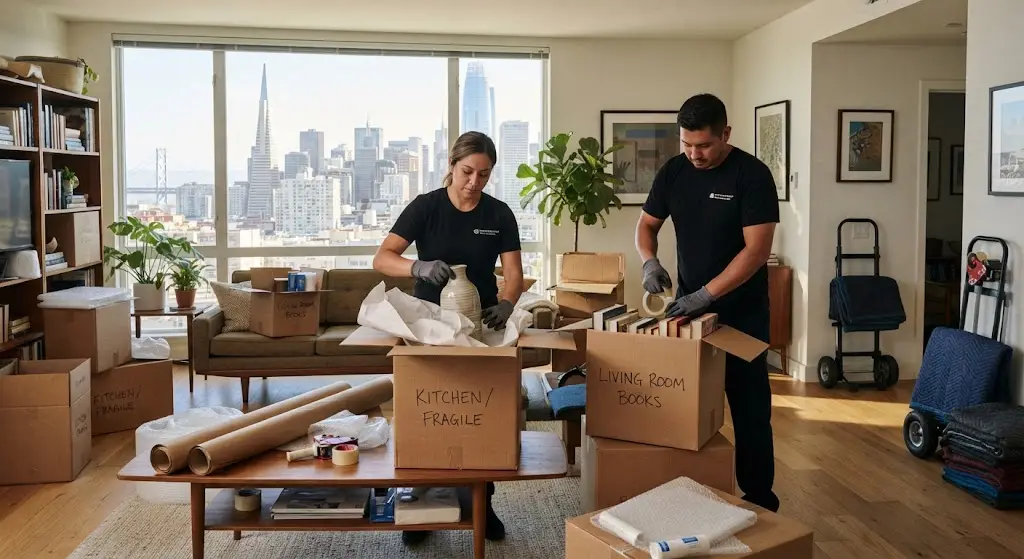
To choose packing services in San Francisco, verify the company’s CPUC (Cal-T) license, compare at least three written quotes, confirm insurance coverage, and ask how they handle SF-specific challenges like narrow stairwells, street parking, and elevator booking. Expect to pay $60 to $80 per hour per packer, plus supply costs.
You’re staring at a pile of boxes. Your grandmother’s china is still in the cabinet. And you have exactly one weekend to make it all disappear into neat, labeled cartons. If this sounds familiar, you’re not alone — and you don’t have to do it yourself.
Hiring a packing service takes the physical labor and the guesswork off your plate. But San Francisco has its own quirks. Steep hills, tight apartment stairwells, unpredictable parking, and fog that can warp cardboard if you’re not careful. Not every packing company is built to handle that.
This guide walks you through exactly what to look for, what things cost, and which questions separate a professional crew from a risky one.
Whether you’re relocating across the Mission, moving into a walk-up in North Beach, or shipping belongings out of state, the right packing crew changes the entire experience. The wrong one can mean broken furniture, hidden fees, or a moving day that spirals out of control before noon.
Why Hiring a Packing Service Makes Sense

Packing takes longer than most people expect. A single kitchen alone can eat up an entire afternoon once you count dishes, small appliances, and the fifteen mismatched coffee mugs everyone seems to own. Multiply that across a whole apartment or house, and a DIY pack job easily swallows a full weekend.
A professional crew brings more than speed. They bring the right materials — dish packs, wardrobe boxes, furniture blankets — and they know how to protect fragile or oversized items during transport. That matters more in San Francisco than in most cities, since your belongings might travel up and down steep grades on I-280 or through stop-and-go traffic on 19th Avenue before they ever reach the new place.
If you’re short on time, moving valuable or sentimental items, or simply dealing with a larger home, a packing service pays for itself in saved stress alone.
Understand San Francisco’s Licensing Rules First
Before you compare prices, confirm the company is even legal to operate. Any mover or packer handling household goods within California must hold a valid permit from the California Public Utilities Commission, sometimes called a Cal-T or MTR number. This number must appear on the side of every moving truck in letters at least four inches high, and its absence is a major red flag.
You can check a company’s status for free. The CPUC runs a free online license search tool, and you can also call their consumer line to confirm a company’s standing. Look for three things: an active license status, a business name that matches the estimate you were given, and current insurance on file.
Licensed movers are required to carry a minimum of $750,000 in public liability and property damage coverage per vehicle, along with workers’ compensation insurance. That coverage protects you if something breaks or someone gets hurt on your property. Skip this step, and you have no real recourse if things go wrong.
What Packing Services Typically Cost in San Francisco
Packing rates in San Francisco generally run between $60 and $80 per hour, though your final bill depends on several factors. Home size is the biggest driver — a studio takes far less time than a three-bedroom house. The number of fragile or oversized items also adds time, since packers move more carefully around glassware, artwork, and awkward furniture.
Supplies are usually billed separately unless a company advertises a flat rate. Packing materials like boxes, tape, and padding often run between $20 and $60 total, though this climbs fast for larger homes or specialty items like mirrors and mattresses.
Some companies now offer flat-rate packages instead of hourly billing. Studio moves can start around $499, one- to two-bedroom moves from roughly $749, and larger homes from about $999, though these numbers vary by provider and what’s included. Always ask whether a quote is hourly or flat, and whether packing supplies are bundled in or billed on top.
Questions to Ask Before You Book
A short phone call can save you a lot of trouble later. Before you commit, ask the company these questions directly.
Do you have an active CPUC or Cal-T license? Get the number and check it yourself rather than taking their word for it.
Is your estimate hourly or flat rate? Ask for the number in writing, not just a verbal quote over the phone.
What happens if something breaks? A legitimate company should explain their claims process clearly, without hedging.
Can you handle my building’s access rules? San Francisco buildings often require elevator reservations, certificates of insurance for the property, or specific service windows. A good local company should coordinate elevator reservations, building service windows, HOA requirements, and certificates of insurance ahead of time.
Do you provide packing materials, or do I need to buy my own? This changes your total cost significantly, so get a clear answer before booking.
Featured Snippet: Fast Answer
<blockquote> <strong>How do I choose a packing service in San Francisco?</strong><br> Check the company’s CPUC (Cal-T) license through the state’s free lookup tool, compare at least three written quotes, and confirm liability insurance. Ask how they handle building access, elevators, and fragile items before booking. </blockquote>
Red Flags to Watch For
Some warning signs are easy to miss if you’re moving fast. Watch for a mover who can’t or won’t provide a Cal-T number — if a company can’t produce one, that’s not a small oversight; it usually means their license was lost or never existed in the first place.
Be cautious of anyone who demands a large cash deposit before doing any work, or who refuses to put an estimate in writing. Vague pricing over the phone, with no willingness to walk through your home or send someone to assess your items, is another common tactic among less reputable operators.
Finally, watch out for companies with no verifiable address or reviews that all sound suspiciously similar. A quick search of recent complaints filed against the company can tell you a lot before you ever pick up the phone.
How to Compare Local Companies
Once you’ve confirmed licensing, start gathering quotes. Get estimates from at least three companies so you have something to compare. Look for companies that offer no-obligation quotes and can clearly break down their hourly rates or flat fees without pressuring you to book on the spot.
Pay attention to how each company talks about San Francisco specifically. Local knowledge matters more here than in a suburb with wide streets and plentiful parking. A company familiar with the city should understand tight stairwells in older Victorians, limited street parking in neighborhoods like Nob Hill or the Mission, and how fog and moisture can affect certain packing materials over time.
Ask each company how many years they’ve operated in the city and whether they carry specialty equipment for pianos, artwork, or antiques if you have any. Their answers will tell you quickly whether they’re generalists or genuinely equipped for San Francisco moves.
Packing Around San Francisco’s Unique Conditions
San Francisco throws a few curveballs that most moving guides never mention. Fog and coastal moisture can warp cardboard boxes left sitting too long, especially in neighborhoods like the Sunset or Richmond. A good crew uses plastic bins or moisture-resistant wrapping for anything staying in storage for more than a few days.
Steep streets and narrow driveways also change how a truck parks and loads. Some blocks require a temporary parking permit from SFMTA to hold space for a moving truck, and an experienced local company will know how to handle that paperwork ahead of time instead of scrambling on moving day. If your building sits on a hill with limited curb access, ask your packing company how they plan to manage the load-in before you commit.
Older buildings present their own challenges too. Victorian and Edwardian homes throughout the city often have narrow stairwells, tight doorways, and no elevator at all. A crew with real SF experience will bring the right dollies and know how to angle large furniture through spaces that trip up less experienced movers.
Tips for Working With Your Packing Crew on Moving Day
Once you’ve hired a team, a little preparation on your end makes the day go faster for everyone. Set aside a box of essentials — chargers, toiletries, and anything you’ll need the first night — and make sure it’s the last thing packed and the first thing you grab.
Clear the walkways before the crew arrives. San Francisco apartments tend to be tight, so giving packers room to move keeps things moving quickly and reduces the risk of bumps or scratches.
Keep anything irreplaceable with you personally rather than in a box. Jewelry, passports, and medications should stay in your own bag, not on the truck. And if something holds sentimental value, say so out loud. Most crews are happy to give an item extra padding once they know it matters to you.
Final Thoughts
Choosing a packing service in San Francisco comes down to three things: verified licensing, transparent pricing, and real local experience. Skip any of the three, and you’re taking on risk you don’t need to.
Take the time to check a company’s Cal-T number, get quotes in writing, and ask direct questions about how they handle the city’s specific challenges. That extra hour of research now can save you a damaged heirloom, a surprise bill, or a moving day that falls apart before it even starts.


Comments are closed.