
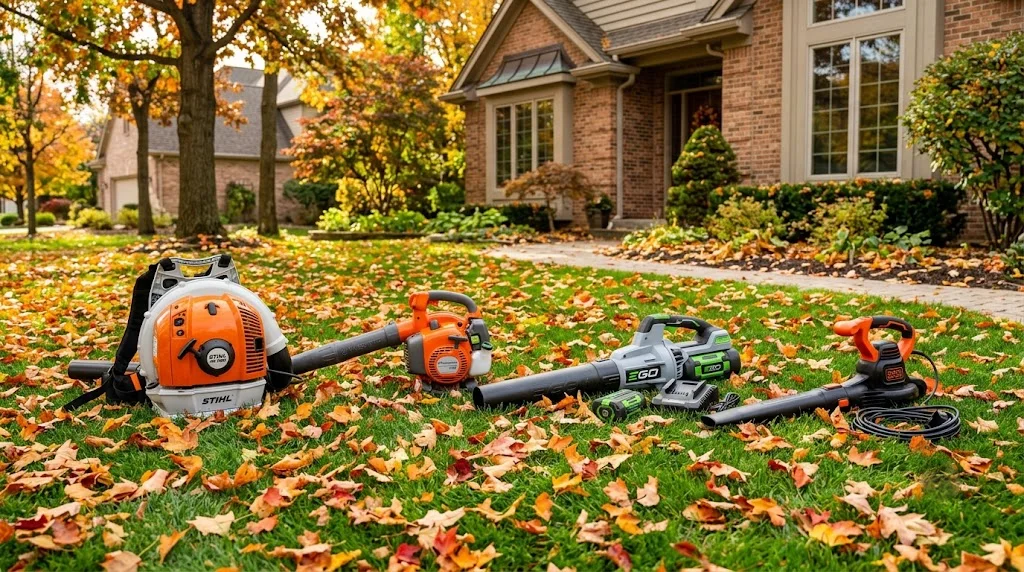
The best leaf blower for most homeowners is a cordless battery model like the Ego Power+ LB6504. It offers strong airflow, long battery life, and a comfortable grip without the fumes or cord of gas and corded options. Larger properties with more trees benefit from a backpack blower instead.
Fall arrives, and suddenly your yard is buried under a carpet of leaves. Raking sounds like a weekend-ruining chore, and that’s exactly why so many homeowners turn to a leaf blower instead. But walk into any hardware store and you’ll face a wall of options: gas, battery, corded, handheld, backpack. Picking the wrong one means a machine that’s too weak, too heavy, or too loud for your actual needs.
This guide breaks down what actually matters when buying a leaf blower, walks through the main types, and points you toward specific models that testers rate highly this year. By the end, you’ll know exactly which blower fits your yard, your budget, and your patience level.
What Makes a Leaf Blower Actually Good
Every leaf blower claims to be powerful. Manufacturers throw around numbers like CFM (cubic feet per minute) and MPH (air speed) on every box, but those numbers only tell part of the story. Consumer Reports, which tests dozens of models each year, looks for blowers that clear a large swath of grass in under a minute and don’t leave stragglers behind that require raking.
Speed matters, but so does thoroughness. A blower can move air fast and still miss leaves that are pressed into the grass. The best machines loosen embedded debris on the first or second pass instead of pushing air over the top of it. Testers also score how much force a blower produces, since a powerful model can move pine cones, twigs, and other heavier debris, and can even clear out gutters.
Weight and balance count for just as much as raw power, especially if you’re clearing a yard for twenty or thirty minutes at a stretch. A blower that feels light in the store can feel very different after ten minutes of continuous use. Good handle design, a comfortable grip angle, and manageable weight distribution make the difference between a chore you dread and one you barely notice.
Noise is the other factor people underestimate until their neighbor complains. Gas blowers tend to run loudest, while many battery models run noticeably quieter. If you live in a neighborhood with tight lot lines, or in a city with leaf blower noise ordinances, this is worth checking before you buy.
Handheld, Backpack, or Wheeled: Choosing Your Type
Leaf blowers fall into three main categories: handheld, backpack, and wheeled, with handheld being the most popular choice among homeowners. Each type suits a different kind of yard, so matching the type to your property matters more than chasing the highest spec sheet.
Handheld blowers work well for smaller and mid-sized yards. They’re light enough to hold with one hand, easy to store in a garage corner, and simple enough for anyone in the household to pick up and use. Most homeowners with a quarter-acre lot or smaller will find a handheld model does everything they need.
Backpack blowers step things up for bigger properties. Consumer Reports notes that backpack blowers help on larger properties with more trees, including hilly yards where a wheeled blower would be hard to maneuver. The weight sits on your shoulders and hips instead of your arm, so you can run the machine longer without fatigue. If your property has more than a handful of mature trees, a backpack blower will save your arm and your afternoon.
Wheeled blowers are the heavy machinery of the leaf blower world. Consumer Reports describes them as designed for large yards, expensive, and usually noisy, though a few models are surprisingly quiet, and notes they can’t vacuum or shred and need about 8 square feet of storage space. Unless you’re managing a large estate or commercial property, most homeowners can skip this category entirely.
Gas vs. Battery vs. Corded Electric
This is where most buying decisions actually get made, since the power source shapes everything from noise to maintenance to how far you can roam from an outlet.
Gas blowers have historically offered the most raw power and unlimited runtime, since you just refill the tank. The tradeoffs are real, though: gas engines are loud, they need regular maintenance like oil changes and spark plug checks, and they produce exhaust fumes that battery models simply don’t. Many cities have started restricting or banning gas leaf blowers entirely, so it’s worth checking your local rules before buying one.
Battery-powered blowers have closed the performance gap significantly. As Consumer Reports puts it, battery leaf blowers have evolved over the past decade from a niche product for light cleanup into a viable alternative to heavy-duty gas-powered blowers. Handheld battery models now match gas power in many cases, though their rechargeable batteries typically run for less than half an hour, making them best suited for quicker jobs. If you need longer runtime, battery backpack blowers are usually more powerful and last longer than handheld battery models, though they cost considerably more.
Corded electric blowers are the budget-friendly option, and they never run out of charge as long as you’re near an outlet. The Worx Turbine WG521 is a strong example here, with a 12-amp motor and the highest CFM rating among corded models, reaching an air volume of 800 CFM and an air speed of 135 MPH. It handles dry leaves, wet leaves, grass clippings, and even small rocks and twigs with ease. The catch is obvious: you’re tethered to a cord, so working far from your house means buying a long extension cord and dealing with the hassle of dragging it around trees and shrubs.
Top Picks Worth Considering
If you want a single recommendation for most yards, the Ego Power+ LB6504 stands out. CNN’s testing team found it sturdy, powerful, and easy to use, with an ergonomic handle and comfortable weight that made it highly maneuverable during extended use. It also held a strong charge even at the highest speed setting, and its speed control dial adjusts airflow across four increments from off to high, with a turbo boost button for extra power when you need it. The tradeoff is a bit more noise when turbo mode kicks in, but the added speed usually makes the job faster overall.
For anyone on a tighter budget who has access to an outlet, the Black+Decker LB700 is worth a look. Testers describe it as lightweight and surprisingly powerful, making it a solid choice for any budget.
If raw power is your top priority and you don’t mind the cord, the Toro PowerJet F700 is hard to beat. It’s rated as the brand’s top electric blower, offering the highest CFM among corded models at 725 CFM and an air speed of up to 140 MPH. It’s built to handle wet leaves, twigs, and pine needles across yards with a lot of tree cover, and it can run with an extension cord as long as 150 feet, giving you plenty of reach.
For gardeners who also want vacuum and mulching functions, the Makita DUB186Z has earned strong reviews as a cordless blower vac that handles both wet and dry leaves without much fuss, making it a good all-in-one pick for smaller gardens.
How Leaf Blowers Get Tested
It helps to know how these rankings actually get made, since it explains why some blowers score higher than their spec sheets suggest. Consumer Reports engineers rope off a standardized swath of grass and dump the same quantity of leaves inside the boundary for every model they test, then time how long each blower takes to clear the pile and check whether it moves every last leaf. To test how well a blower handles debris that’s stuck to the ground, technicians embed synthetic turf with sawdust and rice, then weigh the turf before and after to see how much the blower actually cleared.
Raw power gets measured with what’s called a ball rise test. Engineers direct the blower’s airflow through a vertical tube and measure how high it can lift two dimpled batting cage balls, using both balls together to get a stable reading. This is a more honest measure of real-world strength than the CFM number printed on the box, since it reflects actual air force rather than manufacturer marketing.
What to Think About Before You Buy
Start with your yard size and tree cover, since that decision alone rules out entire categories. A small suburban lot rarely needs a backpack or wheeled blower, while a wooded acre will make a basic handheld model feel underpowered fast.
Think about your local noise rules too. Several cities and towns now restrict gas blower use by time of day or season, and some have banned gas models outright. A battery or corded electric blower sidesteps that problem entirely and keeps you on good terms with your neighbors.
Battery life matters if you’re going cordless. A handheld battery blower with a thirty-minute runtime works fine for a small yard, but larger properties may need a backup battery or a backpack model with a bigger pack. Check whether the blower uses a battery system you already own from another tool, since that can save you a decent amount of money.
Finally, don’t ignore comfort. Pick up the blower in the store if you can, check the handle angle, and imagine holding it for twenty minutes straight. A blower that’s a pound or two lighter, or that balances better on your hip or shoulder, will make cleanup season far less of a grind.
Final Thoughts
There’s no single best leaf blower for everyone, but there is a best leaf blower for your yard. Small and mid-sized lots do well with a handheld battery model like the Ego Power+ LB6504. Bigger properties with more trees call for a backpack blower that spreads the weight across your shoulders. Budget-conscious buyers near an outlet can get excellent performance from a corded electric model like the Worx Turbine or Toro PowerJet.
Match the blower to your yard, not the other way around, and fall cleanup stops being a dreaded chore and becomes a quick task you barely think about.


Comments are closed.