
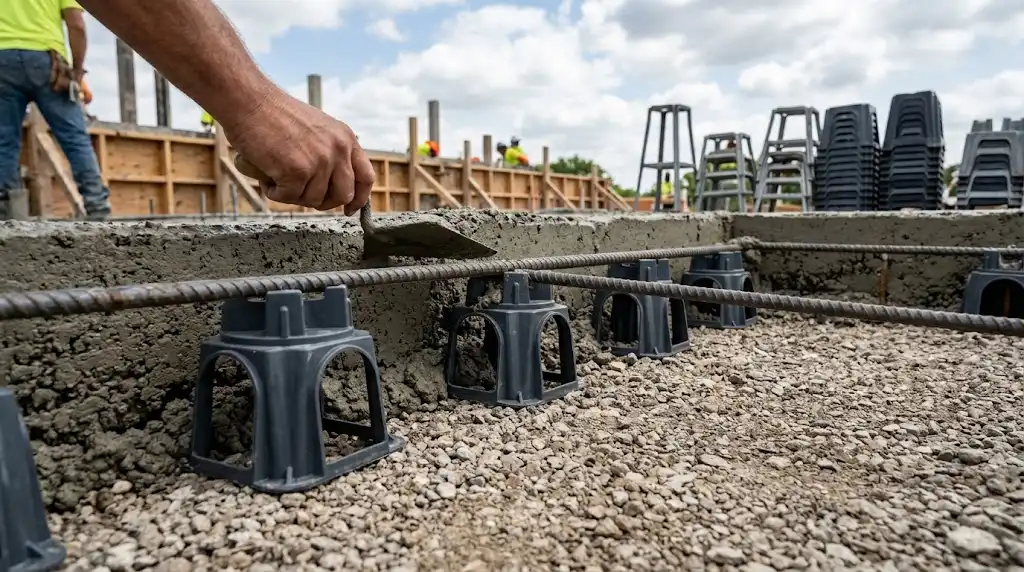
If you’re working on a concrete project or just trying to understand construction plans, you’ve probably noticed these small plastic or metal devices supporting rebar and wondered what they’re really doing there. What is the purpose of a chair or spacer in concrete reinforcement?
Chairs and spacers hold rebar at the proper height and distance from formwork, ensuring correct concrete cover around the steel reinforcement. This positioning is critical—most building codes require 2-3 inches of concrete cover to protect rebar from moisture and corrosion.
Keep reading because there are several different types of chairs and spacers designed for specific applications, and choosing the wrong one can compromise your concrete’s structural integrity and longevity.
Why Proper Rebar Positioning Matters
When rebar sits directly on the ground or against formwork, it won’t be properly embedded in concrete. The concrete cover acts as a protective barrier against water, oxygen, and chemicals that cause steel to rust. Once rebar starts corroding, it expands and cracks the surrounding concrete, leading to structural failure over time.
Properly positioned reinforcement is essential for reinforced concrete to achieve its designed strength and durability, as the steel and concrete must work together as a composite material where the concrete resists compression forces while the strategically placed steel handles tensile stresses—this synergy only functions correctly when rebar maintains precise positioning throughout the concrete pour, which is why chairs and spacers serve as critical components in ensuring the structural integrity that engineers calculate during design.
Common Types Of Chairs And Spacers
Bar chairs come in various configurations depending on where they’re used. Individual bar chairs support single rebars, while continuous chairs (also called bolster chairs) run along the length of multiple bars. Slab bolsters elevate rebar in horizontal applications like floor slabs, while beam bolsters and column chairs are designed for vertical or elevated applications.
Material choice is equally critical for performance and longevity. Plastic chairs resist corrosion and won’t create rust stains, making them ideal for exposed concrete, whereas metal chairs offer high strength at a lower cost but risk rusting if not properly embedded. For detailed specifications on material compatibility, load capacities, and general concrete supplies across different structural applications, technical resources like paradiseconcretesolutions.com provide comprehensive guides for job site planning.
How Do You Choose The Right Chair Or Spacer?
Selecting the appropriate chair or spacer depends on several factors, starting with the type of concrete element you’re building. For horizontal slabs on grade, you’ll typically use slab bolsters or individual bar chairs that can support the weight of workers walking across the rebar during the pour.
The size and spacing of your rebar also dictate which chairs to use. Heavier rebar requires more robust support, and chairs are rated by their load capacity. Most manufacturers provide charts showing maximum bar sizes and spacing intervals for each chair type.
Environmental conditions play a role, too. In coastal areas or anywhere exposed to moisture and salt, plastic chairs are strongly preferred since metal chairs will corrode and leave rust stains. For interior slabs or foundations that won’t be exposed, metal chairs offer an economical solution.
What Happens If You Don’t Use Chairs Properly?
The consequences of skipping or improperly using chairs and spacers can be severe. When rebar rests directly on the ground or formwork, you lose the protective concrete cover. Even a small section of exposed rebar can become a corrosion point.
Structural engineers calculate load capacities based on rebar being positioned at specific locations. If rebar sinks to the bottom of a slab during the pour, the concrete loses much of its designed tensile strength. A slab designed to hold a certain load might crack or fail prematurely.
Repair costs dwarf the minimal expense of proper chairs and spacers. Removing and replacing failed concrete involves demolition, hauling, new materials, and labor—easily running tens of thousands of dollars.
How Many Chairs Or Spacers Do You Need?
The spacing requirements for chairs and spacers are based on preventing rebar from sagging or moving during concrete placement. A general rule of thumb is to place supports every 3 to 5 feet along the length of each rebar, though this varies based on bar size and configuration.
Grid patterns of rebar require supports at intersection points and along individual bars between intersections. For a typical residential slab with rebar on 18-inch centers in both directions, you might need a chair at every other intersection point, creating a support pattern roughly every 3 feet in each direction.
Edge conditions need special attention. Rebar positioned near the perimeter of a slab can easily shift during the pour, so many contractors place chairs more frequently—sometimes every 2 feet—along edges and around openings. When in doubt, adding extra chairs costs little but provides insurance against rebar displacement.
Can You Use Homemade Alternatives?
Some contractors attempt to save money by using makeshift supports like bricks, stones, or wood blocks instead of proper chairs and spacers. This practice is nearly always a bad idea and violates most building codes.
Brick and stone are porous materials that can wick moisture toward the rebar, accelerating corrosion. They also don’t provide consistent height.
Wood blocks present even more serious problems. As concrete cures, moisture can cause wood to rot and leave voids around the rebar. These voids compromise the bond between steel and concrete.
The only acceptable alternative in some situations is using small concrete dobies—precast concrete blocks specifically made for supporting rebar. Given that commercial chairs cost just pennies each, the minimal savings from improvised alternatives aren’t worth the risk.
What Are The Installation Best Practices?
Proper installation starts with ensuring your subgrade or formwork is level and properly prepared before placing any reinforcement. Chairs placed on uneven or soft ground can sink or tip during the concrete pour, negating their purpose. For slabs on grade, the subbase should be compacted and screeded level.
When positioning chairs, make sure they’re stable and won’t rock or tip. Some chairs have wings or wide bases specifically designed to prevent tipping, but they still need to sit flat. Wire ties connecting the chair to the rebar provide additional stability, especially for vertical applications like walls and columns.
Timing matters during the concrete pour itself. Designate someone to watch the rebar as concrete is placed and be ready to reposition any reinforcement that shifts. Having extra chairs on hand lets you add support quickly if needed. Avoid dropping concrete from excessive heights, which can knock rebar out of position.
Calculate Your Support Requirements
Make sure to calculate how many chairs and spacers you’ll need for your specific project before ordering materials. Use the spacing guidelines discussed earlier—typically every 3 to 5 feet along each rebar—and always round up to have extras on hand during installation. Investing a few extra dollars in proper support devices now will save you from expensive repairs and structural problems down the road.


Comments are closed.