
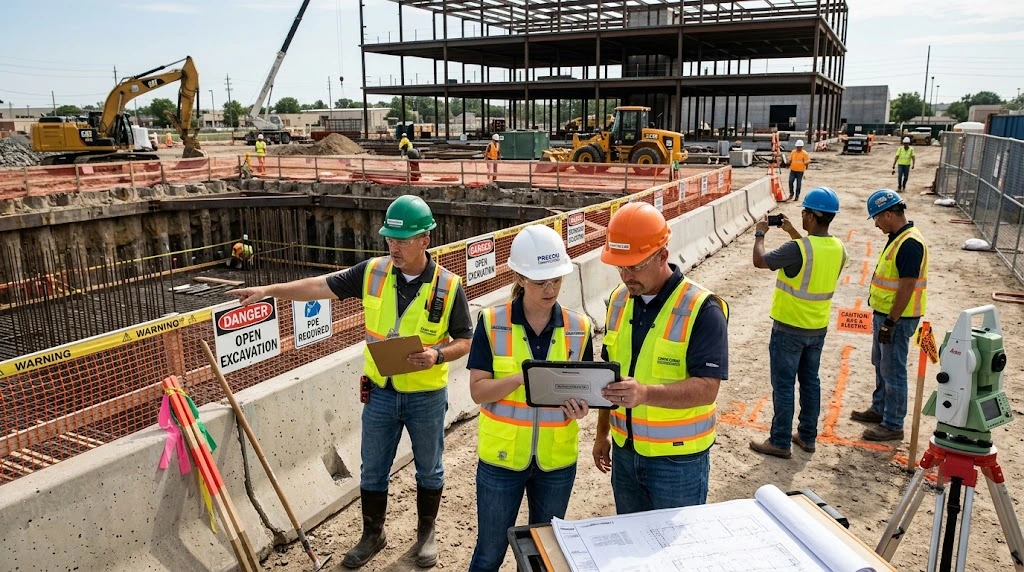
For most of its history, preconstruction documentation has been an instrument of self-defense. Teams photographed existing conditions, surveyed adjacent properties, and recorded the state of a site before breaking ground so that, if a dispute or a damage claim surfaced later, they could prove what was there and what was not. The record existed to settle arguments and limit liability. It lived in a file, and most people hoped never to need it.
That purpose has not gone away, but a second one is quietly emerging alongside it. The same detailed picture of a site captured before work begins is turning out to be a powerful input for keeping people safe during the work itself. The documentation that once protected the balance sheet is starting to protect the workforce, and that shift changes how forward-looking teams think about capturing conditions early.
None of this is a wholesale reinvention of how sites are documented. The shift is more modest and more useful: a record built for one purpose turns out to serve another, and the second purpose may matter more. Reframing the preconstruction walk as a safety activity, not only a legal one, costs very little and changes how a team reads everything it already captures.
Where injuries are actually prevented
The logic behind the shift is well established in safety research. The Prevention through Design initiative at NIOSH describes designing out hazards as the most reliable and effective way to protect workers, and it pushes hazard elimination upstream into the planning and design phase, before anyone sets foot on the site. The implication is simple but underused: the cheapest and safest time to deal with a hazard is before it physically exists, when changing it costs a conversation rather than a shutdown.
The economics reinforce the point. A hazard addressed on a drawing or during a planning review costs almost nothing to change. The same hazard discovered once the structure is standing may require rework, a stoppage, or a resequenced crew, and a hazard discovered only after someone is hurt carries a cost that no budget line can absorb. Pulling hazard identification earlier is the version of safety that also protects the schedule and the margin, which is often what gets it taken seriously in the first place.
A faithful record of preconstruction conditions feeds exactly that kind of upstream thinking. The same idea is now visible in software. “The category often described as construction safety management software has moved beyond logging incidents after they happen toward helping teams spot and plan around hazards before work starts. Increasingly, teams are using visual site documentation and field observations tied to specific locations and dates to identify risks before crews are exposed to them.”When planners can study an accurate view of the site in advance, the conversation shifts from reacting to conditions to anticipating them.
The hazards are knowable before anyone gets hurt
This matters because the dangers in construction are stubbornly consistent and largely foreseeable. OSHA’s guidance on construction fall hazards identifies falls as the leading cause of fatalities in the industry and requires fall protection once work reaches six feet. Many of these hazards are visible long before a worker is exposed to them: the unprotected edge, the floor opening that needs a cover, the route that will force crews to work near a drop. They are not random events. They are conditions, and conditions can be documented.
A preconstruction record gives a safety planner something concrete to work from rather than a memory or a hand-drawn sketch. Where will the leading edges be once the deck is poured? Which access points will pinch when three trades are working the same floor? Which existing structures or utilities create exposure that the design did not anticipate? A clear visual baseline turns those questions from guesswork into a review someone can actually conduct, on the plan, before the schedule starts applying pressure.
From a liability record to a prevention discipline
Treating documentation as a prevention tool is not a leap for the industry; it is an extension of a habit it already has. Safety performance data gathered by the Construction Industry Institute has been collected from member firms since 1990, and it tracks not only injuries but near misses and first-aid cases, treating the systematic recording of what almost went wrong as a way to prevent what could. The same instinct applied earlier, to the conditions of a site before work starts, simply moves prevention further upstream.
The practical difference is in how the record is used. A liability record is consulted after something goes wrong, to assign responsibility. A prevention record is consulted before work begins, to remove the chance that anything goes wrong at all. The artifact can be nearly identical: a thorough, time-stamped, location-tagged picture of the site. What changes is the timing and the intent, and that change is where the safety value lives.
There is a cultural benefit to closing that loop. When a crew sees that conditions they flagged before a pour actually shaped how the work was planned, reporting stops feeling like paperwork and starts feeling like influence. Documentation that visibly prevents problems earns the participation it depends on, and a record that workers trust is a record that stays accurate. The discipline tends to feed itself once people watch it work once or twice.
What this looks like in practice
For a team that wants to put this to work, the move is less about new equipment and more about repurposing a record they may already be capturing. A preconstruction walkthrough that documents the site thoroughly becomes the basis for a pre-task hazard review. Imagery tied to the plan lets a safety lead flag exposures by location and assign controls before crews mobilize. When conditions change, an updated capture keeps the hazard picture current rather than frozen at the kickoff meeting. The record stops being a static insurance policy and becomes a living input to how the work is sequenced and protected.
None of this replaces the fundamentals. Training, supervision, and a strong safety culture still carry most of the weight, and no document on its own keeps a worker off a bad ladder. What good preconstruction documentation does is widen the window in which a hazard can be caught and removed, shifting more of the prevention effort to the phase where it is cheapest and most effective. That is a meaningful gain in an industry where the most serious incidents are so often the predictable ones.
Consider a simple case. A floor that will host mechanical, electrical, and plumbing crews in quick succession can look empty and harmless during the preconstruction walk. A documented capture of that space, reviewed against the planned sequence, can reveal that one opening will sit unguarded between two trades’ scopes, with neither party clearly responsible for covering it. Catching that gap on the record, weeks ahead, is the difference between assigning the control in a planning meeting and discovering it through an incident report.
A familiar record, a new purpose
The encouraging part of this shift is that it asks teams to get more value from something many already do. The existing-conditions survey, the preconstruction photo set, the early site walk: these were built to protect against claims, and they will keep doing that. Pointed forward instead of backward, the same records help a team see trouble coming. As the tools for capturing and organizing site reality keep improving, the line between protecting the project and protecting the people on it will continue to blur, and the industry will be better for it.

Comments are closed.