
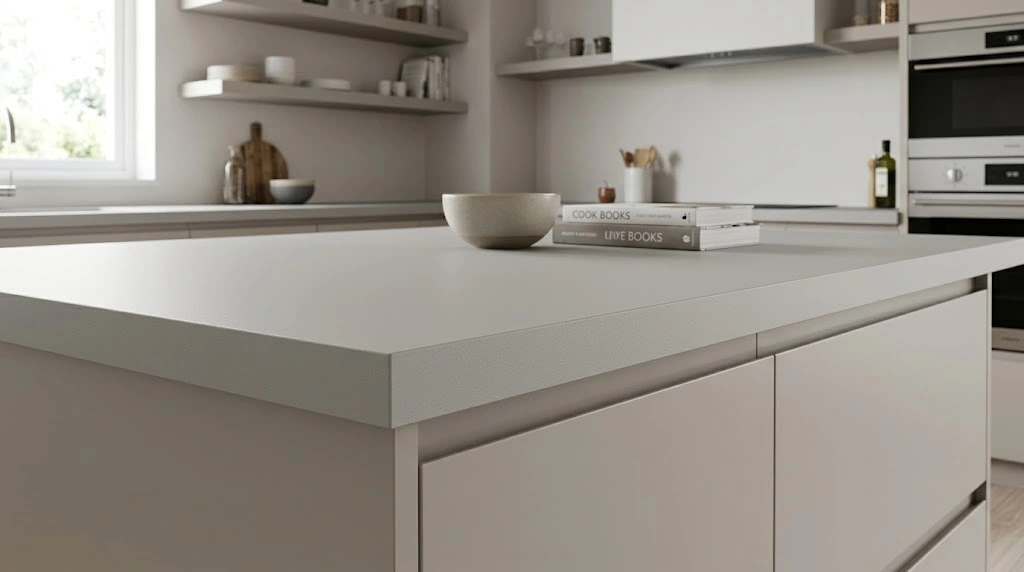
Wilsonart SOLICOR is a specialty laminate with a solid color core that runs all the way through the sheet. Unlike standard laminate, it has no brown edge line, giving countertops, cabinets, and furniture a clean, seamless look from the surface to the edge.
If you’ve ever looked closely at the edge of a laminate countertop, you’ve probably noticed a thin brown line running along the seam. It’s a small detail, but it can throw off an otherwise clean design. Wilsonart SOLICOR laminate was built to fix exactly that problem.
This guide walks you through what SOLICOR is, how it’s made, where it works best, and what makes it different from regular laminate. By the end, you’ll know whether it’s the right pick for your next project.
What Is Wilsonart SOLICOR Laminate

Wilsonart SOLICOR is a specialty laminate with a solid color core. That core color matches the surface color, so when you cut or shape the material, the edge looks just as clean as the top. There’s no dark seam breaking up the design.
SOLICOR laminate provides continuous color, even on the edges of your finished project. That means designers and fabricators can create sharp inlays, crisp edge details, and complex shapes without worrying about a visible seam giving away where two pieces meet.
SOLICOR isn’t a separate product line built from scratch. It’s engineered on the foundation of Wilsonart’s High Pressure Laminate (HPL), so it carries the same performance and durability people expect from standard Wilsonart laminate. The only real difference is that color-matched core.
How SOLICOR Is Different From Standard Laminate

Standard laminate sheets are built in layers. The decorative pattern sits on top, and underneath it are kraft paper layers soaked in resin. Those layers are usually brown, which is why you see that telltale line at every cut edge.
SOLICOR swaps out that plain paper core for one that matches the face color. So whether you’re working with a solid white, a warm linen texture, or a deep charcoal stone look, the core color follows along. These colorthrough designs eliminate the troublesome brown line, creating a crisp, clean look all the way to the edge.
This might sound like a small cosmetic upgrade, but it changes what fabricators can actually build. Waterfall edges, mitered corners, and inlay work all look far more polished when there’s no contrasting line breaking the illusion of a solid material.
Where You Can Use SOLICOR Laminate
SOLICOR shows up in a lot of places, both in homes and in commercial spaces. It works well for countertops, furniture, fixtures, and partitions, and it holds up under the same demanding conditions as any high-performance laminate.
Beyond the obvious countertop use, people choose SOLICOR for desks, display cases, cabinetry, backsplashes, and doors. Retail spaces also lean on it heavily. Store fixtures, shelving units, and workstations all benefit from that seamless edge, especially in spots where customers get up close and touch the surface.
Because the color runs all the way through, designers get more freedom to experiment. Inlay effects, layered cutouts, and sharp geometric edging all read as intentional design choices instead of manufacturing shortcuts. That flexibility is a big reason architects and interior designers keep specifying it for high-visibility commercial builds.
SOLICOR Laminate Specs and Thickness Options
SOLICOR comes in a few different thickness types depending on the core color you pick. Type 160 laminate, available in white and black core, runs 0.048 inches thick. Type 161, which covers almond, grey, and khaki cores, is also 0.048 inches thick. Standard sheets measure 4 feet by 8 feet, which matches typical laminate sheet sizing you’d expect on any job site.
For projects that need extra strength, there’s also SOLICOR Compact Laminate. This version, Type 560, comes in white and black core at a much heartier 0.5 inches thick. Compact laminate is a solid, self-supporting panel rather than a thin sheet that needs a substrate underneath it, which makes it a popular choice for partitions, lockers, and furniture that takes a beating.
Knowing these specs matters when you’re pricing out a job or figuring out what substrate and edge treatment to use. A fabricator working with the thinner sheet laminate needs a different approach than one working with compact panels, so it’s worth confirming which type your supplier has in stock before you finalize a design.
TRACELESS SOLICOR: A Newer Ultra-Matte Option
Wilsonart has also rolled out a newer version called TRACELESS SOLICOR. This ultra-matte, ultra-luxe option comes in six designs, each with a design-matched core color for clean edging detail. It’s aimed at people who want a softer, more muted finish rather than the higher-sheen looks in the standard SOLICOR lineup.
There’s also a compact version of this finish. TRACELESS SOLICOR Compact offers the same six ultra-matte designs, paired with a matching core color and the added durability of a double-faced compact laminate panel. That combination makes it a strong option for high-traffic spaces where you still want that soft, matte look without sacrificing toughness.
If your design leans toward a minimalist or Scandinavian style, TRACELESS is worth a look. The matte finish hides fingerprints and light scratches better than glossier options, which matters a lot in busy kitchens or office break rooms.
Durability and Performance
Laminate gets picked for commercial spaces because it holds up, and SOLICOR is no exception. SOLICOR surfaces are engineered to resist stains, scratches, and wear, even in high-use commercial environments. That’s a big deal for places like restaurants, retail counters, and office reception desks, where surfaces get used hard every single day.
Since SOLICOR is built on Wilsonart’s core HPL technology, it inherits decades of performance testing and manufacturing know-how. You’re not getting a niche side product with unproven durability. You’re getting the same reliable material Wilsonart is known for, just with a smarter core.
Sustainability and Health Certifications
If you’re working on a project that needs to meet green building standards, SOLICOR has some useful credentials. SOLICOR surfaces received a Declare label and are LBC Red List Approved, meaning they support both human and environmental health.
That matters for architects and designers working on LEED-certified buildings or any project where material transparency is part of the spec. Having documentation that shows what’s in a product, and confirming it avoids the worst chemicals on the Red List, makes the approval process smoother.
Fabrication and Installation
One question that comes up a lot is whether SOLICOR needs special tools or handling. It doesn’t. Fabricators can use the standard carbide-tipped tools they’d already use for any high-pressure laminate job. There’s no special equipment to buy and no steep learning curve for a shop that already works with laminate regularly.
This is actually one of the more practical selling points. A fabrication shop can pick up SOLICOR and start working with it right away, using the same saws, routers, and edge-banding process they already know. That keeps labor costs predictable and avoids delays while a crew figures out new techniques.
Design Options and Colors
SOLICOR’s design library has grown a lot over the years. Wilsonart regularly adds new decors to keep pace with design trends. Recent additions included new décors alongside three new core color offerings in popular neutrals like brown, grey, and almond, giving the whole lineup more range.
The pattern options span a wide range too, from industrial plywood looks and linear woodgrains to fine velvet-textured linens and stone patterns. That variety means SOLICOR isn’t locked into one aesthetic. You can go warm and textured with a woodgrain, cool and minimal with a solid neutral, or bold with a stone-inspired pattern, all while keeping that seamless edge.
Is SOLICOR Laminate Worth the Cost
SOLICOR typically costs more than standard laminate because of the extra manufacturing step needed to color-match the core. Whether that extra cost is worth it depends on your project. For a budget-friendly laundry room countertop, standard laminate probably does the job fine.
But for a reception desk, a retail display, or any surface where people will actually see and touch the edges up close, SOLICOR earns its price tag. The seamless look reads as a higher-end material even though it’s still laminate underneath, which means you get a premium appearance without paying for solid surface or stone.
If you’re on the fence, ask your supplier for physical samples. Seeing the edge detail in person makes the difference obvious in a way photos never quite capture. Most fabricators and Wilsonart dealers can get samples to you quickly so you can compare it side by side with standard laminate before committing to a full order.

Comments are closed.