
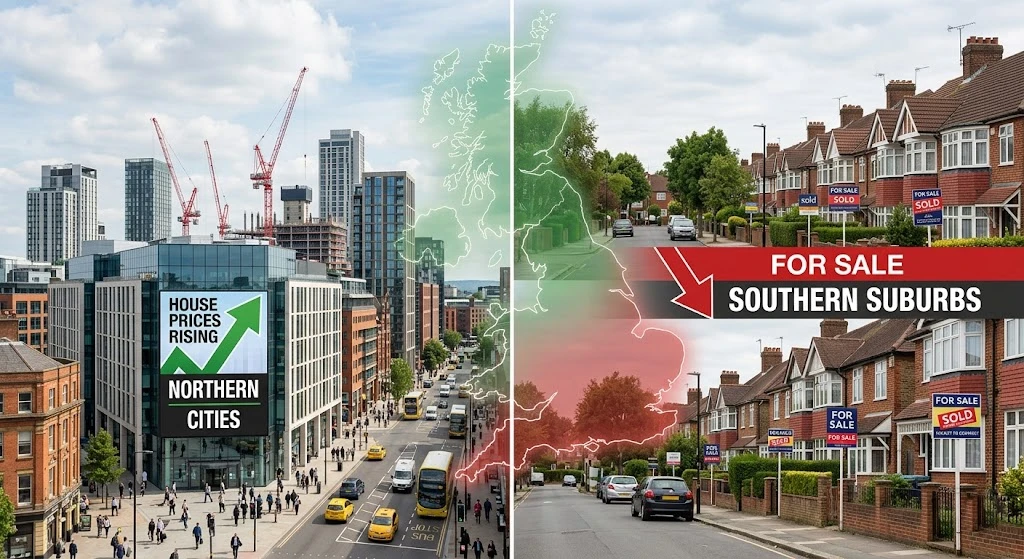
The UK regional housing trends of 2025 and 2026 tell two very different stories depending on where you look. In the North, prices are climbing, demand is strong, and buyers are finding real value. In the South, properties are sitting unsold, prices are falling, and affordability is squeezing buyers out of the market entirely.
This isn’t a blip or a post-pandemic hangover — it’s a structural shift that’s reshaping how people buy, sell, and invest across the country. Whether you’re a first-time buyer weighing up your options, a landlord reviewing your portfolio, or simply trying to make sense of the headlines, understanding these regional housing trends is the smartest place to start.
This article breaks down the UK regional housing trends that matter most right now — what’s driving them, where the real opportunities are, and what buyers, sellers, and investors need to know.
The Big Picture: UK House Prices in 2026
The average UK house price stood at £269,000 in February 2026, roughly £3,000 higher than 12 months earlier. That sounds stable on the surface. But pull back the curtain and you’ll see wildly different stories playing out region by region.
The highest annual growth was in Yorkshire and the Humber, where prices increased by 3.9% in the year to February 2026. Meanwhile, London’s annual house price change came in at -3.3%, with the average property sitting at £542,000.
That’s not a small gap. That’s a structural divide — and it’s been building for years.
Regional Housing Market Trends: North vs South
Here’s a side-by-side comparison of key regions based on the latest government and Land Registry data:
| Region | Avg. House Price (2026) | Annual Price Change |
|---|---|---|
| London | £542,000 | -3.3% |
| South East | ~£380,000 | Falling |
| East of England | ~£330,000 | Flat/Slow |
| UK Average | £269,000 | +1.3% |
| North West | ~£215,000 | +3.1% |
| Yorkshire & Humber | ~£195,000 | +3.9% |
| North East | ~£162,000 | +2.7% |
| Scotland | £188,000 | +2.3% |
| Northern Ireland | £196,000 | +7.5% |
Sources: UK HPI (Feb 2026, Gov.uk), ONS, Benham & Reeves
The numbers tell a clear story. The further north you go, the stronger the growth. The South, meanwhile, is either flat or in negative territory.
Why Northern Regions Are Outperforming
There isn’t one single reason why UK regional housing trends have tilted so heavily northward. It’s a combination of factors that have been quietly building momentum.
Affordability is the biggest driver. Buyers in the North East need just 5.7 times their annual income to purchase the average home — making it the most accessible region in the UK relative to local earnings. In London, that ratio exceeds 12 times income, making it one of the least affordable major cities globally.
When mortgage rates are elevated, affordability becomes everything. Northern buyers are simply better placed to absorb borrowing costs without stretching beyond their means.
Supply is tighter in the North. The South faces a significant surplus, with London and the South East listing 19% and 16% more properties than the prior year. Northern markets, by contrast, have tighter supply, which fuels demand and pushes prices up.
Economic momentum is shifting. Cities like Manchester, Leeds, and Liverpool are no longer just alternatives to London — they’re destinations in their own right. Areas with improved infrastructure, regeneration projects, and strong employment opportunities are seeing the strongest price growth. Cities like Manchester, Birmingham, and Leeds continue to attract both domestic and international investment.
Buy-to-rent math works better up north. More than half of homes listed for sale in the North East and Scotland are now cheaper to buy than to rent. The North West shows a similar trend. The picture changes dramatically further south — in London and parts of the Midlands, fewer than 40% of homes are cheaper to buy than rent.
Why the South Is Struggling
The South’s housing market faces a perfect storm of headwinds right now.
- Oversupply: Too many homes, not enough qualified buyers at current prices
- Affordability crunch: High price-to-income ratios are pricing out first-timers and upsizers alike
- Stamp duty impact: The end of stamp duty relief in April 2025 hit hard, dropping the first-time buyer threshold from £425,000 to £300,000 and adding up to £2,500 in extra costs for southern buyers
- Falling transaction volume: The highest number of repossession sales in England was recorded in the South East, pointing to growing financial stress in the region
- Investor retreat: Speculation around property taxes and regulation has cooled demand for higher-value homes, which are concentrated in London and the South East
London has seen annual falls in house prices for six consecutive months through January 2026 — a streak that underlines just how much structural pressure the capital is under.
Standout Performers: The Local Hotspots
While regional averages paint a useful picture, the real action is happening at the local authority level.
South Tyneside and Northumberland, both in the North East, saw the strongest local growth across 2025, at 10.9% and 10.7% respectively. Scotland featured heavily in the top performers, with Argyll and Bute up 10.3%, South Lanarkshire 9.6%, and West Dunbartonshire 9.3%.
Even within underperforming regions, pockets of growth exist. Bromley led the way in London with annual growth of 6.3%, and Rushmoor was the standout in the South East at 8%.
The lesson? The North-South divide is real, but it’s not absolute. Micro-location matters enormously.
The Rental Market: Regional Splits Persist There Too
The buy-vs-rent calculation looks very different depending on where you live — and that’s reshaping buyer behaviour.
Average UK monthly private rents increased by 3.5% in the 12 months to February 2026. Average monthly rent for England was £1,430, while Wales came in at £828 — a difference of over £600 per month.
For renters in the North, buying is becoming an increasingly attractive escape route. For those in London, high rents and high purchase prices create a double bind that’s pushing many towards longer renting periods or relocating entirely.
What the Long-Term Picture Tells Us
The current North-South split isn’t just a pandemic hangover or a short-term blip — it reflects deeper structural realities.
House prices in London have risen by 83% since 2010, followed by 70% across southern regions of England. Northern regions, by contrast, saw just 41% growth over the same period. Household incomes have grown by 58% since 2010 — meaning there is now more room for house prices to rise in regions where values have lagged behind income growth, and less room in high-value markets.
In other words, the North is catching up. And there’s still headroom to run.
Savills predicts that the North West, North East and Scotland will keep leading growth, with forecasts of up to 29.4% cumulative price growth in the North West by 2029. If that plays out, buyers who move now are entering at a meaningful discount relative to where prices could be in five years.
What This Means for Buyers, Sellers, and Investors
If you’re buying: The North offers better value, stronger yield potential, and more realistic affordability. Cities like Manchester, Leeds, and Liverpool remain strong bets for long-term appreciation. In the South, patience may be rewarded — falling prices could represent a buying opportunity, particularly in commuter belt areas with good transport links.
If you’re selling in the South: Pricing realistically is non-negotiable right now. Around 22% of southern homes are sitting unsold after six months, which means overpriced properties simply won’t move.
If you’re an investor: Rental yields in northern cities are outpacing those in London by a significant margin. With buy-to-rent economics firmly in the North’s favour and ongoing landlord exits reducing supply, demand for rental stock remains robust in markets like Manchester, Liverpool, and Newcastle.
Key Takeaways
- House prices grew fastest in the North West and Yorkshire and the Humber, while they fell in London, the South East, and the South West — based on the latest UK HPI data
- The average UK house price is £269,000, but London sits at £542,000 versus £162,000 in the North East — a gap of over £380,000
- Affordability, tighter supply, and infrastructure investment are driving northern outperformance
- Stamp duty changes and oversupply are the primary drags on southern markets
- Local hotspots exist in every region — micro-location analysis remains essential
The UK’s North-South housing divide is not new. But in 2025 and 2026, it has moved from a trend to a defining feature of the market. Understanding which side of that divide your investment or purchase sits on could be the difference between a smart decision and an expensive one.
Data sources: UK House Price Index (Gov.uk, Feb 2026), ONS Private Rent and House Prices Report (March 2026), House of Commons Library, Benham & Reeves Research, Savills Residential Forecast, Cushman & Wakefield.


Comments are closed.