
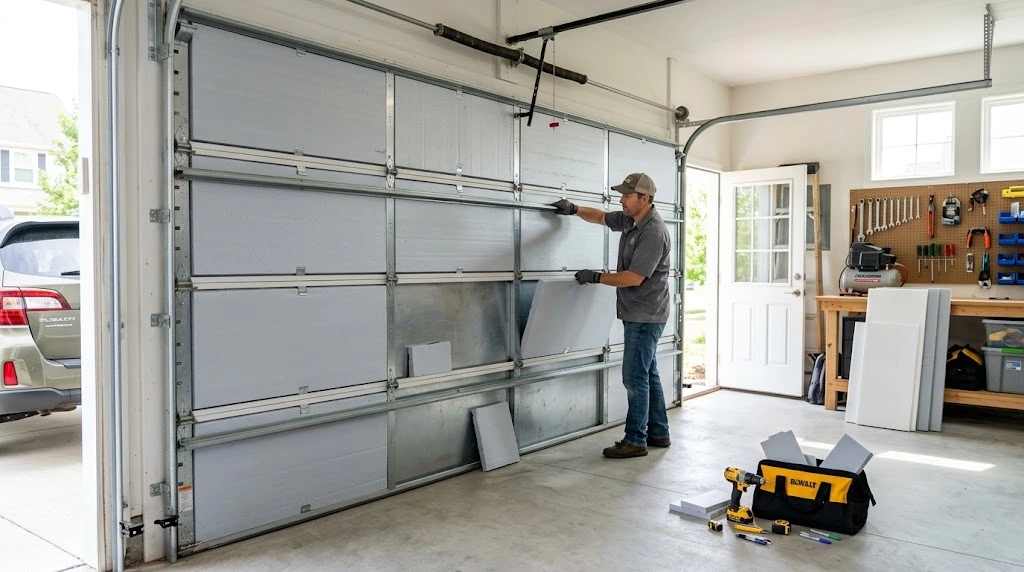
Garage door insulation is a material — foam, fiberglass, or reflective foil — added to your garage door to slow heat transfer. It keeps your garage warmer in winter, cooler in summer, reduces outside noise, and can cut your home’s energy costs by up to 20–30%.
Most homeowners spend time and money insulating walls, attics, and windows. But the garage door? It usually gets ignored. That’s a problem, because your garage door is one of the largest openings in your entire home — and without insulation, it works against you every single day.
The good news is that garage door insulation is one of the most affordable upgrades you can make. You don’t need to replace your door. You don’t need to hire a contractor. And the results show up fast — on your energy bills, in your comfort, and in the noise level inside your home.
This guide covers everything you need to know — what it is, why it matters, which materials work best, and how to choose the right option for your home.
What Is Garage Door Insulation and How Does It Work?

Insulation works by slowing heat transfer. In simple terms, it creates a barrier that keeps warm air from moving to cold areas. In summer, it blocks outdoor heat from baking your garage. In winter, it holds the warmth inside.
Garage door insulation acts as a barrier that slows the transfer of heat between the inside and outside of your garage, which can make a noticeable difference in both comfort and energy costs.
An uninsulated door is basically a thin sheet of metal or wood with nothing stopping temperature from moving straight through it. An uninsulated single-layer steel door provides almost no barrier against outside temperatures, meaning your HVAC system has to work harder to maintain comfortable temperatures in adjacent rooms.
If your garage shares a wall with a bedroom, kitchen, or living room, that temperature bleed affects your whole home — not just the garage itself.
Why Garage Door Insulation Is Worth It

The benefits go well beyond staying warm in January.
Energy savings. Insulating your garage door can significantly reduce temperature fluctuations, preventing heat loss in the winter and keeping your garage cooler in the summer, cutting down energy costs by up to 20–30%. For most families, that’s a real number on a real bill every month.
Noise reduction. The added insulation acts as a buffer, absorbing sounds from street traffic, lawn equipment, or even noisy hobbies inside the garage. If you live on a busy road or work in your garage, this alone makes the upgrade worth it.
More usable space. Insulated garages maintain a consistent temperature, making them more comfortable to use as workspaces, gyms, or storage areas. A garage that’s 105°F in July or 20°F in February is basically unusable. Proper insulation changes that.
Longer door lifespan. Insulation adds structural integrity to the garage door, reducing wear and tear over time. A sturdier door dents less and holds up better through daily use.
Protection for stored items. Extreme temperature swings damage tools, electronics, paint cans, and anything else sitting in your garage. Insulation keeps conditions more stable, so your belongings last longer.
The 4 Main Types of Garage Door Insulation
Not all insulation is the same. The right type depends on your climate, your budget, and how you plan to use the space.
Polyurethane foam is the top-tier choice. Polyurethane insulation is injected as a foam, expanding to fill every gap inside the garage door. This process creates a strong, dense layer that not only insulates well but also adds extra strength and sound reduction. It bonds directly to the steel panels, making the door more rigid and better sealed. Most premium insulated garage doors come with polyurethane already inside.
Polystyrene panels are the most common DIY option. Polystyrene insulation uses pre-cut foam boards that are placed into the door panels. It’s more affordable but provides lower R-values per inch of thickness. The foam boards don’t bond to the steel, so they don’t add structural strength. That said, they’re still a major upgrade over nothing and are easy to install yourself.
Fiberglass batts offer solid thermal performance and work well in larger doors. They come in rolls or cut panels that fit into each door section. Fiberglass insulation offers a relatively good resistance against heat transfer. They’re slightly bulkier to install and require gloves and protective gear, but they do the job well.
Reflective insulation uses foil-faced material that bounces radiant heat away from the garage. This type uses foil-faced materials that reflect heat away from the garage. It’s especially helpful in hot climates where keeping the heat out is the main goal. If you live in a warm region and your main concern is summer heat, reflective insulation is a cost-effective pick.
Understanding R-Values: What the Numbers Mean
R-value is the single most important number when comparing insulation options. It measures how well a material resists heat flow. A higher R-value means better thermal performance.
Here’s what the numbers mean in practical terms for garage doors: R-0 means no insulation and offers no thermal protection, common in basic builder-grade installations. R-6 to R-9 uses polystyrene insulation with rigid foam boards inserted between steel layers. R-10 to R-18 typically uses polyurethane and is the standard for high-performance, energy-efficient doors.
Mild climates like Southern California or the Gulf Coast: R-6 to R-9 is typically adequate. Moderate climates like the Mid-Atlantic or Pacific Northwest: R-9 to R-12 offers a good balance. Cold climates like the Midwest, Northeast, or Mountain states: R-12 to R-18 is recommended for maximum energy savings.
If you use your garage as a gym, workshop, or hobby space, push toward the higher end of that range regardless of your climate. You’ll feel the difference year-round.
DIY vs. Professional Installation
One of the best things about garage door insulation is that most homeowners can do it themselves in a single afternoon.
Many home improvement stores carry complete DIY garage door insulation kits. These kits often include pre-cut insulation panels, fasteners, and instructions, making the process easier for beginners. A basic foam board kit from a retailer like Home Depot or Lowe’s costs between $50 and $150 for a standard single-car door.
The installation process is straightforward. You measure each panel section, cut the insulation to size with a utility knife, and press it into place with a friction fit or adhesive clips. Add about half an inch to your measurements to create a friction fit, then use a straight edge and utility knife to make smooth, accurate cuts — a clean cut ensures easier installation and better insulation performance.
Always wear safety glasses and gloves throughout the process, be cautious when using cutting tools, and when using spray foam, ensure proper ventilation and follow the manufacturer’s instructions.
If you’d rather leave it to a pro, professional installation costs range from $500 to $2,000, depending on the insulation type and the size of the door. That includes both materials and labor. For a heavily used or oversized door, it’s often worth paying for an expert who can handle the details cleanly.
How to Get the Most Out of Your Garage Door Insulation
Insulating the door itself is a great start, but a few extra steps make a much bigger difference.
Seal the gaps first. Check the weatherstripping along the sides and bottom of the door. Old or cracked weatherstripping lets air sneak right past your new insulation. Replacing it is cheap and quick.
Insulate beyond the door. If you want to boost the overall energy efficiency of your garage, consider insulating the walls, ceiling, and windows as well. This will help keep the temperature in check and reduce energy consumption.
Check your work annually. Insulation panels can shift, and weatherstripping wears out. A quick annual inspection keeps everything performing the way it should.
Don’t add insulation to an already-insulated door. Factory-insulated doors are already optimized for weight and performance, and adding extra layers can affect door balance or damage the opener. If your existing door already has insulation inside, leave it as-is and focus on sealing gaps instead.
How Much Does Garage Door Insulation Cost?
The cost varies based on what type you choose and whether you do it yourself.
Reflective insulation generally costs $0.50–$1.00 per square foot. Fiberglass insulation costs around $0.30–$1.30 per square foot, making it a budget-friendly choice. Foam board polystyrene runs slightly higher but still sits well under $200 for most doors. Polyurethane, whether in a kit or applied by a professional, costs more — but it also delivers the best performance.
For most homeowners doing a DIY project with polystyrene or fiberglass, the total spend lands between $50 and $250. You’ll likely recover that cost in energy savings within the first year or two, and the comfort benefits start the day you finish installing it.
Is Garage Door Insulation Worth the Investment?
Yes — and the math is simple. If your garage door is the biggest uninsulated surface in your home, fixing that problem pays off faster than almost any other home improvement you can make.
You get lower energy bills, a quieter space, a more comfortable garage, and a door that holds up better over time. Whether you spend $75 on a DIY kit or $1,500 on a professional upgrade, the return is real and measurable.
Start by checking your current door. If it’s a thin, single-layer panel with no insulation inside, even a basic polystyrene kit will make a noticeable difference. If you’re already planning to replace the door, make R-value a non-negotiable part of what you look for.
Your garage deserves better than being the weak link in your home’s comfort.


Comments are closed.