
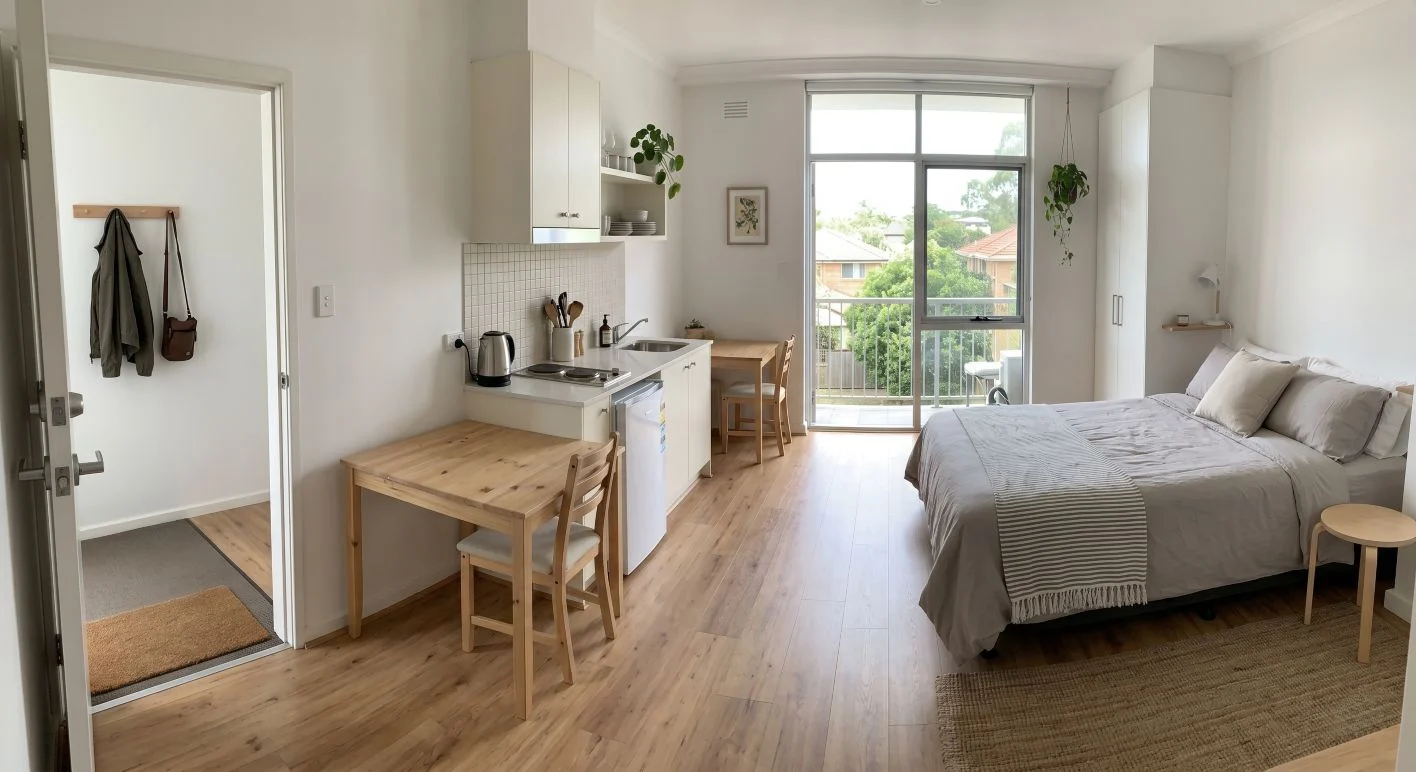
Small studios don’t fail because they’re small. They fail because people cram them with junk, bad furniture, and wishful thinking. I’ve seen tenants in perfectly decent rentals make the place feel like a storage cage just by choosing a giant bed, a deep sofa, and three random side tables they “might use”. You don’t need more room. You need fewer mistakes.
Start with the floor, not the styling
If you can’t walk through the place without turning sideways, nothing else matters.
The first thing I check in any studio is a clear floor path. Front door to kitchen. Bed to wardrobe. Bathroom to desk. If those routes feel awkward, the room feels smaller than it is. Every time. People obsess over cushions and wall prints while a coffee table sits in the middle like it pays rent.
The last time I helped fit out a studio in South Brisbane, we removed one bulky armchair, one wobbling side table, and a shoe rack that blocked the entry. That cleared just over 2 metre square of usable floor space. On paper, that sounds minor. In real life, it changed the whole room.
Keep the centre cleaner than you think you need to. Push storage to the edges. Let the eye travel. It’s not magic. It’s basic spatial control.
Pick the right layout before you move in
A bad layout will punish you daily, no matter how clever your storage hacks look on Instagram.
When people compare rentals, they focus on weekly rent and postcode. Fair enough. But I’d rather take a slightly older studio with one clean rectangular room than a newer one chopped into weird corners with nowhere to place a bed properly. That “modern” layout often wastes more room than it saves.
I’ve walked through more than my fair share of student apartments Brisbane tenants choose because the listing photos look clean and the commute to uni is short. Some work well. I’ve seen some units where the built-ins are so poorly placed that they effectively kill half your usable wall space, leaving you zero room for a decent desk or the storage you actually need. Don’t trust the listing photos. Stand in the room and ask yourself one simple question. Where does the bed go without wrecking everything else?
If the answer takes longer than five seconds, keep looking.
Make every furniture piece earn its keep
Here’s my rule. If a piece only does one job, it needs a very good excuse.
Studios reward furniture that works hard. Beds with drawers. Ottomans with storage. Dining tables that fold down. Desks that double as a vanity. Benches that hold shoes. The old habit of buying a separate item for every tiny function burns space fast.
I’ve had clients ask whether a bundled setup saves effort, and sometimes it does. A Classic furniture package can work if the scale suits the room and every item solves a real problem. If it includes a chunky coffee table, oversized bedside units, or a dining set for four in a one-person studio, skip it. Fast. Convenience means nothing if your furniture turns the place into an obstacle course.
One of the best swaps I’ve seen involved replacing a standard bed frame plus chest of drawers with a gas-lift storage bed. Same footprint. About 600L of hidden storage. That single move freed an entire wall for a desk and made the room feel calmer overnight.
Stop pretending you need separate rooms
You live in a studio. Stop pretending it’s a four-bedroom house that someone just shrunk down with a photocopier.
A lot of tenants waste space trying to force hard divisions between sleeping, working, eating, and relaxing. You don’t need full separation. You need cues. Use a rug to anchor the living zone. Put a lamp near the chair you read in. Face the desk away from the bed if you can. Use an open shelf, not a solid divider, if you need a visual break.
I tried the “mini living room plus mini dining room plus mini office” setup years ago in a compact rental, and it was rubbish. Too many pieces. Too many zones. The room felt busy all the time. Once I cut it back to one proper work spot and one comfortable sitting spot, everything worked better.
Studios improve when you stop acting like every activity needs its own dedicated furniture set. It doesn’t.
Use the walls like you mean it

Most renters leave vertical space untouched, then complain they’ve run out of storage. That’s on them.
Go up. Tall bookcases. Wall hooks. Over-door organisers. Floating shelves where the lease allows them. If drilling won’t fly, use strong adhesive hooks and renter-friendly mounting systems. Bunnings and Kmart both sell plenty of options that do the job without turning your bond into a hostage negotiation.
Put daily-use items at arm level. Store ugly or rarely used stuff higher up. Keep the bottom third of the room lighter so the floor still feels open. If you stack heavy storage low and clutter high, the whole place feels top-heavy and annoying. Yes, that’s a technical term I use when I’m tired.
And don’t waste the back of doors. Towels, bags, cleaning gear, even pantry overflow. Dead surfaces should work.
Hide visual clutter brutally
Open storage looks great for about twelve minutes.
After that, you’re staring at cords, receipts, workout bands, extra toilet paper, and six things you swore you’d put away later. Visual clutter shrinks a room faster than actual square metre loss because your brain never gets a break. It keeps scanning. It keeps feeling crowded.
Use baskets, lidded tubs, bed valances if you must, and closed cabinets wherever you can. Match containers when possible. Not because matching bins are stylish, but because they stop the room looking chaotic.
I use a stupidly simple test with clients. Can you reset the room in under 10 minutes? If not, your storage system fails. Good small-space storage should be quick, boring, and obvious. You shouldn’t need a strategy meeting just to put away laundry.
Fix the light before you buy more stuff
Dark corners make a studio feel cramped, full stop.
Pull curtains higher and wider than the window frame so more glass stays visible during the day. Add one mirror opposite natural light if the room allows it. Use warm lighting in corners that disappear at night. Most people rely on one harsh ceiling fitting and wonder why the place feels like a dodgy waiting room.
I’d also avoid heavy, dark furniture unless the room gets excellent light. Pale timber, off-white, muted grey, soft olive, these work well in a lot of Australian rentals because they bounce light without making the place feel sterile. You want the room to feel open, not like a display suite no one actually lives in.
And no, buying ten decorative objects won’t fix bad lighting. It’ll just give the shadows more things to sit on.
Measure first, spend second
Guesswork costs money. Every single time.
Measure the room. Measure the wall lengths. Measure the clearance around the bed. Measure the depth of the desk. Then mark furniture footprints on the floor with painter’s tape before you buy anything. I still do this. It looks slightly ridiculous and saves a fortune.
Watch door swings. Check wardrobe access. Leave enough room to pull out chairs and open drawers properly. A sofa that’s only 15 cm too deep can wreck the walkway and make the whole studio feel badly planned.
If you only remember one thing, remember this. Space-saving starts before the furniture arrives, not after you’ve wedged it in and started making excuses.

Comments are closed.