
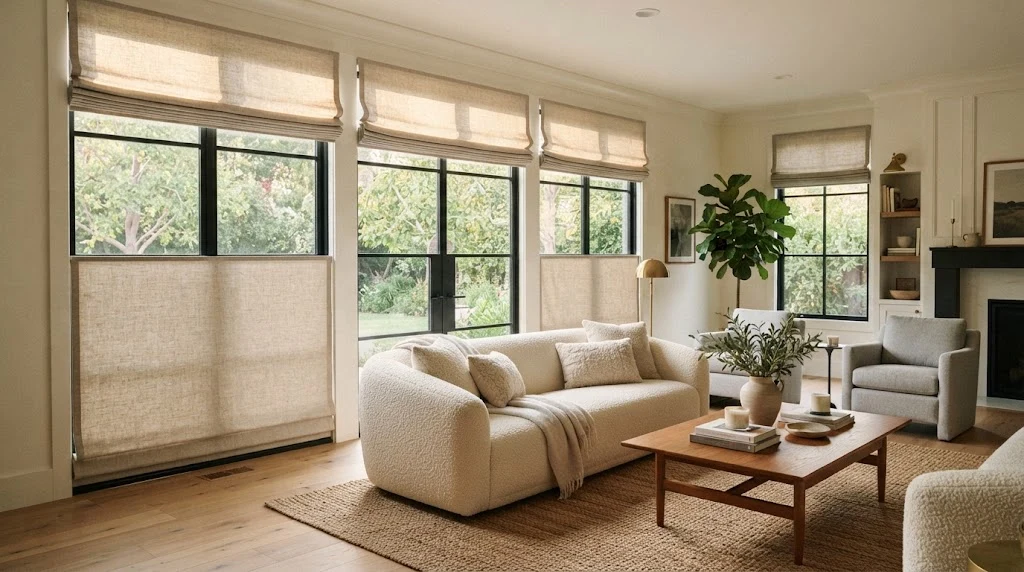
Top-down bottom-up Roman shades use two rails instead of one. You can lower the top rail to let in light while the bottom stays closed for privacy, or raise the bottom rail like a normal shade. Both rails move independently, so you get full control over light and privacy in every room.
Picture this. You wake up, and the first thing you want is soft morning light without your neighbors getting a clear view of your bedroom. A regular shade forces you to pick one or the other. Top-down bottom-up Roman shades solve that problem, and once you understand how they work, you will wonder why every window in your house does not have them.
This guide walks through what these shades are, how they operate, where they work best, and what to think about before you buy.
What Are Top-Down Bottom-Up Roman Shades?

A standard Roman shade only moves one way. You pull it down from the top, and it stacks in soft folds as it rises back up. That is fine for basic coverage, but it does not give you much say over which part of the window stays covered.
Top-down bottom-up Roman shades add a second rail. One rail sits at the top of the window, and the other sits at the bottom. Fabric stretches between them, so no matter where you position each rail, the shade always looks tidy and intentional. You can drop the top rail a few inches to let sunlight spill in above eye level while the bottom rail stays put for privacy. Or you can raise the bottom rail to open the lower half of the window while the top stays shut.
This is why people sometimes describe them as two shades in one. You are not choosing between light and privacy anymore. You get both, adjusted to exactly where you need them.
How Top-Down Bottom-Up Roman Shades Work

The mechanism is simpler than it sounds. Each rail connects to its own set of cords or a spring-loaded lift, and both rails ride along the same track so they never twist or bunch up. When you lower the top rail, the fabric above it folds down neatly, opening a gap at the top of the window. When you raise the bottom rail, the fabric below it lifts and stacks, just like a normal shade closing from the bottom.
Because the fabric stays tensioned between the two rails at all times, the shade never looks sloppy or half-finished. You can stop at any height on either end, and the folds hold their shape.
Most manufacturers recommend a specific order when you operate the shade. Lower the bottom rail fully before you touch the top one. Pulling the top rail straight down without adjusting the bottom first can cause the fabric to bunch unevenly. Once you get used to the sequence, it becomes second nature.
Why People Choose Top-Down Bottom-Up Roman Shades
The biggest draw is control. You decide exactly how much of the window stays covered and which section lets light through. That matters more than people expect once they live with a shade like this for a few weeks.
Street-facing windows are a common example. A single-family home with a bedroom facing the sidewalk usually deals with a tradeoff: keep the shade down all day for privacy and lose natural light, or open it and lose privacy. With a top-down bottom-up shade, the bottom half stays closed so passersby cannot see in, while the top half opens to let daylight fill the room.
Furniture protection is another reason people bring up. Direct sun fades upholstery, wood, and flooring over time. Dropping the top rail partway blocks the harshest overhead light while still letting the room breathe, which helps furnishings last longer without turning the space dark.
There is also a simple comfort factor. Fully closed shades can make a room feel boxed in, especially during the day. Being able to open just the top section keeps a room feeling airy and connected to the outdoors, even when you need privacy below.
Best Rooms for Top-Down Bottom-Up Roman Shades
Bathrooms are a natural fit. Most people want daylight in a bathroom, but almost nobody wants a clear view in from outside. Lowering the top rail brings in soft light while the bottom stays fully covered.
Bedrooms benefit for similar reasons. At night, you can close the shade completely for full privacy and blackout coverage. In the morning, dropping the top rail lets in gentle light without exposing the room to neighbors or the street.
Living rooms and kitchens work well too, especially in homes where the windows face a yard, patio, or busy street. You get natural light through the top of the window while keeping the lower half private from anyone walking by.
Home offices deserve a mention as well. Glare on a computer screen is a real annoyance, and top-down bottom-up shades let you block the lower half of a window where sun typically hits a desk, while still keeping the room bright overall.
Cordless, Corded, and Motorized Options
You will run into three main ways to operate these shades, and the right one depends on your household and your windows.
Cordless versions use a spring-loaded mechanism built into each rail. You simply push or pull the rail by hand to the height you want, and it holds there. Because there are no dangling cords, cordless shades are the safer choice for homes with young children or pets, and most window covering brands now recommend them as the standard option for that reason.
Corded shades use a continuous cord loop to move each rail. They tend to handle larger or heavier fabric better, which makes them a good pick for wide windows. If you go this route, always install the safety tensioner that comes with the shade, since it keeps the cord anchored and out of reach.
Motorized shades take things a step further. A remote, wall switch, or smart home app moves the rails for you, which is especially handy for tall windows or skylights you cannot easily reach. Many people also set up automatic schedules, so the shade opens at sunrise and closes at sunset without any manual effort.
Materials and Style Choices
Roman shades come in a wide range of fabrics, and the material you pick changes both the look and the function of the shade. Light-filtering fabrics soften sunlight and reduce glare while still letting the room feel bright. Blackout fabrics block nearly all outside light, which makes them a strong choice for bedrooms or media rooms where you want full darkness.
Fold style matters too. Flat folds give a crisp, tailored look that suits modern or transitional rooms. Soft folds have a more relaxed, drapery-like appearance that works well in traditional spaces. Woven wood and natural fiber options bring texture and warmth, and many of these now come with the top-down bottom-up feature built in.
Whatever fabric you choose, make sure it is rated for dual-rail movement. Not every material holds its shape well when tensioned between two moving rails, so it is worth checking with the manufacturer or retailer before you commit to a fabric you love.
Installation and Care Tips
Installation follows the same basic steps as any Roman shade, with a bit more attention paid to the second rail. Mount the bracket according to the manufacturer’s instructions, make sure the shade hangs level, and test both rails before you consider the job finished. Inside mounts give a cleaner, built-in look, while outside mounts offer better light blocking and cover more of the window frame.
Cleaning is straightforward. Dust or vacuum the fabric regularly using a low-suction attachment to keep debris from building up in the folds. If a spot appears, treat it with a mild detergent and let the fabric air dry fully before you raise or lower the shade again. Every few months, check the cords or lift mechanism to make sure everything still moves smoothly, and tighten or adjust as needed.
Cost and Buying Considerations
Prices vary based on fabric, size, and operating system. Cordless options usually cost a bit more than standard corded shades because of the added hardware in each rail, and motorized versions sit at the top of the price range once you factor in the motor and any smart home compatibility. Custom sizing also adds to the cost compared to off-the-shelf shades, but it is usually worth it for an exact fit, especially on oddly sized or oversized windows.
Before you buy, measure your window carefully and decide whether you want an inside or outside mount, since that changes the measurements you will need. Think through how you actually plan to use the shade in that room. A bedroom might call for a blackout fabric, while a home office might do better with something that filters light instead of blocking it completely.
Final Word
Top-down bottom-up Roman shades give you a level of control that a standard shade simply cannot match. You get to decide how much light comes in and from where, without giving up privacy in the process. Whether you go with cordless for child safety, corded for larger windows, or motorized for convenience, these shades adapt to how you actually live in each room. Once you try one, it is hard to go back to a shade that only moves one way.

Comments are closed.