
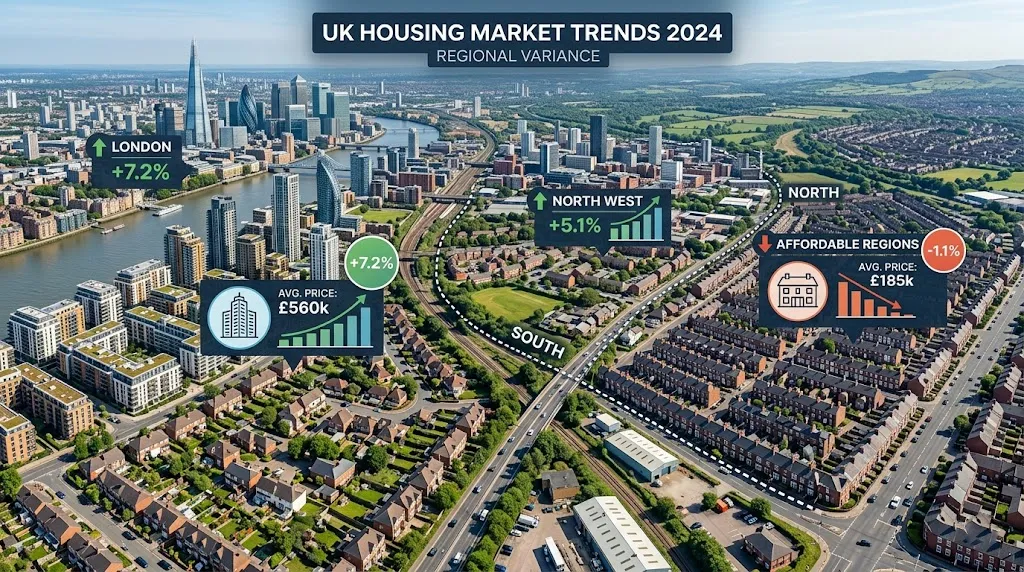
UK house prices continue to change in 2026 as different regions move in different directions. Some areas are getting more expensive, while others are slowing down or even falling. According to the latest data from the Zoopla House Price Index, the average UK house price is now £271,900, showing a small yearly rise of 1.5%.
This guide explains everything in simple English. You will learn about property types, regions, cheapest cities, most expensive cities, and which areas are growing or falling. Tables are included to make the data easy to understand.
What is happening with UK house prices in 2026?
The UK housing market is slowly stabilising after a period of slow growth and high mortgage rates. Prices are not rising fast, but they are also not falling sharply overall.
- Average UK house price: £271,900
- Yearly growth: +1.5%
- Monthly growth: +0.1%
- Quarterly growth: +0.6%
This shows a balanced market, where buyers and sellers are more evenly matched.
Some important trends include:
- Northern regions are growing faster
- Southern England is slowing down
- Flat prices are weaker compared to houses
- Demand for family homes is stronger
UK House Prices Overview Table (2026)
| Metric | Value |
|---|---|
| Average UK house price | £271,900 |
| Annual growth | +1.5% |
| Monthly growth | +0.1% |
| Strongest region | Northern Ireland (+6.9%) |
| Weakest region | South East (-0.2%) |
| Most expensive city | Prime Central London (£978,700) |
| Cheapest city | Hull (£116,400) |
| Fastest growing city | Belfast (+6.2%) |
| Weakest city | Hastings (-3.1%) |
UK House Prices by Property Type
Different types of homes are performing differently in the market. Some are growing faster, while others are losing value.
Key points:
- Semi-detached homes are performing the best
- Flats are the weakest segment
- Detached and terraced homes are stable
Property Type Table
| Property Type | Average Price | Yearly Change |
|---|---|---|
| Detached houses | £458,700 | +1.7% |
| Semi-detached houses | £281,800 | +2.5% |
| Terraced houses | £241,600 | +1.7% |
| Flats & maisonettes | £193,000 | -1.3% |
| All properties | £271,900 | +1.5% |
Simple Explanation
People now prefer homes with more space. After COVID-19, many families want gardens and extra rooms. That is why flats are not performing well in many cities, especially in London and the South East.
UK House Prices by Region
The UK is divided into different regions, and each region is performing differently.
Key trends:
- North is growing faster
- South is slowing down
- London is flat
Regional Table
| Region | Average Price | Growth |
|---|---|---|
| North East | £151,100 | +3.4% |
| Scotland | £174,400 | +3.0% |
| Northern Ireland | £194,300 | +6.9% |
| Yorkshire & Humber | £194,000 | +2.3% |
| North West | £208,300 | +3.6% |
| Wales | £210,800 | +2.5% |
| East Midlands | £233,000 | +1.6% |
| West Midlands | £238,000 | +2.1% |
| South West | £311,500 | +0.1% |
| East of England | £338,700 | +0.8% |
| South East | £384,100 | -0.2% |
| London | £529,500 | 0.0% |
Simple Explanation
Northern Ireland is the strongest region because it is still affordable. Buyers can still find cheaper homes compared to southern England.
London is very expensive, so growth is slow.
20 Cheapest Cities in the UK
Some cities in the UK still have very low house prices. These are mostly in the North and Scotland.
Key insight:
Even cheap cities are still growing slowly.
Cheapest Cities Table
| Rank | City | Price | Growth |
|---|---|---|---|
| 1 | Hull | £116,400 | +2.9% |
| 2 | Sunderland | £127,600 | +3.3% |
| 3 | Aberdeen | £130,000 | +1.1% |
| 4 | Dundee | £135,800 | +2.0% |
| 5 | Grimsby | £136,100 | +0.7% |
| 6 | Middlesbrough | £140,100 | +2.7% |
| 7 | Burnley | £141,200 | +5.4% |
| 8 | Blackburn | £152,100 | +6.0% |
| 9 | Stoke | £156,900 | +3.3% |
| 10 | Doncaster | £163,600 | +3.0% |
Simple Explanation
These cities are cheaper because:
- Lower demand
- More available land
- Lower salaries compared to the South
But many of them are now growing quickly due to affordability.
20 Most Expensive Cities in the UK
Some UK cities are extremely expensive, especially in the South.
Key insight:
Southern cities are expensive but growth is slow.
Expensive Cities Table
| Rank | City | Price | Growth |
|---|---|---|---|
| 1 | Prime Central London | £978,700 | -1.7% |
| 2 | London | £522,200 | -0.3% |
| 3 | Cambridge | £467,900 | -0.5% |
| 4 | Oxford | £450,000 | +0.6% |
| 5 | Crawley | £414,500 | +0.6% |
| 6 | Reading | £407,800 | -0.6% |
| 7 | Brighton | £393,700 | -1.0% |
| 8 | Aldershot | £392,300 | +0.5% |
| 9 | Southend | £355,300 | +1.1% |
| 10 | Bristol | £341,700 | +1.1% |
Simple Explanation
These cities are expensive because:
- High job opportunities
- Limited housing supply
- Strong demand from professionals
Fastest Growing UK Housing Markets
Some cities are growing much faster than others.
Top growth cities:
- Belfast
- Blackburn
- Burnley
- Rochdale
- Liverpool
Why are they growing?
- Homes are still affordable
- More first-time buyers
- Better transport links
- People moving from expensive cities
Growth Table
| City | Price | Growth |
|---|---|---|
| Belfast | £198,500 | +6.2% |
| Blackburn | £152,100 | +6.0% |
| Burnley | £141,200 | +5.4% |
| Rochdale | £186,900 | +4.8% |
| Liverpool | £169,700 | +4.5% |
Cities Where Prices Are Falling
Not all cities are growing. Some are falling due to high prices and low demand.
Key insight:
Most falling cities are in southern England.
Falling Cities Table
| City | Price | Change |
|---|---|---|
| Hastings | £263,700 | -3.1% |
| Worthing | £335,200 | -1.8% |
| Brighton | £393,700 | -1.0% |
| Bournemouth | £317,200 | -1.3% |
| Reading | £407,800 | -0.6% |
Simple Explanation
These areas are expensive, so buyers are slowing down. High mortgage costs also reduce demand.
Why UK House Prices Are Changing
There are 4 main reasons:
1. Interest Rates
Higher mortgage rates make buying more expensive.
2. Location Demand
North is cheaper, so demand is rising faster.
3. Supply of Homes
Some cities have too few homes, which increases prices.
4. Buyer Preferences
People want larger homes with space for working from home.
UK House Price Forecast for 2026
The market is expected to stay stable in 2026.
Expected trends:
- 1% to 3% growth overall
- Northern regions will grow faster
- London will stay flat
- Flats may remain weak
Simple forecast:
The UK housing market will not crash or boom. It will grow slowly and steadily.
FAQs About UK House Prices
What is the average UK house price in 2026?
The average price is around £271,900.
Which city is cheapest in the UK?
Hull is the cheapest city at £116,400.
Which city is most expensive?
Prime Central London is the most expensive at £978,700.
Are UK house prices rising?
Yes, but slowly. Growth is around 1.5% yearly.
Will house prices fall in 2026?
Some cities may fall slightly, but overall the market is stable.
Conclusion
The UK housing market in 2026 is balanced but divided. Northern cities are growing faster because they are more affordable, while southern cities are slowing down due to high prices.
Overall:
- Prices are stable
- Growth is slow
- Regional differences are very strong
If you are a buyer, understanding location trends is more important than ever before.

Comments are closed.