
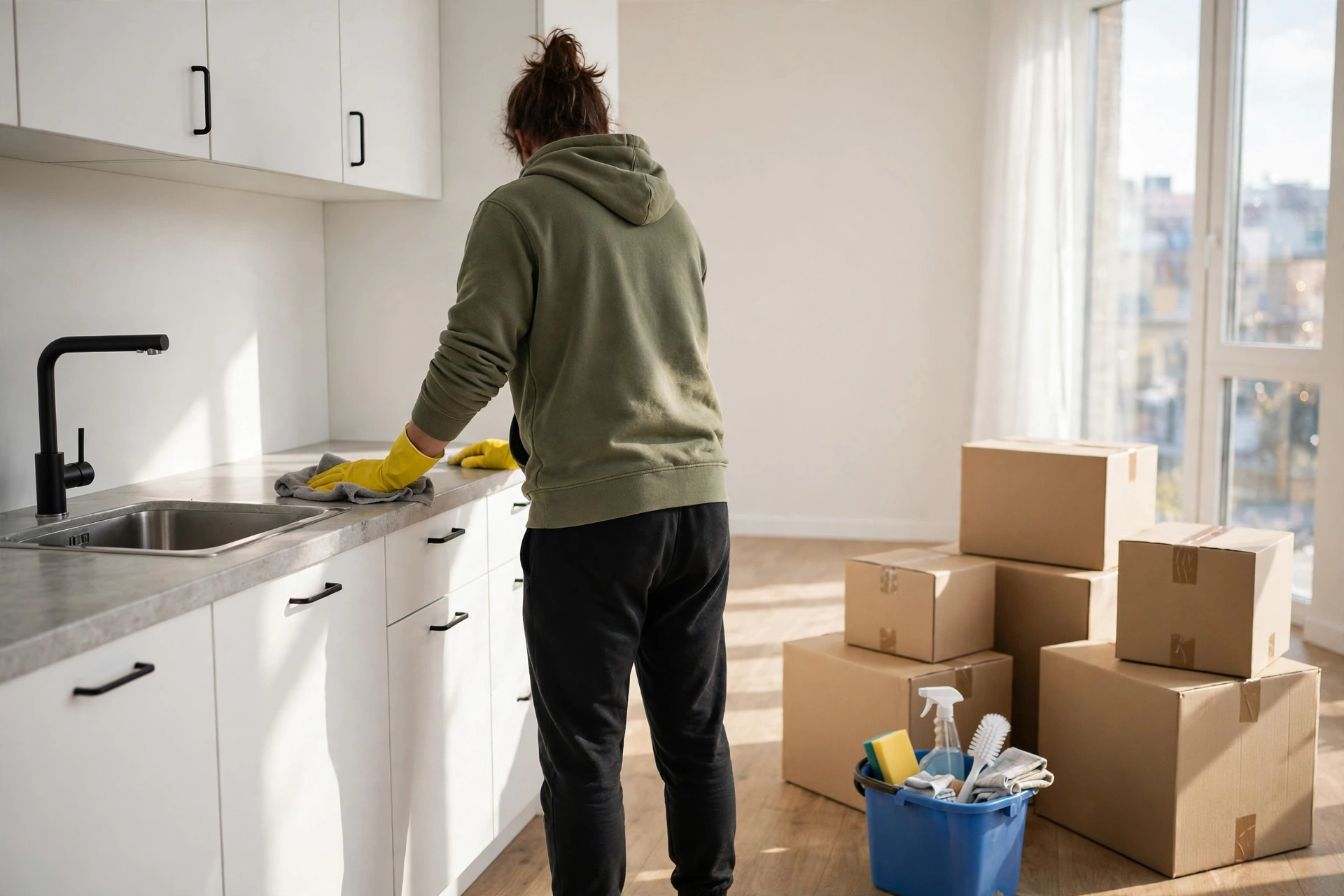
Moving out is expensive enough without losing part of your deposit over a dirty oven or a limescaled shower head. Cleaning is the top cause of deposit claims: the Deposit Protection Service (DPS) reported it accounted for 29.38% of deduction causes in 2025, the fifth year running, while the Tenancy Deposit Scheme (TDS) says cleaning featured in 54% of disputes reaching adjudication in the year to March 2025.
This checklist walks through every room the way an inventory clerk will, explains what the law actually requires, and sets out what a professional clean costs. It is written for renters in England and Wales; Scotland and Northern Ireland have their own deposit schemes and rules, noted where they differ.
Can your landlord make you pay for a professional clean?
No — not in England. Under the Tenant Fees Act 2019, landlords and letting agents cannot require you to pay for professional end-of-tenancy cleaning as a condition of your tenancy. The ban applied to new tenancies from 1 June 2019 and to all tenancies from 1 June 2020. A clause saying you “must have the property professionally cleaned”, must use a named company, or must produce a cleaning receipt is unenforceable, and charging a banned fee can carry a penalty of up to £5,000 for a first breach. Wales has broadly similar provisions under the Renting Homes (Fees etc.) (Wales) Act 2019.
What the Act did not do is remove the standard you have to meet. You must return the property in the same state of cleanliness recorded at check-in, allowing for fair wear and tear — and fair wear and tear applies to condition, not cleanliness. A carpet worn thin by years of use is wear and tear; a carpet stained by a spilled drink is not. If the property is returned dirtier than it was let, your landlord can still claim the reasonable cost of putting that right from your deposit, provided they can evidence it. A thorough DIY clean can meet the standard.
Before you start: dig out the check-in inventory
Your benchmark is not “spotless” in the abstract — it is the condition recorded when you moved in. Find the check-in inventory and schedule of condition, and the photos you took on moving-in day. Clean to that standard, room by room, and photograph everything again once you have finished. If the property was not professionally cleaned before you moved in, you cannot be held to a professional standard at check-out. Work through the property after your belongings are out, top to bottom, so dust falls onto floors you have not cleaned yet.
Kitchen checklist
The kitchen generates more deposit deductions than any other room, and the oven is the item inventory clerks flag most often. Budget most of your time here.
- Oven: clean inside including racks, trays and the glass door (both sides). Burnt-on grease is the most common complaint, so use an oven cleaner and leave it to work for the time stated on the label.
- Hob and extractor: degrease hob rings or the glass plate, clean the extractor hood and wash or replace the grease filter if your agreement says so.
- Fridge and freezer: empty, switch off, defrost the freezer, and wash shelves, drawers and door seals. Leave doors slightly ajar to prevent mould.
- Cupboards and drawers: empty everything and wipe inside and out, including handles and the tops of wall units.
- Worktops, splashback and sink: degrease, descale the taps, polish the sink and clean the drain and overflow.
- Other appliances: clean the microwave inside and out, wipe the washing machine drawer and door seal, and empty the dishwasher filter.
- Floors and walls: mop hard floors, wipe tiles and grout, and spot-clean marks on painted walls. Empty all bins.

Bathroom checklist
Bathrooms are judged on limescale, mould and grout. In hard-water areas, limescale builds up fast, and what looks like a stain to you reads as neglect on a check-out report.
- Bath, shower and basin: descale taps, shower heads and glass screens, remove soap scum, and clean the plugholes and overflow.
- Toilet: clean inside, outside and behind, including the cistern, seat hinges and the floor around the base.
- Tiles and grout: scrub grout lines and reseal any mouldy silicone only if it was already failing at check-in — otherwise clean it. Wipe down all tiles and mirrors.
- Mould: treat visible mould with a mould remover and ventilate the room. If mould is caused by a structural or ventilation problem, report it to your landlord in writing — damp caused by the building is not your cleaning bill.
- Extras: clean the extractor fan cover, empty and wipe bathroom cabinets, and mop the floor including behind the door.
Living areas and bedrooms
- Dust everything: shelves, skirting boards, windowsills, light switches, sockets, radiators and the tops of door frames and wardrobes.
- Walls and ceilings: remove cobwebs, wipe light fittings, and spot-clean marks. Do not paint over scuffs without asking — a mismatched patch can count as damage.
- Carpets and floors: vacuum thoroughly, including under furniture that stays, along edges and under radiators. Treat visible stains. Mop hard floors and remove scuff marks.
- Furniture that came with the property: wipe inside wardrobes and drawers, clean mirrors and glass, and leave beds stripped with the mattress vacuumed and stain-free.
- Curtains and blinds: dust or vacuum blinds, and wash curtains only if the care labels allow it and they were clean at check-in.
- Remove everything that is yours: check lofts, cupboards, sheds and under-stair storage. Anything left behind can be charged as removal costs.
Windows, doors and general
- Windows: clean inside glass, frames, sills and handles. External windows are usually the landlord’s responsibility in a block of flats, but ground-floor windows you can reach safely should be done.
- Doors: wipe doors, handles and hinges, and check that keys, fobs and remotes are all accounted for.
- Light bulbs: replace any blown bulbs with the correct type — a missing bulb is an easy deduction to avoid.
- Garden, balcony and outside areas: mow the lawn, trim hedges to their check-in state, sweep paths and patios, and remove all rubbish. Empty bins and return wheelie bins to their storage spot.
- Rubbish and recycling: remove every bag, including from cupboards, the loft and any outside store.
- Final walk-through: check every room against the inventory, test taps and lights, and leave heating on a low frost setting if you are leaving in winter.
DIY vs professional cleaning: what it costs
Doing it yourself costs little more than supplies and time. Budget around £45–£80 for cleaning products plus a carpet cleaner hire for a two-bedroom flat, according to a 2026 cost comparison by removalcompanies.reviews. The trade-off is a full day or two of hard work, and the risk that a missed oven or shower screen costs more in deductions than a cleaner would have charged.
A professional end-of-tenancy clean is priced as a fixed job, not by the hour, and most firms will return free of charge within a day or two if the agent flags anything — ask for that guarantee in writing. Average prices published by Checkatrade (updated August 2026) are:
- Studio flat: £180
- One-bedroom property: £220
- Two-bedroom property: £260
- Three-bedroom property: £300
London prices run higher — around £200 for a studio, £240 for a one-bedroom, £285 for a two-bedroom and £330 for a three-bedroom. Checkatrade’s broader house cleaning guide (October 2026) puts the overall range for an end-of-tenancy clean at £100–£500, averaging £300, depending on size and condition. Hourly rates, where charged, run £20–£25 outside London and £22–£27 in London. Always confirm what is included before you book: oven cleaning, internal window cleaning and carpet steam cleaning are common extras, with carpet cleaning typically adding around £35 per room.
Deposit disputes: how the schemes work
If you rent on an assured periodic tenancy in England — assured shorthold tenancies became periodic tenancies on 1 May 2026 — your landlord must protect your deposit in a government-approved scheme within 30 days of receiving it, and give you the prescribed information about where it is held. There are three schemes in England and Wales: the Deposit Protection Service (DPS), MyDeposits and the Tenancy Deposit Scheme (TDS). Scotland has its own three schemes — SafeDeposits Scotland, MyDeposits Scotland and the Letting Protection Service Scotland — and Northern Ireland has the Tenancy Deposit Scheme Northern Ireland and MyDeposits Northern Ireland, with different deadlines. Deposits in England are capped at five weeks’ rent where annual rent is under £50,000, and six weeks’ rent where it is £50,000 or more.
At the end of the tenancy, your landlord must return your deposit within 10 days of you both agreeing how much you get back — the clock runs from agreement, not from the day you hand over the keys. If you disagree about a deduction, the deposit stays protected in the scheme until the dispute is resolved. Every scheme runs a free dispute resolution service: both sides must agree to use it, both submit evidence, and the decision is final. Only around 1% of protected deposits ever reach formal adjudication — 46,950 cases out of 4,706,470 deposits protected in the year to March 2025, according to TDS. Your best protection is evidence: the check-in inventory, your moving-in photos, your check-out photos, receipts, and all correspondence in writing. Adjudicators decide on evidence, and they will not award a cleaning deduction without proof that the property was dirtier at check-out than at check-in.

The printable summary checklist
- Kitchen: oven, hob, extractor, fridge and freezer defrosted, cupboards inside and out, sink and taps descaled, floors mopped.
- Bathroom: bath, shower and basin descaled, toilet cleaned inside and out, grout and mould treated, mirrors and tiles wiped, floor mopped.
- Living areas and bedrooms: dusted top to bottom, walls spot-cleaned, carpets vacuumed and stains treated, wardrobes and drawers emptied and wiped, curtains and blinds cleaned.
- Windows and doors: glass, frames and sills cleaned, handles wiped, all keys, fobs and remotes accounted for.
- Floors: vacuumed and mopped throughout, including edges, under radiators and under furniture that stays.
- Garden and balcony: lawn mown, hedges trimmed, paths swept, all rubbish removed, bins emptied and returned.
- General: all personal belongings removed, loft, garage and sheds checked, blown bulbs replaced, final photos taken of every room.
Conclusion
An end-of-tenancy clean is not about impressing anyone — it is about matching, room by room, the condition recorded when you moved in, and being able to prove it. Clean the oven properly, descale the bathroom, photograph everything, and keep your paperwork. Most deposit disputes are avoidable, and the ones that do happen are decided on evidence. If your next move is towards buying rather than renting again, our UK Home Buyer Toolkit brings together the calculators you need, from affordability to stamp duty.


Comments are closed.