
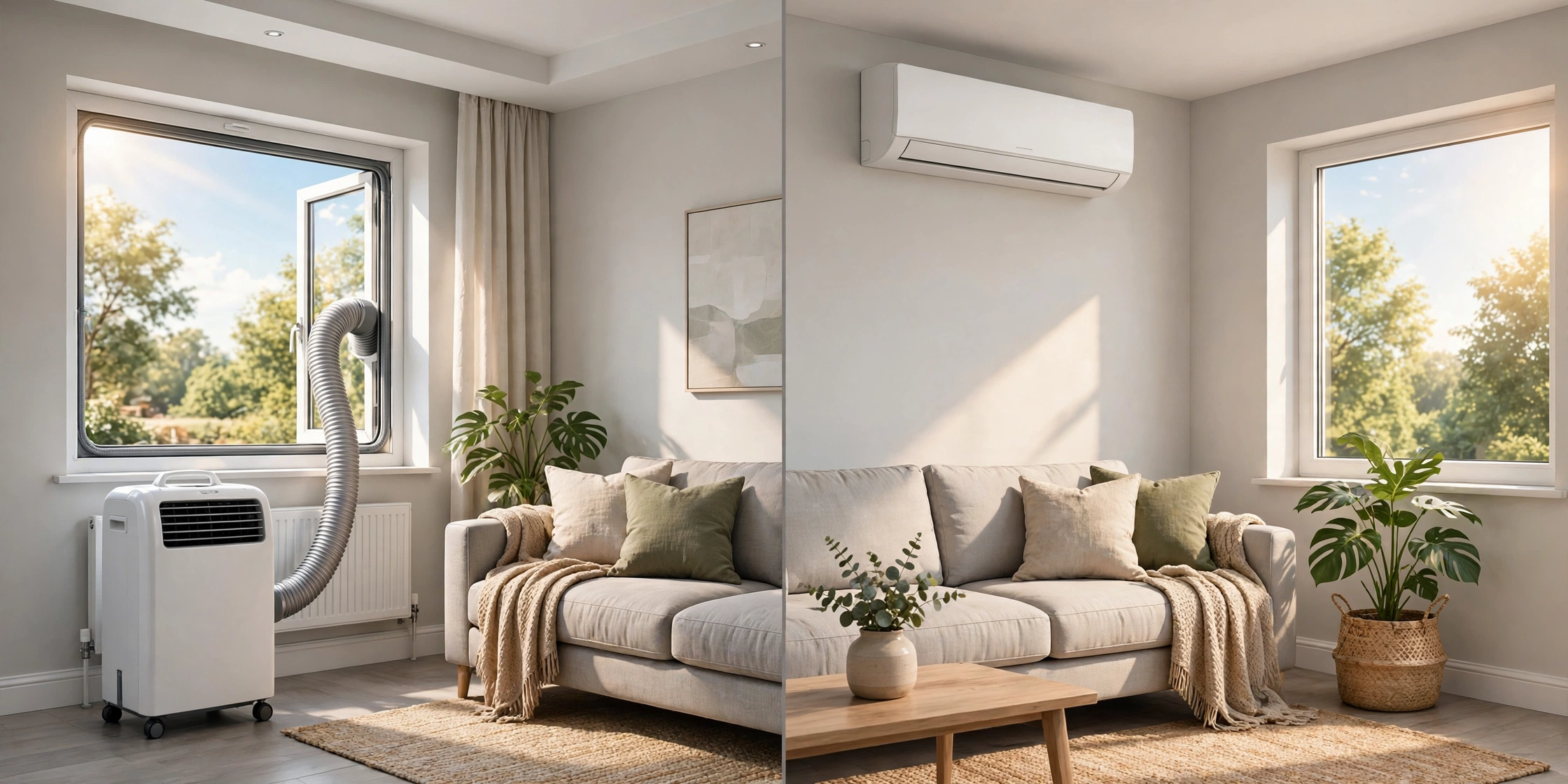
British summers are no longer a joke about three warm days and a thunderstorm. Summer 2026 was the warmest UK summer on record according to the Met Office, with 37 consecutive heatwave days somewhere in the UK and temperatures peaking at 38°C in June and 38.2°C in August. Most UK homes were never built with cooling in mind, so when the heat arrives, the question is no longer whether to cool your home — it is how.
For most households the choice comes down to two options: a portable air conditioner you wheel in and plug in, or a split system — a fixed wall-mounted unit with an outdoor condenser, professionally installed. They do the same job in very different ways, at very different prices. This guide compares them on upfront cost, running cost, cooling power, installation, noise and who each one suits, using 2026 UK prices.
How Each System Works
A portable air conditioner is a single box on wheels that sits inside the room. It cools the air, then pushes the hot air it has removed outside through a flexible hose, which you vent through a window using a sealing kit. The whole refrigeration system — compressor included — is inside the room with you.
A split system has two parts: a slim indoor unit mounted high on the wall, and an outdoor condenser unit that sits outside the house. The two are joined by sealed refrigerant pipework through the wall. The noisy, hot part of the system lives outdoors, while only the quiet cooling coil sits inside.
That one design difference explains almost everything else in this comparison. A portable throws some of the air it has just cooled out of the window through its hose, so warm air is constantly drawn back in through gaps around doors and windows. A split system keeps the hot side outside and throws away none of your cooled air, so it cools the same room using far less electricity.
Upfront Costs: What You Pay to Buy One
This is where the portable wins by a wide margin.
A portable air conditioner typically costs £200–£600 in the UK in 2026, according to MoneyMagpie’s July 2026 guide. Across a catalogue of 49 portable models checked in April 2026, prices ran from £256.99 to £3,999.95 with a median of £409.99. In practice, a decent small unit for a bedroom starts at around £200–£300, a mid-range model for a living room or home office at £300–£500, and a premium smart model at £500–£700 or more.
A single-room split system, professionally installed, typically costs £1,500–£3,000 fitted in the UK in 2026, according to Selectra’s 2026 figures and Airtasker’s cost guide. Checkatrade breaks it down further: a 12,000 BTU wall-mounted unit averages around £750, with installation labour averaging around £1,150 per unit (typically £960–£1,380). The Energy Saving Trust puts a single-room split at around £1,900 all-in. Prices run 20–30% higher in London and the South East, and rise further if the outdoor unit needs scaffolding, a long pipe run or a new electrical circuit.
A two-room multi-split system — one outdoor unit serving two indoor units — typically costs £2,800–£4,500 fitted.
| Portable air conditioner | Split system (one room) | |
|---|---|---|
| Unit price | £200–£600 | £750–£1,100 (unit only) |
| Installation | £0 — plug in and go | Around £960–£1,380 labour |
| Total upfront | £200–£600 | £1,500–£3,000 fitted |
If you are budgeting for a bigger home spend, it is worth running the numbers first — our affordability calculator shows what a home improvement budget looks like against your income and deposit, and the UK Home Buyer Toolkit brings together the stamp duty, affordability and mortgage tools in one place.
Running Costs: What It Costs to Use
The split system wins this round — by roughly two-thirds.
All running-cost figures below use the Ofgem price cap rate of 26.32p per kWh for 1 October to 31 December 2026. Your own tariff may be higher or lower, but the gap between the two types stays the same.
| Portable (2.6 kW, single hose) | Split (2.5 kW, bedroom) | Split (3.5 kW, living room) | |
|---|---|---|---|
| Electricity drawn | About 1.00 kW | About 0.38 kW | About 0.50 kW |
| Cost per hour | About 26p | About 10p | About 13p |
| Cost per 8-hour day | About £2.11 | About 81p | About £1.05 |
Those are worked examples from Be Cool Refrigeration, updated in November 2026. Which? testing found the average portable costs about 22p per hour on its highest setting, with a range of 17p to 31p. A 7,000 BTU portable comes in nearer 20p an hour; a 12,000 BTU portable nearer 32p an hour.
Put another way, a summer of realistic use — four hours a day for 60 days — costs roughly £63 in electricity for a portable and roughly £24 for a bedroom split. The reason is efficiency: split systems carry energy ratings of A++ or A+++, while portable units are usually rated A or below. A split draws roughly 0.5–0.8 kWh per hour; most portables draw 1.0–1.5 kWh per hour for the same cooling.
That said, keep the running cost in perspective. Even a portable used through a whole British summer typically adds only a few tens of pounds to your electricity bill. The purchase price is the bigger decision, not the running cost.
Cooling Power: What Size Do You Need?
Both types are sized in BTU (British Thermal Units) — the higher the BTU, the bigger the room it can cool. As a rough guide for UK rooms:
| Room size | Portable | Split |
|---|---|---|
| Small bedroom, up to ~16 m² | 7,000 BTU | 2.0–2.5 kW (7,000–9,000 BTU) |
| Bedroom or home office, 16–26 m² | 9,000 BTU | 2.5 kW (9,000 BTU) |
| Living room, 20–30 m² | 12,000 BTU | 3.5 kW (12,000 BTU) |
A 9,000 BTU portable suits a 16–26 m² room, and a 12,000 BTU portable a 20–30 m² room, according to iHeat’s 2026 UK guide. An undersized portable will run constantly and never quite cool the room — and because single-hose portables leak cooled air out of the window, they struggle more than their BTU rating suggests in larger or south-facing rooms. A split system of the same nominal size cools more effectively, because none of its cooled air is wasted.
Installation: Plug In vs Professional Fitting
Portable: no installation at all. You wheel it into the room, fit the window sealing kit, plug it in and switch it on. When the heatwave ends, you roll it into a cupboard. That is the portable’s biggest advantage — and the reason it is the only realistic option for many renters.
Split: a professional job. The refrigerant pipework must be handled by an F-Gas certified engineer — it is illegal for an unqualified person to work with refrigerants in the UK. The installer mounts the indoor unit, drills through the wall for the pipework, sites the outdoor condenser on a wall bracket or the ground, and commissions the system. You will also need a suitable electrical supply, and sometimes a new circuit.
There are extra rules if you live in a flat. If you are a leaseholder, your lease almost certainly requires the freeholder’s or managing agent’s written consent — usually a formal “licence for alterations” — before anything is fixed to the outside of the building. Separately, planning rules are stricter for flats than for houses: a cooling-only unit is excluded from permitted development, and since 29 May 2025 the permitted development right in England covers a unit that also heats, with limits (one unit per block of flats, up to 0.6 cubic metres). If you rent, you need your landlord’s permission for any fixed installation. A portable, by contrast, is an appliance, not an alteration — nothing is fixed to the building, so neither the lease nor planning law is engaged.

Noise: Can You Sleep Through It?
This is the difference you will notice every night. A portable keeps its compressor in the room with you, and most models run at 50–65 dB — roughly the level of a normal conversation at the quiet end, and a loud one at the top end. Some owners compare the sound to a lawnmower. A split system’s compressor is outside, so the indoor unit is far quieter, typically 19–45 dB — a whisper at the low end. If you want to cool a bedroom overnight, the split system is the clear winner.
Portable vs Split: Pros and Cons
| Portable air conditioner | Split system | |
|---|---|---|
| Upfront cost | £200–£600 | £1,500–£3,000 fitted |
| Running cost | ~26p/hour (9,000 BTU) | ~10p/hour (bedroom split) |
| Energy rating | Usually A or below | Usually A++ or A+++ |
| Installation | None — plug in | Professional, F-Gas engineer |
| Noise | 50–65 dB | 19–45 dB (indoor unit) |
| Moves between rooms | Yes | No — fixed to one room |
| Renter-friendly | Yes | Needs landlord/freeholder consent |
| Heats in winter | Some models, less efficiently | Most heat efficiently (reverse-cycle) |
| Best for | Occasional use, renters, one hot room | A room you cool every summer |
One extra point in the split system’s favour: most modern splits are reverse-cycle, meaning they heat as well as cool. In winter they work as an efficient air-source heater, so the system earns its keep all year. Some portables also heat, but less efficiently.
Which One Suits Your Home?
Choose a portable if:
- You rent, or you live in a flat where you cannot get consent for an outdoor unit.
- You only need cooling for a few weeks a year — a bedroom during heatwaves, or a home office.
- You want to move the cooling between rooms.
- Your budget is a few hundred pounds, not a few thousand.
- You are not sure you will stay in the home long enough to justify a fixed installation.
Choose a split system if:
- You own your home and cool the same room every summer.
- You want to sleep with the cooling on — the quiet indoor unit makes a real difference.
- You want the lowest running costs and the best efficiency.
- You would also like efficient heating in winter from the same unit.
- You are cooling a larger room or an open-plan space, where a portable would struggle.

If you live in a flat, the decision is often made for you: a portable is the option no freeholder can veto, while a split needs freeholder consent and a planning check. Leaseholders with a balcony or a usable external wall and written consent should go for a reverse-cycle split — typically £1,500–£2,500 fitted for one room. If there is nowhere for an outdoor unit at all, a monobloc system (no outdoor box) is the fallback, at around £2,000–£5,000.
The Verdict
For most UK homes, the honest answer is that a portable is the sensible buy and a split is the better machine. A portable costs a few hundred pounds, needs no permission and cools a bedroom through a heatwave for roughly £2 a day in electricity. A split costs £1,500–£3,000 fitted, needs a professional installer and possibly your freeholder’s consent — but it is quieter, cheaper to run, more efficient, and it heats your home in winter too.
If you only suffer through two or three hot weeks a year, buy the portable and spend the £1,000-plus you saved on something else. If you cool the same room every summer, sleep badly in the heat, or want a permanent, quiet solution, the split system pays for itself in comfort — and over several years, in running costs as well.
And if the upgrade is part of a bigger plan for your home, the UK Home Buyer Toolkit and our mortgage overpayment calculator can help you work out what the numbers look like before you commit.
FAQs
Can I use a portable air conditioner in a rented flat?
Yes. A portable is an appliance, not an alteration — nothing is fixed to the building, so you do not need your landlord’s permission to use one, and no planning permission applies. You only need a window for the exhaust hose.
Do I need planning permission for a split system in a flat?
Usually, yes — or at least a planning check. Flats have tighter rules than houses: a cooling-only unit is excluded from permitted development, and since May 2025 the permitted development right in England covers units that also heat, limited to one unit per block of flats up to 0.6 cubic metres. Separately, your lease will almost always require the freeholder’s written consent. Check both before you buy.
How much does a portable air conditioner cost to run?
At the Ofgem price cap rate of 26.32p per kWh (October to December 2026), a typical 9,000 BTU portable costs about 24p an hour, or about £1.90 for an 8-hour day. A whole summer of realistic use — a few hours a day through the hot weeks — typically adds a few tens of pounds to your electricity bill.
What size air conditioner do I need?
As a rough guide, a 9,000 BTU unit suits a 16–26 m² room and a 12,000 BTU unit a 20–30 m² room. If the room is south-facing, has large windows or poor insulation, go a size up. A split system of the same BTU cools more effectively than a portable, because it does not waste cooled air through a window hose.
Can a split system heat my home in winter?
Yes — most modern split systems are reverse-cycle, so they work as an efficient air-source heater in winter as well as a cooler in summer. That year-round use is a big part of the case for paying more upfront. Some portable models also heat, but less efficiently.

Comments are closed.