
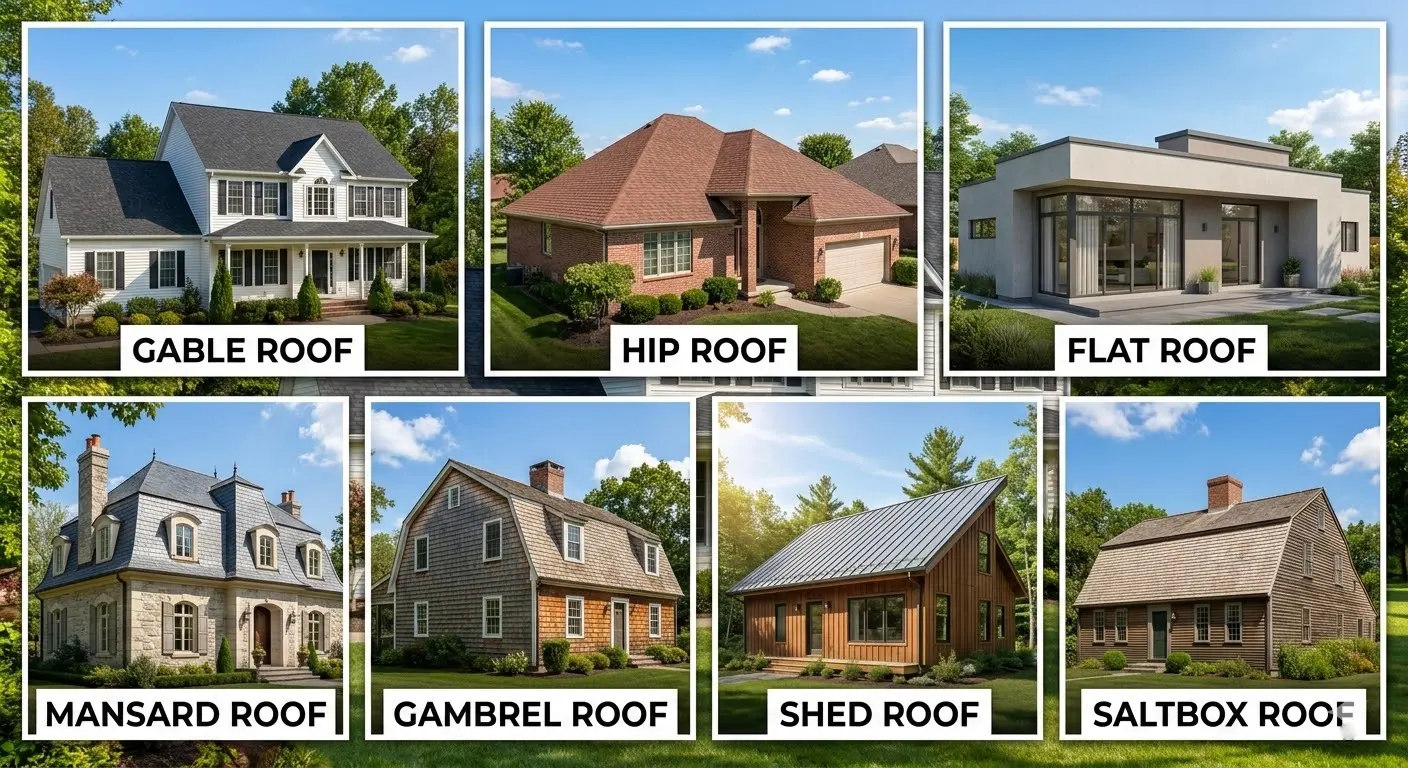
The most common roofing styles include gable, hip, flat, mansard, gambrel, shed, and saltbox roofs. Each type differs in shape, cost, and climate performance. Your local weather, budget, and home style are the biggest factors when choosing the right roof for your home.
Your roof does a lot more than keep the rain off your head. It shapes how your home looks from the street, affects how much energy you use, and plays a big role in how well your house holds up against whatever weather your region throws at it. Choosing the right roof style matters — and there are more options than most people realize.
Whether you’re building a new home, replacing an old roof, or just curious about the house down the street, this guide breaks down the most common roofing styles in plain language. You’ll learn what each style looks like, where it works best, and what trade-offs come with it.
Gable Roof

The gable roof is the one kids draw when they sketch a house. Two sloping sides meet at a ridge at the top, and the triangular sections at each end — called gables — are typically covered in siding. It’s the most common roof style in North America, and for good reason.
Gable roofs shed rain and snow well, allow for good attic ventilation, and are straightforward to build. That simplicity keeps construction costs lower than most other roof types. You can also use almost any roofing material — asphalt shingles, metal panels, wood shakes, or slate all work well on a standard gable.
The one weak spot is wind. The flat, triangular ends of a gable roof can catch strong gusts like a sail. In hurricane-prone areas, builders add extra bracing to compensate. If you live somewhere with frequent high winds or tropical storms, you might want to look at a hip roof instead.
Hip Roof

A hip roof slopes on all four sides, with each side angling down toward the walls of the house. There are no flat ends — just four sloping planes that meet at a ridge or, on square buildings, a single point at the top. This design is common in the suburbs and shows up frequently on bungalows, ranch-style homes, and houses in coastal or storm-prone regions.
The four-sided slope gives hip roofs better wind resistance than gables. Research using wind tunnel testing has shown that hip roofs — especially those on square footprints — handle extreme winds far better than their gable counterparts. Some insurance companies even offer premium discounts to homeowners in hurricane zones who have hip roofs.
The trade-off is cost and head space. Hip roofs are more complex to frame, which drives up labor costs. The sloping rafters on all sides also eat into usable attic space. If you want a lot of room in your attic, a gable or gambrel might serve you better.
Flat Roof

Flat roofs aren’t perfectly flat — they have a slight pitch, usually around 1/4 inch per foot, just enough to move water toward drains. You’ll find them most often on commercial buildings, apartment complexes, and modern-style homes. They’ve also grown in popularity for residential additions and garages.
One major advantage is usable rooftop space. Flat roofs can hold HVAC equipment, solar panels, green roofs, or even rooftop decks. They’re also cheaper to build than pitched roofs because they require less framing and fewer materials.
Drainage is the big concern. If water sits on a flat roof for too long, it can leak through the membrane and damage the structure below. Regular maintenance and high-quality waterproofing membranes — such as TPO, PVC, or EPDM — are essential. Flat roofs in snowy climates need extra attention because heavy snow buildup adds serious structural weight.
Mansard Roof

The mansard roof comes from France. It’s named after 17th-century French architect François Mansart, who made it famous. Each of the four sides has two distinct slopes — the bottom section is steep, almost vertical, while the upper section is much shallower. From street level, you mostly see the steep lower portion, and the house looks almost flat on top.
This design was originally a clever workaround. In Paris, buildings were taxed based on height up to the cornice line. A mansard roof let builders squeeze in a full livable floor — called a garret — above that line without triggering higher taxes. Today, the same principle applies: a mansard roof creates significantly more attic or upper-level living space than most other styles.
The steep lower slopes make it easy to add dormers, which bring in light and make the space feel more open. The downside is complexity and cost. Mansard roofs need more materials and skilled labor, which makes them one of the pricier options on this list. They’re a great fit if you want architectural character and extra square footage without expanding the building’s footprint.
Gambrel Roof

Think of a classic red barn and you’re picturing a gambrel roof. It’s a two-sided design — like a gable — but each side breaks into two different angles. The upper section near the ridge is relatively shallow, while the lower section near the eaves drops steeply. That break in angle is the key to what makes gambrel roofs special.
The steep lower slope creates far more usable space under the roof than a standard gable would at the same building width. Farmers figured this out centuries ago, which is why gambrel-style barns are still all over New England and the Midwest. On residential homes, that same principle translates into a large, open loft or attic area.
The weakness of a gambrel is weather resistance. The lower, steeper section can catch wind, and the angle where the two slopes meet requires careful flashing and waterproofing to prevent leaks. Heavy snow can also be problematic if the angle of the break causes ice dams to form. Gambrel roofs work best in mild climates where wind and snow aren’t major concerns.
Shed Roof

A shed roof is exactly what it sounds like — a single sloping plane that drops in one direction. It’s the simplest roof form you can build. Every rafter is identical, which means less waste, faster construction, and a lower price tag. Shed roofs started on outbuildings and home additions, but they’ve become a favorite in modern and minimalist residential architecture.
The single slope drains water efficiently, which makes it a practical choice in rainy climates. The steep end of the roof also creates a tall wall that’s ideal for windows or clerestory glazing, bringing natural light deep into the interior. Many builders use shed roofs specifically to face solar panels toward the sun while keeping the roofline clean.
Attic space is limited with a shed roof, especially on the low end where headroom disappears quickly. It also works best on smaller or simpler structures. On a large home, a single dramatic slope can look top-heavy or awkward unless the design is carefully worked out.
Saltbox Roof

The saltbox roof has a distinctly colonial American character. It looks like a gable roof where one side extends much further down than the other, giving the house a long, asymmetrical profile — similar in shape to the wooden salt boxes that colonial households once used for storing salt. This style appeared when homeowners added rear additions to their homes, and the original gable roof was simply extended to cover the new space.
The practical result is a home with more interior space than the footprint might suggest. The long rear slope creates a tall ceiling on one side and a low ceiling on the other, which suits a specific type of open floor plan well. Saltbox roofs shed rain and snow efficiently because of those steep slopes.
The asymmetrical shape does require careful interior planning. The low side of the roof limits headroom in those rooms, so you’ll want to put storage, bathrooms, or lower-traffic areas there. Saltbox homes work well in the Northeast, where the style has a long architectural history and the steep slopes handle heavy snowfall effectively.
How to Choose the Right Roofing Style for Your Home

Your climate is the starting point. If you live in a hurricane or high-wind zone, a hip roof is your safest bet. In heavy-snow regions, a steep-pitched gable or saltbox keeps snow moving off the roof before it builds up. In dry, warm climates, a flat roof is a reasonable and cost-effective option as long as drainage is properly designed.
Budget matters too. Gable and shed roofs are the most affordable to build because of their simple geometry. Hip roofs cost more because of the extra framing involved. Mansard and gambrel roofs sit at the higher end, both because of complexity and the volume of materials they require.
Finally, think about how the roof will look with your home’s exterior. A flat or shed roof looks sharp on a modern, minimalist design but can feel out of place on a traditional colonial. A mansard or gambrel fits naturally on period-style homes. Matching the roof to the architecture gives your home a finished, intentional look — and that pays off in curb appeal and resale value.
Comments are closed.