
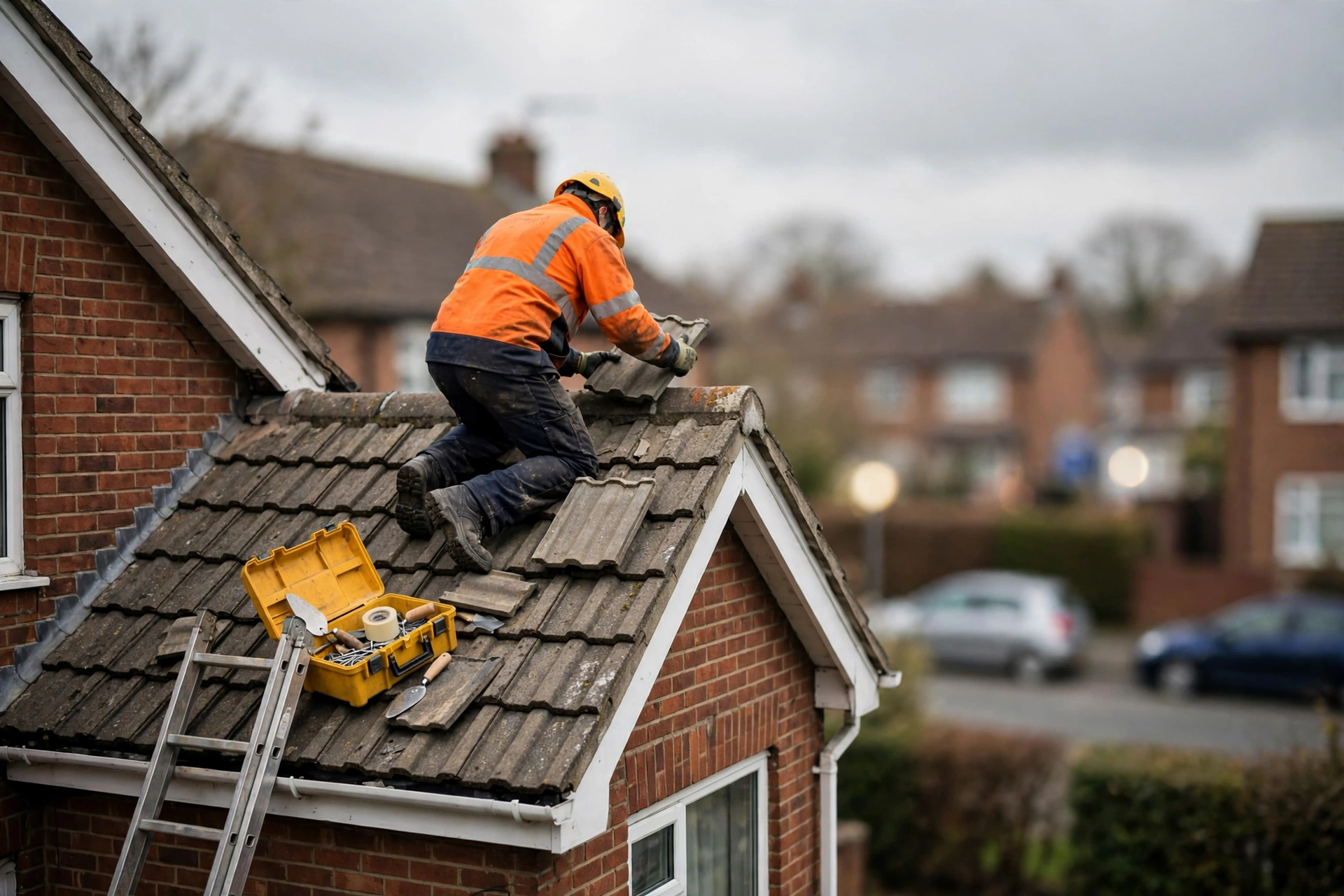
A leaking roof forces a decision most homeowners would rather put off: pay for a repair and hope it holds, or bite the bullet and replace the whole roof? The wrong call either way costs money — repair a failing roof and you pay for the same scaffolding again and again; replace a sound one and you have spent thousands you did not need to.
The answer depends on three things: how old your roof is for its material, how widespread the damage is, and what the structure underneath looks like.
The short answer
Repair when the damage is localised, the rest of the roof is sound, and the roof still has a good chunk of its expected life left — a few slipped tiles after a storm, a failed flashing, or one leak with a clear cause.
Replace when the damage is widespread, leaks keep coming back in different places, the felt and battens underneath are perishing, the roofline is sagging, or the roof is at or past the end of its material’s lifespan.
Roofers often use a rule of thumb: if the repairs you need add up to more than roughly 25–30% of what a full replacement would cost, replacement is usually the better long-term investment. Treat it as a guide, not a law — but it is a useful first check against any quote.
What roof repairs typically cost in the UK
Repair costs depend on the covering, the size of the affected area and — often the biggest factor — access. A job that needs scaffolding costs far more than the same job done from a ladder.
According to Checkatrade’s roof repair cost guide (table updated June 2026), typical repair rates per square metre for work covering up to 3 m², excluding VAT and access equipment, are £90–£120 for concrete tiles, £110–£160 for clay tiles, £150–£220 for natural slate, £100–£140 for a bitumen flat roof, £120–£170 for EPDM rubber and £130–£180 for GRP fibreglass. The same guide puts lead flashing repair at £50–£70 per metre, stepped lead flashing at £80–£120 per metre, dry ridge repair at £50–£70 per metre, and a rooflight replacement from £1,000. Replacing up to five roof tiles costs £170–£500, according to Checkatrade’s tile replacement guide (October 2026), with the top end reflecting jobs that need scaffolding.
MyBuilder (August 2026) bands jobs as minor (£100–£300), moderate (£500–£1,000) and major (£2,500+), while MyJobQuote (October 2026) puts the average roof repair at around £650. Most single repairs land in the hundreds, not the thousands.
What a full roof replacement costs
According to Checkatrade’s roof replacement guide (updated October 2026), the average cost of a roof replacement in the UK is around £8,000, with most homeowners spending between £4,000 and £19,000. The higher end reflects larger, more complex roofs such as slate hip roofs. Checkatrade’s figures are quoted plus VAT, so the bill on your quote will be higher once VAT is added.
By roof shape, Checkatrade gives £7,000–£16,250 for a gable roof (£110–£260 per m²), £9,250–£18,000 for a hip roof (£145–£285 per m²), and £2,800–£7,500 for a flat roof (£45–£120 per m²). By material, its installation guide (October 2026) puts supply and fit at £120–£230 per m² for concrete tiles, £160–£275 per m² for clay tiles, £160–£275 per m² for natural slate, and £50–£110 per m² for a flat roof. MyBuilder’s new roof guide (August 2026) gives a narrower typical range of £5,000–£12,000. The guides assume different roof sizes and coverings, so read them as a corridor, not a target, and get at least three written quotes for your own roof.
If you are weighing up the spend, our UK Home Buyer Toolkit brings together calculators for affordability, stamp duty and moving costs, which can help you judge how a big roof bill fits into your wider plans — especially if you are buying a home whose survey has just flagged roof work.
How long different roofs last
Age alone should never decide the question, but it is the most useful single clue. Published lifespans are ranges, not promises, and installation quality and exposure matter as much as the material.
| Covering | Typical UK lifespan |
|---|---|
| Natural slate | 80–100+ years (Welsh slate often 100+) |
| Clay tiles | 60–80 years (BRE minimum life expectancy: 60 years) |
| Concrete tiles | 40–60 years |
| EPDM rubber (flat) | 20–30 years, up to 50 if well fitted |
| GRP fibreglass (flat) | 25–40 years |
| Felt / bitumen (flat) | 10–20 years |
Sources: HomeBuilding (September 2025) for pitched coverings; Building Research Establishment via Marley for clay tiles; GreenSpec and Less for flat roof membranes. One caveat: the covering often outlasts its fixings — slate itself almost never wears out, the nails corrode first — so a roofer should check the underlay and battens from inside the loft, not just the tiles from outside.

Signs your roof can be repaired
A repair is usually the right call when:
- Damage is limited to one area — a few cracked or slipped tiles, one failed flashing, or a single leak with an identifiable cause.
- The rest of the roof is in good condition — tiles firmly fixed, a straight ridge line, no widespread wear.
- The underlay and battens are sound — no daylight showing through gaps in the loft, no perished felt, no soft battens.
- The roof is not old for its material — a 15-year-old concrete tile roof with storm damage is a repair; the same damage on a 55-year-old one may not be.
- The problem has a single, clear cause — storm-lifted tiles, a slipped slate or a cracked flashing are fixable faults, not system failures.
Signs your roof needs replacing
A replacement is usually the better investment when several of these appear together:
- More than 20–30% of tiles are cracked, slipped or missing — widespread failure means the covering is degrading as a whole.
- Leaks keep returning in different places — one fixed leak is a repair; repeated leaks point to a roof failing as a system.
- Daylight is visible in the loft — gaps, perished felt or missing underlay mean the waterproofing layer itself has gone.
- The roofline is sagging — dips or waves along the ridge usually mean rotten or weakened timbers. Get prompt professional advice; it will not improve on its own.
- Repairs are becoming a habit — call-outs several winters in a row often cost more, in total, than one planned re-roof.
- The roof is at or past its expected life — a felt flat roof over 15–20 years old or a concrete tile roof over 50, showing any sign above, is usually ready for replacement.
If you recognise three or more of these, get a professional inspection before spending anything on repairs — a reputable roofer will check the covering, underlay, battens, timbers and leadwork together, not just the symptom you noticed.
Repair vs replacement: side by side
| Factor | Repair | Replacement |
|---|---|---|
| Typical cost | £150–£1,500 for most jobs (MyBuilder, Aug 2026); £90–£220 per m² by covering (Checkatrade, Jun 2026) | Around £8,000 on average, typically £4,000–£19,000 (Checkatrade, Oct 2026) |
| Lifespan gained | Fixes the fault; the rest of the roof keeps ageing | Resets the clock: 40–100+ years pitched, 20–40 years modern flat roofs |
| Disruption | Usually a day or less; often no scaffolding | Scaffold 1–2 weeks; 3–7 working days on site for a standard semi (Checkatrade) |
| Building regulations | Rarely triggered for small repairs | Full re-roof usually needs sign-off and an insulation upgrade |
| VAT | 20% standard rate | 20% standard rate; fitted insulation 0% until 31 Mar 2027, then 5% |
| When it makes sense | Localised damage, sound structure, roof with life left | Widespread damage, recurring leaks, perished underlay, end of life |
The hidden costs: scaffolding, VAT and building regulations
Scaffolding can be the difference between a cheap repair and an expensive one. Checkatrade’s scaffolding guide (October 2026) puts scaffolding for a two-storey semi at £650–£1,100 per week, averaging £875, or £20–£25 per m². MyBuilder puts a full-wrap scaffold for a two-storey semi at £1,500–£2,600 for the hire period. Confirm whether erection, dismantling and the hire period are included — and whether the price includes VAT.
VAT is charged at the standard 20% rate on almost all roofing work when the firm is VAT-registered. The one real exception is fitted roof or loft insulation: under HMRC’s VAT Notice 708/6, installing energy-saving materials in a home is zero-rated until 31 March 2027, then moves to the reduced 5% rate. That relief covers the insulation element only — tiles, labour and scaffolding stay at 20%.
Building regulations apply to most re-roofing even when planning permission does not. A like-for-like re-roof usually needs no planning permission under permitted development, unless the property is listed, is covered by an Article 4 direction, or the roof shape is changing. But re-covering more than 50% of a roof — or more than 25% of the building’s total external envelope — counts as renovating a thermal element under Approved Document L, and a full re-roof always crosses that line. The roof’s insulation must then be brought up towards current standards where practical (a target U-value of around 0.16 W/m²K), and the work signed off by a roofer on a competent person scheme such as CompetentRoofer, or through your council’s building control.

Will your insurance pay?
Home insurance covers sudden, unforeseen events — not roofs wearing out. Most buildings policies pay for roof damage caused by a storm, a falling tree or an impact, including the water damage that follows. They will not usually pay for leaks caused by wear and tear, gradual deterioration or perished felt. That distinction — sudden event versus slow decline — decides almost every roof claim.
The Association of British Insurers defines a storm as gusts of at least 55mph, rainfall of at least 25mm per hour, snow of at least 30cm in 24 hours, or hail heavy enough to damage hard surfaces, and insurers often check weather records for your postcode. If a claim is refused, complain formally in writing — the insurer has eight weeks to send a final response, and you then have six months to take the complaint to the Financial Ombudsman Service, which asks whether storm conditions occurred, whether the damage is consistent with storm damage, and whether storm conditions were the main cause.
If storm damage is the cause, talk to your insurer before authorising work, and keep photos and a roofer’s report on the cause. If the roof simply wore out, the bill is yours either way — all the more reason to choose the option that lasts.
How to decide
- How old is the roof, and what is it made of? A roof in the last quarter of its expected life is a replacement candidate.
- How much of it is damaged? Under 20% and localised leans repair; over 30% and spread across slopes leans replacement.
- What is underneath like? Sound battens and underlay support a repair; perished felt or rotten timbers do not.
- What will the repairs add up to? More than 25–30% of a replacement quote, and replacement usually wins on value.
- What else is coming? A re-roof is the cheapest moment to add insulation, fit solar panels or replace rooflights — each would need scaffolding on its own.
Get at least three written quotes with the same scope: covering, underlay, battens, flashings, scaffolding, waste removal, VAT treatment and building control sign-off. A cheap quote that omits scaffolding or insulation is not cheaper — it is incomplete. If you are buying and the survey flags roof work, factor the full replacement figure into your offer: our affordability calculator can help you see how the extra borrowing or cash reserve affects what you can comfortably spend.
Frequently asked questions
Can I just repair half a roof?
Yes — partial re-roofing of one slope is common when the other slope is sound. But re-covering more than 50% of the whole roof triggers Building Regulations, and the new slope’s insulation must meet current standards. Ask your roofer whether the remaining slope has enough life left to justify leaving it.
How long does a roof replacement take?
According to Checkatrade, a standard pitched roof on a semi takes 3–7 working days, a flat roof 2–4 days, and a large or complex slate roof 1–3 weeks. Scaffolding is usually up for one to two weeks in total. Work cannot safely continue in high winds or heavy rain, so winter jobs often run longer.
Does a new roof add value to a house?
There is no guaranteed uplift, and no reputable source puts a single figure on it. What a new roof reliably does is remove a survey flag that can delay or reduce a sale, since a roof at the end of its life is one of the first things buyers and surveyors look at.
The bottom line
Repair when the problem is small, local and clearly caused — and the roof has years left in it. Replace when the damage is widespread, the leaks keep coming back, or the structure underneath is failing. The cheapest option is rarely the lowest quote today; it is the one you do not have to pay for twice. Get the loft inspected, get three like-for-like quotes, and use the 25–30% rule as your sanity check.

Comments are closed.