
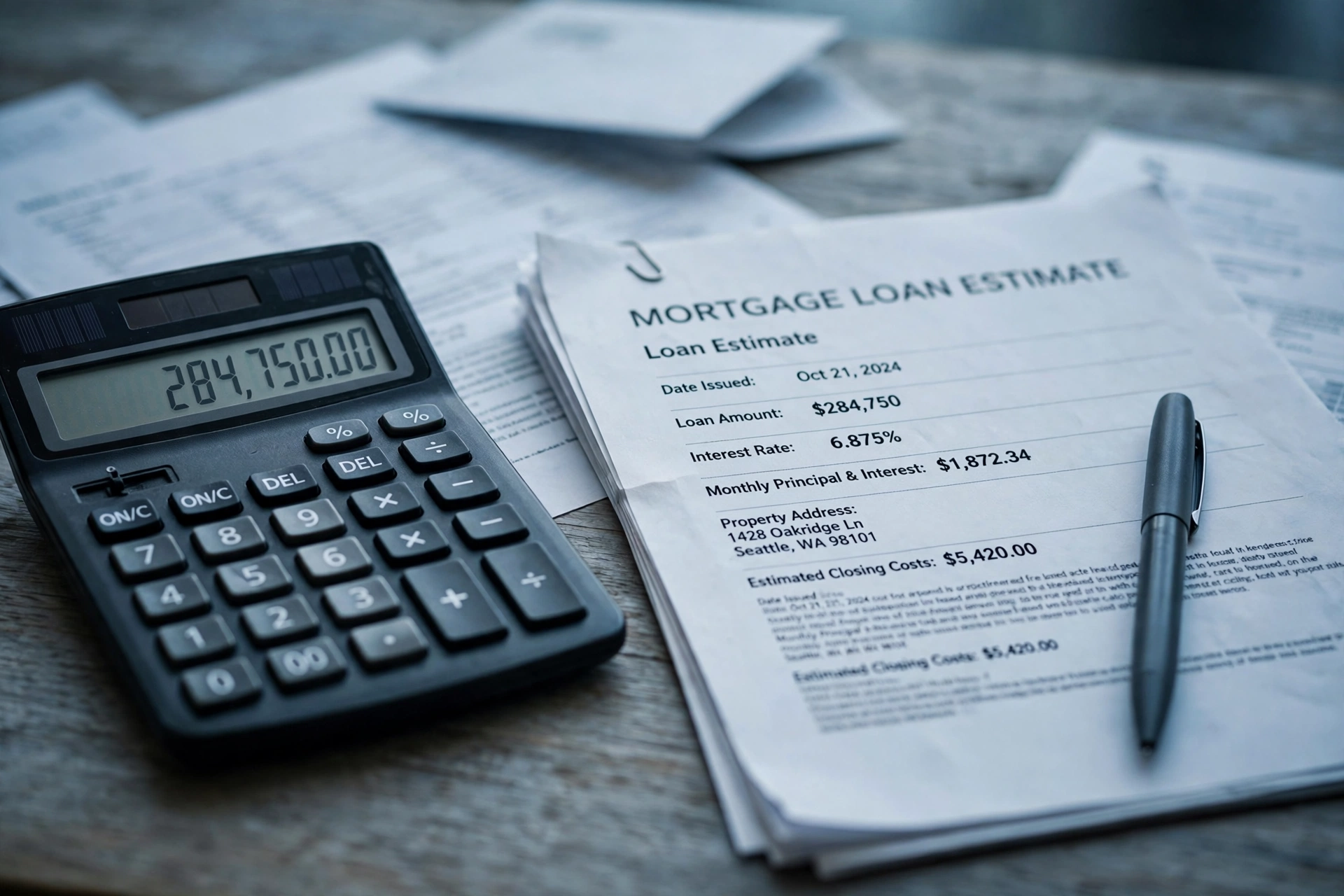
Earlier this month, the average five-year fixed mortgage rate in the UK touched 6% — the first time it has been at that level in nearly three years. The financial data provider Moneyfacts put the average at 5.99% in the latest figures published on 30 October, with the average two-year fix at 5.97%.
That is a long way from the cheap money of a few years ago, and it comes just days before the Bank of England’s next interest-rate decision on Thursday 5 November. Here is what the 6% moment actually means, why it happened, and what you can do about it — calmly, and without panic.
What 6% costs on a typical mortgage
Percentages are abstract; monthly payments are not. Take a typical example: a £250,000 repayment mortgage over 25 years.
- At 5.99% — the current average five-year fix — the monthly payment works out at roughly £1,609 a month.
- At 4.50% — closer to what many borrowers were paying on older deals — it is roughly £1,390 a month.
That is a difference of about £220 a month, or around £66,000 more interest over the life of the loan. These are illustrative figures using the standard repayment formula — your own payments depend on your loan size, term and exact rate — but they show why headlines about “average rates near 6%” matter more than they first appear.
It is also worth knowing that the average covers almost every deal in the market. Brokers note that many individual products still sit below 6%, and around 25 lenders were offering sub-5% fixed deals in mid-October, according to Moneyfacts. Your position depends on your deposit, your credit profile and which lenders you compare.
Why rates rose when the base rate did not move
One of the confusing things about this episode is that the Bank of England’s Bank Rate has not moved at all. It has been on hold at 3.75% since December 2025, and September’s Monetary Policy Committee meeting voted 6-3 to keep it there.
Fixed mortgage rates are not set by Bank Rate directly. They are priced off swap rates and gilt yields in the bond market — in effect, what it costs lenders to fund long-term lending. Since the US-Iran conflict escalated in the spring, those funding costs have jumped: the 30-year gilt yield briefly exceeded 6% in early October, its highest since 1998, on LSEG data.
That is why your mortgage got more expensive while the Bank of England did nothing. The base rate is currently the floor under mortgage costs rather than the ceiling.
Thursday’s decision: what could happen
The MPC announces its next decision on Thursday 5 November at 12:00 UK time, alongside its quarterly Monetary Policy Report. Three scenarios matter:
A rise to 4% (the market’s near-certain outcome). A Reuters poll of 63 economists taken on 12–14 October found 54 expecting a quarter-point rise to 4%, and money markets were pricing the odds above 90% after September inflation hit 3.5%. It would be the Bank’s first rate increase in more than three years. Several forecasters — including Capital Economics, Oxford Economics and Bank of America — also expect another rise early in 2027, taking Bank Rate to 4.25%.
A hold at 3.75%. It cannot be ruled out. Nine economists in the same Reuters poll expected no change, and the MPC’s job is to weigh inflation against growth, not to follow market pricing. A hold would likely be accompanied by tough language on inflation.
What a rise would do to your mortgage. If you are already on a fixed rate, nothing changes until your deal ends — your payment is locked. If you are on a variable or tracker deal, your rate could move within weeks. For new borrowers, much of the rise is already in fixed-rate pricing; lenders have been raising rates for weeks in anticipation.
Important framing: this decision is not made yet. Treat “near-certain” as a market forecast, not a fact.

The wider picture: prices stalling, pressure building
Two other data releases this week explain why the market feels stuck:
- House prices: Nationwide reported on 30 October that annual house price growth slowed to 0.5% — the slowest since January 2024 — with the average property at £273,566, flat on the month. Chief economist Robert Gardner said surveyors report new buyer inquiries remain weak.
- Borrowing: Bank of England figures for September showed mortgage approvals for house purchase fell to about 53,400, the lowest since December 2023 — a sign buyers are sitting on their hands.
And looking further ahead, the Office for Budget Responsibility warned this week that mortgage payments are expected to reach 4.25% of household disposable income by 2031 — the highest share since 2009, and more than double the 2% level of 2021. The average effective rate on outstanding mortgages is forecast to climb from 4% now to around 5% by 2031, as borrowers roll off cheaper fixed deals.
Five practical steps before Thursday
You cannot control the MPC’s vote. You can control your own position.
1. Check your current deal’s expiry date. Around 1.8 million fixed-rate mortgages are set to expire this year, according to industry analysis. If yours ends within six months, most lenders let you lock in a new deal early — typically up to six months ahead — and switch for free if a better deal appears before the old one ends.
2. Compare deals properly — rate versus fees. A deal at 5.6% with a £999 fee can be more expensive than one at 5.75% with no fee, depending on your loan size. Work out the total cost over the fixed term, not just the headline rate. Brokers have told the press that many sub-6% products remain available, so the average is not the ceiling of your options.
3. Look at overpayments. If you are stuck on a higher rate, overpaying even a small amount each month can cut the term and the total interest sharply. Our Mortgage Overpayment Calculator shows exactly what an extra £50 or £100 a month would do to your balance.
4. Don’t let a remortgaging window close by accident. Falling onto a lender’s standard variable rate — which averages 7.13% across the market — is usually the most expensive option. Set a reminder three to six months before your deal ends so you choose the switch rather than sleepwalking onto the SVR.
5. Talk to a mortgage adviser. This article is not financial advice. An independent adviser can compare the whole market, including deals you cannot get by going direct, and can help if your circumstances are complicated — self-employment, a small deposit, or a property with quirks.
For a broader view of what you can genuinely afford at these rates, try our Affordability Calculator and the UK Home Buyer Toolkit, which brings all our calculators together in one place.

Frequently asked questions
Will the Bank of England raise rates on 5 November?
Markets and most economists expect a quarter-point rise from 3.75% to 4% — 54 of 63 economists in the October Reuters poll — but the decision is not announced until 12:00 UK time on the day. Anything else is speculation.
Is 6% mortgage rate high by historical standards?
It is the highest average in nearly three years, but far below the 1980s and 1990s, when double-digit rates were normal. The pain now is relative: it follows a long period of cheap money, so the jump feels sudden.
Should I fix for two years or five?
There is no universal answer. Two-year deals are slightly cheaper on average (5.97% versus 5.99%) and keep you flexible if rates fall; five-year deals give certainty for longer. It depends on how you weigh security against flexibility — a good question for an adviser.

Comments are closed.