
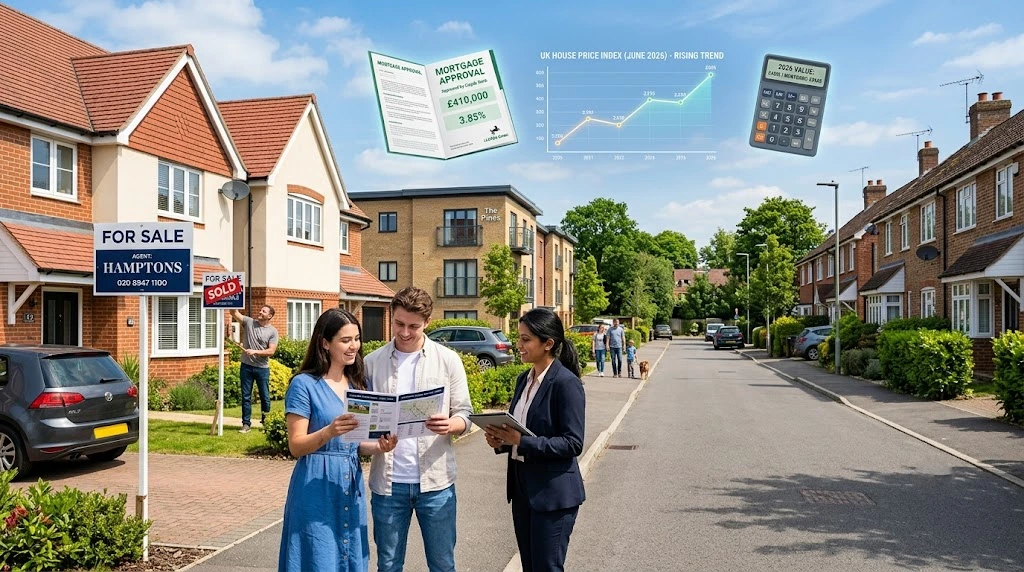
What is the average UK house price in June 2026?
The average UK house price is £271,900, which is 1.4% higher than June 2025. However, growth has slowed because higher mortgage rates have made borrowing more expensive.
The UK housing market continues to change as buyers and sellers adjust to higher mortgage costs and economic uncertainty. Even though the market has slowed compared to last year, house prices are still growing at a steady pace in many parts of the country.
According to the latest data, the average UK house price reached £271,900 in June 2026. This is 1.4% higher than the same time last year, showing that demand remains strong despite rising borrowing costs.
Many people are taking longer to make buying decisions because mortgage rates remain higher than they were at the beginning of the year. At the same time, buyers now have more homes to choose from, especially in southern England, giving them greater bargaining power.
The market also looks different depending on where you live. Northern England and Scotland continue to see healthy price growth, while London and some southern regions are experiencing slower sales and small price declines.
Whether you are buying your first home, planning to sell, or simply following the housing market, understanding the latest trends can help you make better decisions.
In this guide, you’ll learn:
- The latest UK house prices
- Why prices are still rising
- How mortgage rates affect buyers
- Which regions are performing best
- Which property types are selling fastest
- Expert predictions for the rest of 2026
- Practical tips for buyers and sellers
Key Takeaways
The table below highlights the most important facts from the UK House Price Index for June 2026.
| Market Indicator | June 2026 |
|---|---|
| Average UK House Price | £271,900 |
| Annual House Price Growth | 1.4% |
| Sales Activity | 7% lower than last year |
| Average Mortgage Rate | Around 4.8% |
| Buyer Demand | Lower than 2025 |
| Best Performing Regions | North East, North West, Scotland |
| Weakest Market | London and South East |
| Market Outlook | Moderate growth expected |
What Is the UK House Price Index?
The UK House Price Index (HPI) measures how much house prices change over time. It helps buyers, sellers, investors, and property experts understand whether the housing market is growing or slowing down.
Instead of looking at asking prices, the House Price Index focuses on the actual prices that homes are sold for. This gives a more accurate picture of the market.
Experts use information from completed property sales, mortgage valuations, and recently agreed sales to calculate the index each month.
The House Price Index answers important questions such as:
- Are house prices going up or down?
- Which regions are performing best?
- How expensive is it to buy a home?
- How fast is the market changing?
By following the House Price Index, buyers and sellers can make smarter decisions before entering the property market.
UK Housing Market at a Glance
Although market activity has slowed during the first half of 2026, demand for homes remains steady.
Many buyers are still looking for properties, but higher mortgage rates have increased monthly payments. Because of this, some people are waiting for interest rates to fall before buying.
Sellers are also facing a different market than they did a year ago. Homes that are priced correctly continue to attract buyers, while overpriced properties often stay on the market for much longer.
Overall, the housing market is becoming more balanced. Buyers have more choices, while sellers need to be realistic about pricing.
Average UK House Prices in June 2026
House prices vary depending on the type of property. Larger family homes continue to increase in value, while flats remain the weakest part of the market.
Average House Prices by Property Type
| Property Type | Average Price | Annual Price Change | Annual Growth |
|---|---|---|---|
| All Properties | £271,900 | +£3,720 | +1.4% |
| Flats & Maisonettes | £192,700 | -£1,160 | -0.6% |
| Terraced Houses | £241,300 | +£6,220 | +2.6% |
| Semi-Detached Houses | £281,200 | +£7,980 | +2.9% |
| Detached Houses | £457,900 | +£8,320 | +1.8% |
What Does This Mean?
The table shows that semi-detached homes recorded the strongest annual growth. These properties remain popular with families because they offer more space while still being more affordable than detached homes.
Detached houses also increased in value, although at a slower pace.
Flats were the only property type to record a yearly price decline. Higher borrowing costs have made it harder for many first-time buyers, who are the main buyers of flats.
Why Are UK House Prices Still Rising?
Many people expected house prices to fall sharply in 2026. Instead, prices have continued to rise, although much more slowly than in previous years.
Several important factors are helping to support the market.
1. Limited Housing Supply
The UK still does not have enough homes to meet demand.
Although more properties are available than last year, the overall supply of quality homes remains lower than the number of people looking to buy.
When supply is limited, prices tend to stay stable.
2. Strong Long-Term Demand
People continue to buy homes for many reasons.
Some buyers are starting families, while others need more space to work from home. Many investors also continue to see property as a long-term investment.
This steady demand helps support house prices even during slower markets.
3. Wage Growth
Average earnings have increased in many industries over the past year.
Although higher wages do not completely offset rising mortgage costs, they help some buyers afford larger monthly payments.
This has prevented a major drop in house prices.
4. Falling Mortgage Rates Since Spring
Mortgage rates climbed during the early months of 2026 before beginning to fall again.
Lower mortgage rates reduce monthly repayments, making home ownership more affordable.
If rates continue to fall during the second half of the year, buyer confidence could improve.
5. Better Choice for Buyers
Unlike the busy market seen after the pandemic, buyers now have more properties to choose from.
This creates a healthier market where buyers can compare homes, negotiate prices, and avoid rushed decisions.
While this slows price growth slightly, it also creates a more stable housing market.
House Price Growth Over the Past Three Months
The market has remained fairly stable during spring 2026.
| Month | Average UK House Price |
|---|---|
| March 2026 | £271,700 |
| April 2026 | £271,900 |
| May 2026 | £272,300 |
| June 2026 | £271,900 |
Although prices changed only slightly from month to month, the overall trend remains positive.
This stability suggests that the market is adjusting to higher borrowing costs rather than experiencing a major decline.
Why This Matters for Buyers and Sellers
Understanding the House Price Index can help you make better property decisions.
For buyers, it shows whether prices are rising or falling and helps identify good opportunities.
For sellers, it provides valuable information about local market conditions and realistic pricing.
Instead of relying on headlines alone, using market data allows both buyers and sellers to make informed decisions based on real trends.
How Mortgage Rates Are Affecting Home Buyers
Mortgage rates have been one of the biggest factors shaping the UK housing market in 2026.
At the beginning of the year, many mortgage deals were available at less than 4%. By April, average rates had climbed to almost 5%, making home loans much more expensive. Although rates have started to fall slightly, they are still higher than many buyers would like.
A higher mortgage rate means a larger monthly payment. Even a small increase can add hundreds of pounds to the yearly cost of owning a home.
For this reason, many buyers are taking more time before making an offer. They want to be sure they can comfortably afford their monthly repayments.
How Higher Mortgage Rates Affect Monthly Costs
| Region | Estimated Extra Monthly Cost |
|---|---|
| London | £244 |
| South East | £195 |
| East of England | £170 |
| South West | £150 |
| West Midlands | £125 |
| East Midlands | £115 |
| Yorkshire and Humber | £98 |
| North West | £82 |
| Scotland | £76 |
| North East | £69 |
The table shows that buyers in London have been affected the most. Because house prices are much higher, even a small rise in mortgage rates leads to a much larger monthly payment.
In contrast, buyers in the North East have seen a much smaller increase because homes are generally more affordable.
What Does This Mean for Buyers?
Higher borrowing costs have changed the way many people buy homes.
Instead of stretching their budget, many buyers are:
- Looking for smaller properties.
- Saving for a larger deposit.
- Comparing mortgage deals more carefully.
- Waiting for lower interest rates before buying.
Even with these challenges, many buyers are still moving forward because they need more space, want to stop renting, or are relocating for work.
Buyer Activity Across the UK
The UK property market remains active, but buyer confidence has weakened compared to last year.
Property experts estimate that sales agreed are around 7% lower than they were in June 2025. Buyer enquiries have also fallen as people become more cautious.
This does not mean buyers have disappeared. Instead, many are taking longer to make decisions.
Several factors have contributed to this slower market.
Main Reasons Buyer Activity Has Slowed
- Higher mortgage rates.
- Rising living costs.
- Economic uncertainty.
- Political changes.
- More homes available for sale.
Because buyers now have more choice, they do not feel pressured to make quick decisions. They often compare several properties before making an offer.
For sellers, this means pricing a home correctly has become more important than ever.
Regional House Price Comparison
Not every part of the UK housing market is performing the same way.
Northern regions continue to show stronger growth, while parts of southern England have experienced slower sales and weaker price growth.
House Price Growth by Region
| Region | Annual Price Growth | Market Activity |
|---|---|---|
| North East | 3.5% | Very Strong |
| North West | 3.4% | Strong |
| Scotland | 3.0% | Strong |
| Yorkshire and Humber | 2.6% | Healthy |
| West Midlands | 2.2% | Stable |
| East Midlands | 1.8% | Moderate |
| Wales | 1.3% | Slower |
| South West | 0.8% | Weak |
| East of England | 0.4% | Weak |
| South East | -0.3% | Slow |
| London | -0.2% | Slow |
Why Northern England Is Performing Better
Several reasons explain why northern regions continue to outperform southern areas.
First, homes are generally much more affordable. Buyers can purchase larger properties without taking on very high mortgage payments.
Second, demand remains steady because many families are moving to areas that offer better value for money.
Finally, housing supply remains limited in some northern towns and cities, helping to support prices.
Why London and the South Are Slower
London has experienced slower price growth for several months.
Higher property prices mean buyers need larger mortgages, and today’s higher interest rates make these loans much more expensive.
Many first-time buyers simply cannot afford these higher monthly payments.
As a result, sellers often need to lower their asking prices or wait longer to find a buyer.
Which Property Types Are Selling Fast?
Different types of homes are performing differently across the UK.
Family houses remain the strongest part of the market, while flats continue to face challenges.
Property Market Performance
| Property Type | Buyer Demand | Market Performance |
|---|---|---|
| Detached Houses | High | Strong |
| Semi-Detached Houses | Very High | Excellent |
| Terraced Houses | High | Strong |
| Bungalows | Moderate | Stable |
| Flats | Low | Weak |
Semi-detached homes continue to attract the greatest interest.
These properties offer enough space for growing families while remaining more affordable than detached homes.
Terraced houses also continue to perform well because they are popular with both first-time buyers and investors.
Detached homes remain desirable, although higher prices mean buyers often take longer to complete a purchase.
Why Are Flats Struggling?
Flats remain the weakest part of the housing market in 2026.
Many one-bedroom and two-bedroom flats have stayed on the market for longer than expected.
Several factors explain this trend.
Higher Costs for First-Time Buyers
Most flats are purchased by first-time buyers.
These buyers usually have smaller deposits and rely more heavily on mortgages.
Because borrowing has become more expensive, many first-time buyers have delayed their purchase.
Service Charges
Many flats include service charges and management fees.
These extra monthly costs make flats less attractive when household budgets are already under pressure.
More Choice
There are also more flats available for sale in many cities.
With increased supply, buyers have plenty of options and often negotiate lower prices.
Expert Market Analysis
Property experts believe the housing market is becoming more balanced after several years of rapid change.
During the pandemic, demand was extremely high, and homes often sold within days.
Today’s market is different.
Buyers are taking more time to compare properties, negotiate prices, and secure the best mortgage deal.
This creates a healthier market where prices grow at a more sustainable pace.
Experts also believe that falling mortgage rates could improve buyer confidence during the second half of 2026.
If average mortgage rates fall below 4.5%, more buyers are expected to return to the market.
However, if borrowing costs remain high, house price growth is likely to stay modest for the rest of the year.
What This Means for Buyers and Sellers
The current market offers opportunities for both buyers and sellers.
For buyers, there is more choice than there was a year ago. This means you can compare properties, negotiate prices, and avoid making rushed decisions.
For sellers, success depends on realistic pricing. Well-priced homes continue to attract interest, while overpriced properties may remain on the market for several months.
In today’s market, accurate pricing, good presentation, and patience are more important than ever.
UK Housing Market Outlook for the Rest of 2026
The UK housing market is expected to remain stable during the second half of 2026. While experts do not expect a sharp fall in house prices, they also believe that price growth will stay modest.
The biggest factor affecting the market will continue to be mortgage rates. If lenders reduce interest rates further, more buyers may return to the market. Lower monthly repayments would make buying a home more affordable, especially for first-time buyers.
However, if mortgage rates remain close to their current level, many buyers may continue to delay their purchases. This could keep house price growth slow for the rest of the year.
Another important factor is the UK economy. Inflation, employment levels, and government policies can all influence buyer confidence. A strong economy usually encourages more people to buy homes, while uncertainty often causes buyers to wait.
Overall, experts expect the market to remain balanced. Homes that are priced fairly should continue to sell, while overpriced properties may take longer to find buyers.
UK Housing Market Forecast for 2026
| Market Factor | Expected Trend |
|---|---|
| House Prices | Slow but positive growth |
| Mortgage Rates | Gradual decline expected |
| Buyer Demand | Likely to improve if rates fall |
| Property Sales | Stable with slight recovery |
| Best Performing Regions | North East, North West, Scotland |
| Weakest Markets | London and South East |
The market may not experience the rapid growth seen in previous years, but it is also unlikely to face a major downturn unless there is a significant economic shock.
Is Now a Good Time to Buy a Home?
Many people are asking whether 2026 is the right time to buy a property. The answer depends on your personal financial situation.
If you have a stable income, a good credit score, and enough savings for a deposit, this could be a good time to enter the market. Buyers now have more properties to choose from, and many sellers are willing to negotiate on price.
At the same time, it is important to compare mortgage deals carefully. Even a small difference in interest rates can save thousands of pounds over the life of a mortgage.
If you are unsure about your budget, speaking with a mortgage adviser can help you understand how much you can comfortably afford.
Reasons to Buy in 2026
- More homes are available for sale.
- Sellers are more open to negotiations.
- House prices continue to grow slowly.
- Mortgage rates have started to fall.
- Competition among buyers is lower than in previous years.
Reasons Some Buyers May Wait
- Mortgage rates are still higher than they were in early 2025.
- Monthly repayments remain expensive in some areas.
- Economic uncertainty may affect confidence.
- Some experts expect further mortgage rate cuts later in the year.
Tips for First-Time Buyers
Buying your first home is exciting, but it also requires careful planning. Here are some simple tips to help you make a smart decision.
1. Set a Realistic Budget
Know how much you can afford before you start looking at properties. Remember to include extra costs such as legal fees, surveys, moving expenses, and insurance.
2. Save a Larger Deposit
A bigger deposit can help you qualify for better mortgage deals and lower monthly repayments.
3. Compare Mortgage Offers
Do not accept the first mortgage offer you receive. Compare deals from different lenders to find the best interest rate and repayment terms.
4. Choose the Right Location
Think about schools, transport links, local shops, healthcare services, and future property values before choosing an area.
5. Arrange a Property Survey
A professional survey can identify hidden problems with a property before you buy it. Spending a little money on a survey can save you much more in future repair costs.
Tips for Home Sellers
Selling a property in today’s market requires careful preparation. Buyers have more choices than they did a few years ago, so making your home stand out is important.
Price Your Home Correctly
Setting a realistic asking price is one of the most important steps. An overpriced property may stay on the market for months, while a fairly priced home is more likely to attract serious buyers.
Improve First Impressions
Simple improvements can make a big difference. Keep your home clean, tidy, and well-lit for viewings. Fresh paint, small repairs, and a well-maintained garden can also increase buyer interest.
Be Flexible During Negotiations
Many buyers now expect some room for negotiation. Being open to reasonable offers can help you complete a sale more quickly.
Work with an Experienced Estate Agent
A knowledgeable estate agent understands local market conditions and can help you price and market your property effectively.
Frequently Asked Questions (FAQs)
1. What is the average UK house price in June 2026?
The average UK house price is £271,900, representing an annual increase of 1.4%.
2. Why have house prices slowed down?
Higher mortgage rates have increased the cost of borrowing, causing some buyers to delay purchasing a home. This has reduced demand and slowed price growth.
3. Which UK region has the strongest house price growth?
The North East continues to lead the market with annual house price growth of around 3.5%, followed closely by the North West and Scotland.
4. Are mortgage rates expected to fall?
Many property experts expect mortgage rates to decrease gradually during the second half of 2026. Lower rates could encourage more buyers to return to the market.
5. Is 2026 a good year to buy a home?
For buyers with stable finances and a suitable mortgage, 2026 can be a good time to buy. There are more homes available, and many sellers are willing to negotiate.
Final Thoughts
The UK House Price Index for June 2026 shows that the housing market is adjusting to higher borrowing costs rather than experiencing a major slowdown. Although buyer activity has eased, average house prices continue to rise at a modest pace, supported by steady demand and limited housing supply.
Regional differences remain clear. Northern England and Scotland continue to perform well thanks to stronger affordability, while London and parts of southern England face slower growth because of higher property prices and increased mortgage costs.
For buyers, today’s market offers more choice and greater negotiating power than in recent years. Taking time to compare mortgage options and choosing a home within your budget can help you make a confident purchase.
For sellers, realistic pricing is the key to success. Well-presented homes with competitive asking prices continue to attract serious buyers, even in a slower market.
Looking ahead, the outlook for the rest of 2026 remains cautiously positive. If mortgage rates continue to fall and economic conditions improve, buyer confidence is likely to strengthen, supporting a healthier and more balanced housing market.
Whether you are buying your first home, selling a property, or simply following the latest market trends, staying informed about the UK House Price Index can help you make smarter property decisions.


Comments are closed.