
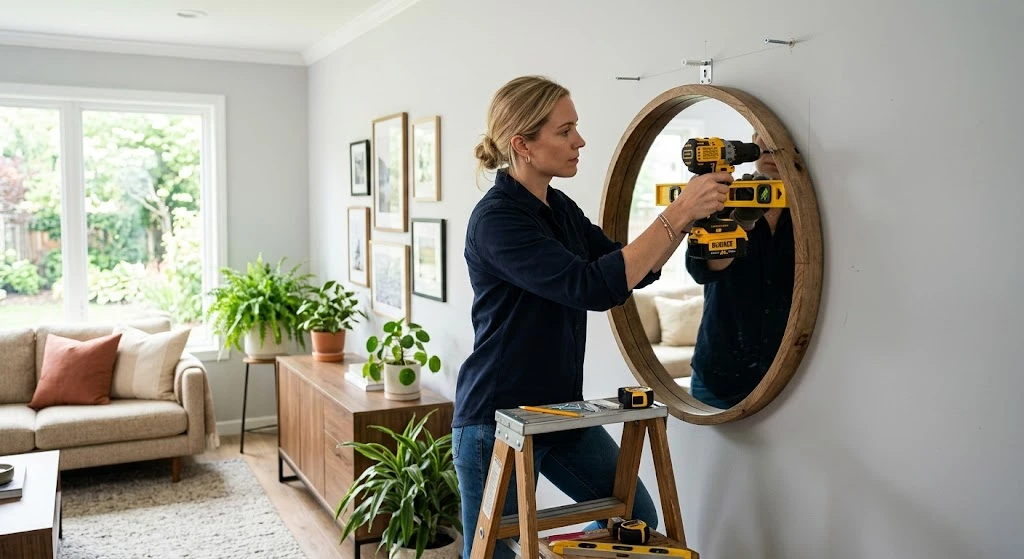
To hang a mirror safely, first identify your wall type — drywall, plaster, brick, or tile. Then weigh your mirror, choose the right anchor or hardware, mark the correct height (57 inches center from floor), and secure it using studs, toggle bolts, or masonry anchors based on your wall.
A mirror can change a whole room. It adds light, makes small spaces feel larger, and pulls a wall together. But hanging one wrong? That’s where things get messy — and dangerous. A mirror that falls doesn’t just shatter. It can damage your floor, crack your wall, and hurt someone standing nearby.
The good news is that hanging a mirror safely isn’t complicated. You just need to know what you’re working with before you reach for a drill.
Know Your Wall Type First

Before you buy any hardware, you need to figure out what your wall is made of. This one step saves you from buying the wrong anchors, making extra holes, or watching your mirror slide down the wall three weeks later.
Here’s a quick test: press a thumbtack into the wall. If it goes in easily, you have drywall. If it meets hard resistance, you’re likely dealing with plaster. If the surface is hard and you can see texture or exposed brick, you’re looking at masonry. Each wall type needs a different approach, and mixing them up is the most common mistake homeowners make.
How Much Does Your Mirror Weigh?

Weight changes everything about how you hang a mirror. A light decorative mirror under 10 lbs is easy to manage with basic picture hooks. A large bathroom mirror or a full-length framed piece can hit 50 to 60 lbs or more.
Check the product listing or the box for weight specs. If you don’t have those, set the mirror on a bathroom scale. That number tells you exactly which hardware to buy. As a general rule, a 24×60-inch wood-framed mirror weighs around 24 lbs, while a 72×48-inch mirror can reach 60 lbs or more. Knowing this upfront keeps you from guessing at the hardware store.
Hanging a Mirror on Drywall
Drywall is the most common wall material in homes built after the 1950s. It’s easy to work with, but it has limits. Plain drywall can support about 20 to 25 lbs on its own using standard anchors. Anything heavier than that needs to connect to a stud or use heavy-duty toggle bolts.
To find studs, use an electronic stud finder and run it along the wall. Studs are typically spaced 16 or 24 inches apart. If your mirror placement lines up with a stud, drive a wood screw directly into it — that’s your strongest option.
If no stud is available where you want the mirror, toggle bolts are your best bet. These have spring-loaded wings that open up behind the wall once inserted, spreading the load across a wider area. They’re rated to handle much more weight than standard plastic anchors, which you should avoid for anything heavier than a small decorative frame.
Self-drilling anchors are another solid option for mid-weight mirrors. They go straight into the drywall with a screwdriver — no pre-drilling needed — and expand as you tighten the screw.
Hanging a Mirror on Plaster Walls
Plaster walls show up mostly in older homes built before the 1950s. They’re harder and denser than drywall, which makes them trickier to work with. Driving a screw into plaster without the right prep often causes it to crack or crumble around the hole.
Use toggle bolts here too, but drill a clean pilot hole first. The goal is to get the wings behind the wall without disturbing the surrounding plaster. Some people also use molly bolts on plaster walls — these expand behind the surface when tightened and hold well for medium-weight mirrors.
Always check that your anchor is rated for the mirror’s weight. The rating is printed on the package. Don’t estimate — go slightly higher than the actual weight of your mirror to give yourself a safety buffer.
Hanging a Mirror on Brick or Concrete
Brick and concrete walls are the strongest surfaces you’ll work with, and they can hold a lot of weight. But drilling into them requires the right tools. A regular drill won’t cut it. You need a hammer drill and masonry drill bits to get a clean, solid hole.
Once you have your hole drilled, you have a few hardware options. Masonry anchors — also called expansion bolts or sleeve anchors — work well for most mirrors. You insert the anchor into the hole, and it expands against the masonry as you drive in the screw. For very heavy mirrors, wedge anchors offer even stronger holding power.
Concrete screws, sometimes called Tapcons, are another popular option. They tap directly into the masonry without needing a separate anchor. They’re clean, strong, and easy to use once you have the right drill bit.
One tip: drill your pilot hole about a quarter inch deeper than the anchor’s length. Clear the dust out of the hole before inserting the anchor — debris in the hole weakens the hold.
Hanging a Mirror on Tile
Tiled walls, common in bathrooms, require extra care. Drill into tile at the wrong speed or angle and you’ll crack it. Use a carbide or diamond-tipped drill bit made specifically for tile. Keep the drill at a low speed with gentle, steady pressure.
Aim your anchor point at the grout line when possible. Grout is easier to drill through than tile itself, and a cracked tile is much harder to fix than a cracked grout line. Once you’re through the tile and into the wall behind it, switch to the appropriate anchor for whatever’s behind — drywall, plaster, or masonry.
The Best Hanging Hardware for Heavy Mirrors
For heavier mirrors, your hardware choice matters as much as your anchor choice.
D-rings are metal loops attached to the back of the mirror frame. They connect to wall hooks and offer a secure, stable hang. Make sure both rings sit at equal distances from the top edge of the frame — uneven D-rings mean a crooked mirror.
Picture wire paired with D-rings works well for mirrors that need to hang level with some adjustment room. Use stainless steel braided wire rated for at least the mirror’s full weight, and ideally higher.
A French cleat is the strongest option for large, heavy mirrors. It’s a two-piece interlocking bracket — one piece mounts to the wall, the other attaches to the back of the mirror. When the mirror slides onto the wall piece, the angled edges lock together and distribute the weight evenly across the entire width of the cleat. This method also keeps the mirror perfectly flush to the wall and prevents it from swinging or tipping.
Measure Twice, Hang Once
The standard hanging height puts the center of the mirror at 57 inches from the floor. That’s roughly average eye level in most rooms. If you’re hanging the mirror above furniture like a console table or dresser, position its center point about 6 to 8 inches above the top of the furniture.
Mark your spot with a pencil, then use a level to confirm your hardware placement is straight before drilling anything. A two-foot level works well here. Taking five extra minutes at this stage saves you from having to fill holes and start over.
If your mirror hangs from two points, measure the distance between those points on the mirror itself, then transfer that exact measurement to the wall. Mark both points, check them with a level, and drill.
Common Mistakes to Avoid
The biggest mistake people make is trusting adhesive strips for anything over 10 lbs. Adhesive hooks feel solid at first, but heat and humidity — especially in bathrooms — wear down the bond over time. They work fine for small decorative mirrors, but skip them for anything substantial.
Another common error is using the plastic anchors that come in the box with the mirror. Manufacturers often include the most basic anchors to keep costs down. For heavier mirrors, upgrade to toggle bolts or self-drilling metal anchors that are rated for the actual weight.
Always test your installation before stepping away. Give the mirror a gentle tug after hanging it. If anything shifts or feels loose, take it down and re-examine the anchor. Better to catch it now than hear a crash at 2 a.m.
When to Call a Professional
Some mirrors are just too heavy or too complicated to hang alone. If your mirror weighs more than 75 lbs, hangs above a bed or couch, or sits on a wall you’re not confident about, bring in a handyperson or installer. The cost is small compared to a broken mirror or a patched wall.
Hanging a mirror safely comes down to three things: knowing your wall, matching your hardware to the weight, and measuring before you drill. Get those right, and your mirror will stay exactly where you put it.


Comments are closed.