
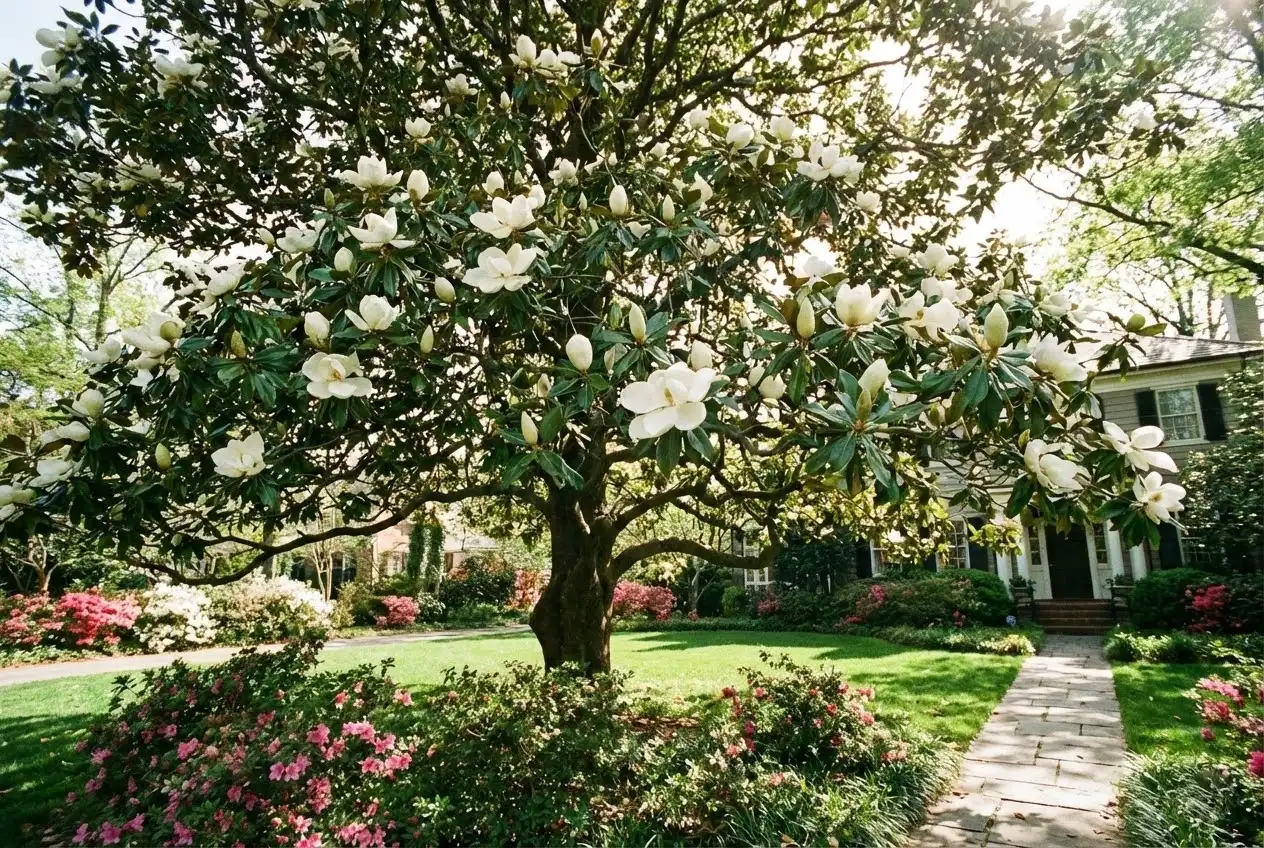
There are over 200 species of magnolia trees worldwide, divided into evergreen and deciduous types. The most popular include Southern Magnolia, Saucer Magnolia, Star Magnolia, Sweetbay Magnolia, and Little Gem. Each variety differs in size, bloom color, and climate preference.
Walk past a magnolia tree in full bloom and you’ll stop in your tracks. The flowers are big, the fragrance is strong, and the whole tree looks like it was put there just to make the neighborhood look better. It’s hard not to love them.
What surprises most people is that magnolias aren’t just one type of tree. There are over 200 species spread across the globe, and they come in all shapes and sizes — from compact 10-foot shrubs to towering 80-foot giants. Some keep their leaves all year. Some drop them every fall. Some bloom in late winter before any other tree wakes up from the cold.
Whether you’re planning your yard or just curious about what’s growing down the street, this guide covers everything you need to know about the most popular types of magnolia trees.
A Quick History of Magnolia Trees
Magnolia trees have been around for a very long time — we’re talking 100 million years. Fossils show that these trees existed before bees were even part of the picture. Back then, beetles did the pollinating, and many magnolia farms today still see beetles visiting the flowers at night.

There are eight magnolia species native to North America, and the rest come mostly from Asia. Over the centuries, plant breeders have crossed different species to create hundreds of hybrids, which is why you’ll find magnolias that thrive in places as cold as Minnesota and as warm as Florida.
Southern Magnolia (Magnolia grandiflora)

If you’ve ever seen a big, glossy-leafed tree covered in creamy white blooms the size of dinner plates, you’ve met the Southern Magnolia. This is the classic, the one most people picture when they hear the word “magnolia.”
It grows between 40 and 80 feet tall, making it one of the largest in the family. The flowers measure 8 to 12 inches across and bloom from late spring through early summer — sometimes popping up again in the fall. It’s an evergreen, so you get beautiful foliage year-round. It thrives in Zones 6 through 10 and does well across the American South.
Two popular cultivars are worth knowing: ‘Little Gem’ tops out around 20 to 25 feet, making it a great choice for smaller yards. ‘Bracken’s Brown Beauty’ grows to about 40 feet and has distinctive wavy-edged leaves with a rich brown underside.
Saucer Magnolia (Magnolia × soulangeana)

The Saucer Magnolia is one of the most widely planted ornamental trees in the world, and once you see it in spring, you understand why. The flowers open in a saucer shape — wide, cup-like blooms in shades of white, pink, and soft purple — before a single leaf appears on the tree.
This is a deciduous tree, meaning it drops its leaves in fall. It reaches 20 to 30 feet tall and wide, making it a strong focal point in any yard. It handles cold winters better than the Southern Magnolia and grows in Zones 4 through 9. If you live in the North and want a magnolia that can take the cold, this is one of your best options.
One thing to watch: late frost can damage the early blooms. Planting it on the north side of your home can slow bud development just enough to protect the flowers.
Star Magnolia (Magnolia stellata)

The Star Magnolia is the small one of the family — and it’s absolutely charming. It grows just 10 to 15 feet tall and wide, which makes it perfect for smaller gardens or as a standalone accent near a front door or walkway.
Its flowers are white or pale pink, with thin, strap-like petals that fan out like a star. They open in late winter and early spring, often before the snow is fully gone. That early bloom makes it one of the first signs of spring in colder climates. It grows in Zones 4 through 9, and it handles both partial shade and full sun well.
The ‘Royal Star’ cultivar is particularly popular. It’s disease resistant, cold hardy, and produces an impressive number of blooms even on a young tree.
Sweetbay Magnolia (Magnolia virginiana)

The Sweetbay Magnolia has a character all its own. The leaves have a silvery-white underside that catches the breeze beautifully, and the flowers carry a soft lemon scent that’s different from most other magnolias.
This tree grows 15 to 20 feet tall and can behave as either semi-evergreen or fully deciduous depending on your climate. In warmer zones it holds onto its leaves through winter, while in colder areas it drops them in fall. It thrives in Zones 5 through 10 and handles wet, boggy soil better than almost any other magnolia — something most trees can’t manage.
It’s a native tree found naturally from Massachusetts down to Florida, and it’s an underused gem in home landscaping. If you have a wet or low-lying spot in your yard, this is the tree to plant there.
Jane Magnolia (Magnolia ‘Jane’)

The Jane Magnolia is part of a group called the “Little Girl” hybrids, developed by the U.S. National Arboretum in the 1950s and 60s. It grows just 10 to 15 feet tall, making it a natural fit for compact gardens.
What makes Jane stand out are the flowers. They’re deep reddish-purple on the outside with a lighter pink-and-white interior, shaped like tulips, and they bloom in spring after most frost danger has passed. That late bloom time is a real advantage — it means the flowers usually survive late-season cold snaps that can wipe out early-blooming varieties.
It’s deciduous and grows in Zones 4 through 8. You’ll often see it re-bloom lightly through the summer, which is a bonus most magnolias don’t offer.
Loebner Magnolia (Magnolia × loebneri)

The Loebner Magnolia is a hybrid between the Star Magnolia and the Kobus Magnolia. It combines the best of both parents — the delicate, star-shaped flowers of one and the faster growth rate and larger size of the other.
This tree grows to about 15 to 20 feet and produces fragrant white or pink flowers in early spring before the leaves arrive. The popular ‘Merrill’ cultivar has pure white blooms and grows a bit taller than the others. ‘Leonard Messel’ shows soft pink flowers and has excellent frost tolerance.
It works well in Zones 4 through 9 and adapts to a range of soil types. If you want something that looks like a star magnolia but grows a little faster and bigger, this is the one to choose.
Cucumber Tree (Magnolia acuminata)

The Cucumber Tree is one of the most underrated trees in the magnolia family. It’s the hardiest of the group and one of the fastest growers, reaching 60 to 80 feet tall with a strong, straight trunk and a full, pyramidal crown.
The flowers are chartreuse to yellow-green, smaller than most magnolias, and they bloom in late spring. The fruits that follow are green, elongated, and cucumber-shaped — which gives the tree its name. They ripen to a bright red by late summer. It’s native to the eastern United States and thrives in Zones 3 through 8, making it one of the few magnolias that grows well in northern states like Michigan and Wisconsin.
If you want a large shade tree with magnolia roots and cold-weather toughness, the Cucumber Tree delivers.
Bigleaf Magnolia (Magnolia macrophylla)

The Bigleaf Magnolia holds a remarkable record: it produces the largest simple leaves and the largest flowers of any tree native to North America. The leaves can stretch up to 30 inches long, giving the tree a lush, tropical appearance even in temperate climates.
The flowers are white with purple markings at the base and can reach 10 to 12 inches across. They bloom in late spring and early summer. This is a deciduous tree that grows 30 to 40 feet tall and works best in Zones 5 through 8. It needs some space — both for its wide canopy and its extraordinary foliage — but if you have the room, it creates a genuinely dramatic landscape statement.
How to Choose the Right Magnolia for Your Yard
The right magnolia depends on three things: your climate zone, your available space, and when you want blooms.
For cold climates in Zones 4 and 5, the Star Magnolia, Jane Magnolia, and Cucumber Tree are the safest choices. If you’re in the warm South in Zones 7 through 10, the Southern Magnolia is the classic pick. For small yards anywhere, Little Gem or Jane Magnolia fit without overwhelming the space.
Most magnolias prefer full sun, slightly acidic soil, and good drainage. They don’t need much pruning — just remove damaged or crossing branches right after they finish blooming. Fertilize in spring if the tree looks pale or slow, but a healthy magnolia in good soil usually takes care of itself.
Plant one in the right spot and it’ll outlive you. Magnolia trees can live well over 100 years when they’re placed correctly. That’s not just a tree — it’s a long-term investment in your yard, your home, and frankly, your whole neighborhood.


Comments are closed.