
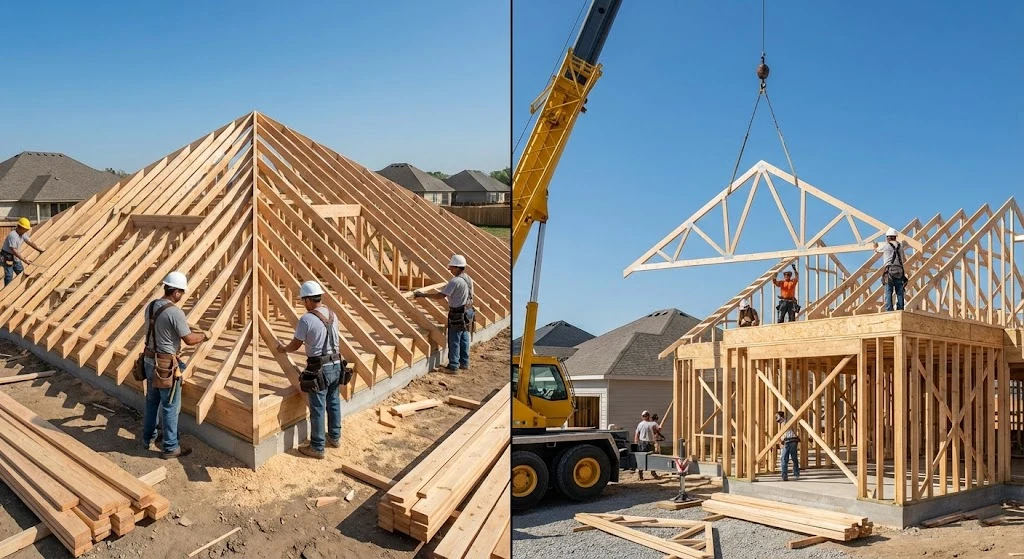
Rafters vs Trusses: Which Is Better: Trusses are prefabricated roof frames built in a factory and delivered to your site. Rafters are cut and assembled on-site. Trusses cost less and install faster, while rafters give you more design freedom and usable attic space. Your best choice depends on your budget, site access, and what you want from the space beneath your roof.
When you’re building or replacing a roof, two words come up fast — rafters and trusses. Most people don’t think much about what’s holding their roof up, but this one decision affects your budget, your timeline, and even how you can use the space inside your home. Getting it wrong can cost you thousands.
Both systems do the same basic job: they support your roof. But the way they do it, how much they cost, and what they allow you to do afterward are very different. This guide breaks it all down so you can make the right call for your specific situation.
What Are Rafters?

Rafters are the traditional way to frame a roof. They’re individual angled beams, usually made from 2×8, 2×10, or 2×12 lumber, that run from the peak of the roof — called the ridge board — down to the top of your exterior walls. When rafters are used for home construction, they’re delivered as raw lumber and then measured, cut, and assembled by the contractor on-site.
Think of rafters like handmade furniture. A skilled carpenter takes raw materials and builds everything right there on your property. That takes more time, but it also gives you a lot more control over the final shape and design. Rafter construction is particularly well-suited to remote job sites, since the ridge beam and other materials are custom-made on location — no waiting for factory delivery or dealing with transport logistics.
Rafters also need extra support to hold everything together. Rafter boards are fastened to the ridge board at the peak and the top plate where they join the wall. Collar ties are installed horizontally to give the structure strength and stability, and ceiling joists form the bottom of each rafter while also creating the ceiling of the room below.
What Are Trusses?

Trusses are a more modern solution. Modern roof trusses were invented in the 1950s. Since then, they have become the most popular form of roof support, largely because they’re more cost-effective and structurally superior for most buildings. According to the National Association of Home Builders, about 3 out of 4 residential home builders today report using prefabricated roof trusses.
Trusses are prefabricated, triangular framing systems made from wood or metal. Because trusses are engineered for each specific roof design, they’re designed and manufactured off-site, then delivered as complete units ready to be placed on top of your framed walls. The web of internal bracing members is what makes them so strong — they spread the load across the entire structure rather than concentrating it in single beams.
The basic components of a truss include two top chords, a bottom chord, and web pieces along with metal connector plates. Because of the way trusses are structured, you gain more rigidity and have less potential deflection, or bending, than with rafters. That stability is one of the main reasons builders love them for standard residential construction.
Cost: Which One Saves You More Money?

This is usually the first question homeowners ask, and the answer is fairly clear. Truss installation costs around $7–$9 per square foot, compared to $10–$14 per square foot for rafters — a total savings of roughly 15% to 30% if you choose trusses.
Why the price difference? It comes down to labor. Because trusses require less labor, they are 20%–50% cheaper than stick-built rafters. When a carpenter builds rafters from scratch on your roof, every beam gets measured, cut, and fitted by hand. That takes days. Trusses arrive ready to install.
Roof trusses cost $5 to $14 per square foot installed, while rafters cost $7 to $30 per square foot installed, making trusses the more budget-friendly option. That upper end of the rafter range gets reached quickly when your roof has a complex shape or when skilled labor in your area comes at a premium.
One thing to keep in mind: trusses aren’t always cheaper once you add everything up. It’s essential to factor in the additional costs of trusses, including shipping costs and potentially renting a boom or crane to lift them into place. If your property is hard to access, that crane rental can chip away at your savings fast.
Strength and Structural Performance
Both systems can hold up a roof for decades, but they work differently under pressure. Engineered trusses deliver higher strength-to-weight ratios and meet the International Residential Code (IRC R802.10) for modern roof structure components. They’re ideal for snow, wind, and seismic zones.
A rafter beam spanning 15 feet at an incline doesn’t have a lot bracing it other than its own stiffness. But that same span configured as a truss will also have multiple members bracing it along that length, which results in more stability. The triangular web design of a truss is simply better at distributing weight across multiple points.
Rafters can absolutely be strong — but their strength depends heavily on the person building them. Rafters can be very strong, but strength and structural integrity depend heavily on skilled carpentry, the size of the rafters, correct placement of ceiling joists, a proper ridge board or beam, and quality framing connections. In other words, a truss built in a factory to engineering specs will perform predictably every time. A rafter roof is only as good as the carpenter who builds it.
Installation Time: How Fast Can You Get a Roof Up?
If you’re working against a deadline or just want to get your home closed in before bad weather hits, this matters a lot. A truss roof installs in one to two days, unlike several days for rafters. This means fewer weather delays and lower crew costs.
Trusses are faster to install since they’re prefabricated to fit your roof’s design. Rafters take more time to build on-site, especially for complex roof designs. It also takes a higher level of skill and expertise to cut and install rafters. For a general contractor trying to keep a project on schedule, trusses are the obvious pick.
That said, trusses do have one timing risk: lead times. Since they’re made in a factory to your roof’s exact dimensions, any delay in manufacturing or delivery can put your whole project on hold. Rafters don’t have that problem since everything is built on-site as you go.
Design Flexibility: Which Gives You More Options?
This is where rafters pull ahead — and for some homeowners, it’s the deciding factor. With rafter construction, you have the potential to remodel areas of your home in the future. For example, you could convert your attic space into a living space or maximize already-existing spaces such as a finished master bedroom.
Trusses fill the attic space with their web of internal bracing members. That bracing is exactly what makes them so strong, but it also means you can’t really use the attic for anything else. The internal web blocks most usable attic areas, and cutting or altering truss members weakens the structure — changes that are risky or impossible once trusses are in place.
For smaller or more complex roof shapes, rafters offer the control needed to build steep pitches, hips, and dormers on-site. This makes them better suited for custom homes or remodels where design precision matters. If you want vaulted ceilings, exposed beams, or a dramatic cathedral ceiling, rafters are typically the way to go.
Trusses aren’t entirely without design options, though. Scissor trusses, for example, can create a vaulted ceiling effect. If you have any vaulted ceilings in your plan, you can use scissor trusses to provide enough steepness — though you’ll want to consult an architect to confirm that works for your design.
Attic Space and Insulation
Installing attic insulation is easier with rafters given the ample space the beams create between the roof and drywall below. The insulation can be sandwiched in between the rafter beams, resulting in better energy efficiency.
On the flip side, trusses actually create better natural ventilation because of how the web members allow air to circulate. Trusses provide good insulation plus better ventilation because of how they’re designed, which means choosing them can reduce what you pay in energy bills without the need for extra work or additional installations.
So both can be energy-efficient — they just get there differently. With rafters, you control insulation placement manually between the beams. With trusses, the built-in air movement does a lot of the work for you.
When Should You Choose Trusses?
If your roof needs to cover a large open space — like a garage, great room, or workshop — trusses are ideal. They can span up to 60 feet without needing interior load-bearing walls. That’s a huge deal if you want an open floor plan.
Choose trusses when your site is easy to access by truck, your budget is tight, your timeline is short, and you don’t have plans to finish the attic. For most standard new builds, trusses are the practical, cost-effective default.
When Should You Choose Rafters?
Rafters make more sense when your property is hard to reach by large truck or crane, when you want a custom roof design, or when attic conversion is on your future to-do list. Rafters are the better choice when you want steep-slope, vaulted, or decorative ceilings, have a complicated roofline, need the option of finishing the attic, or when your site makes it difficult to transport or lift pre-assembled trusses.
They also work well for smaller projects. Rafters are particularly great for smaller projects, such as sheds or cabins, where a large truss delivery doesn’t make practical sense.
So, Which Is Actually Better?
There’s no single winner here — it depends entirely on what your project needs. For most new homes being built today, trusses are the smarter call. They’re cheaper, faster, stronger under standard conditions, and predictable in performance. That’s why roughly three out of four homebuilders choose them.
But if you care about maximizing your living space, want a custom ceiling, or you’re building somewhere a crane truck simply can’t reach, rafters give you something trusses can’t — flexibility. The best approach is to talk to a licensed roofer or structural engineer before you commit. Bring your floor plan, your budget, and your long-term goals for the space. They can look at your exact situation and tell you which system actually makes sense for your home.

Comments are closed.