
Editor’s note — 5 November 2026: This article has been fully rewritten using only verifiable facts from reputable reporting. Earlier claims that could not be verified — including the wrong build year and size for the Los Angeles mansion, a wrong sale price for the Michigan farm, a stale asking price for the Louisville childhood home and a wrong result against Joe Frazier — have been removed or corrected.
Muhammad Ali — born Cassius Clay in Louisville, Kentucky — went from a small pink house on Grand Avenue to some of the most famous homes in sports history: a mansion in Los Angeles, a ranch in New Jersey, an 81-acre farm in Michigan and a quiet desert home in Arizona where he spent his final years. This is what is actually known — and verified — about Muhammad Ali’s houses.
Who Was Muhammad Ali?
Born Cassius Marcellus Clay Jr. on 17 January 1942 in Louisville, Kentucky, Muhammad Ali became the most famous boxer — and one of the most recognised people — of the 20th century. He took up boxing at 12, after his bicycle was stolen, won Olympic gold at Rome in 1960, and beat Sonny Liston in February 1964 to become world heavyweight champion. Weeks later he announced he had joined the Nation of Islam and changed his name to Muhammad Ali. In 1967 he refused induction into the US military over the Vietnam War, was stripped of his titles and spent more than three years in exile from boxing before the US Supreme Court overturned his conviction in 1971. He went on to become the first boxer to win the heavyweight title three times, with the “Rumble in the Jungle” against George Foreman in 1974 and the “Thrilla in Manila” against Joe Frazier in 1975 among the most famous fights ever staged. Diagnosed with Parkinson’s disease in 1984, he lit the Olympic flame at Atlanta in 1996, received the Presidential Medal of Freedom in 2005 and was named Sports Illustrated’s Sportsman of the Century in 1999. He died on 3 June 2016 in Scottsdale, Arizona, aged 74.
| Full name | Muhammad Ali (born Cassius Marcellus Clay Jr.) |
| Born | 17 January 1942, Louisville, Kentucky |
| Died | 3 June 2016, Scottsdale, Arizona (aged 74) |
| Profession | Professional boxer, activist |
| Olympic achievement | Gold medal, light-heavyweight, Rome 1960 |
| Professional record | 56 wins (37 by knockout), 5 losses |
| Titles | First boxer to win the world heavyweight title three times |
| Health | Diagnosed with Parkinson’s disease in 1984 |
| Honours | Presidential Medal of Freedom (2005); Sports Illustrated Sportsman of the Century (1999) |
| Children | Nine, including professional boxer Laila Ali |
| Net worth at death | Estimated at around $50 million |
The Louisville Childhood Home: 3302 Grand Avenue
Ali’s most famous home is the smallest one he ever lived in: a modest pink two-bedroom, one-bathroom house at 3302 Grand Avenue in Louisville’s Parkland neighbourhood. The four-room clapboard bungalow, built in 1920 and measuring around 1,200 square feet, was where the Clay family lived from 1947 — when Ali was five — until 1961. His father, Cassius Clay Sr., was a sign painter and artist; his mother, Odessa, was a devout Baptist. Ali shared a bedroom with his younger brother Rudolph (later Rahman). He was born at Louisville General Hospital, not in the house, but Grand Avenue is where he grew up: shadowboxing on the porch steps, racing the city bus down the street and listening to heavyweight bouts on the radio. It was from this house that the 12-year-old Cassius rode his bicycle to the Louisville Home Show in 1954 — and when the bike was stolen, the policeman he reported it to, Joe Martin, suggested he take up boxing.
The family moved out once Ali’s earnings allowed him to buy his parents a larger home on Buechel Bank Road, across town. The Grand Avenue house passed through several owners over the following decades. In 2015 it was bought by George Bochetto, a former Pennsylvania boxing commissioner, and his business partner Jared Weiss. Over two years they restored the house to the way it looked when the Clay family lived there in 1955 — repainting the pink facade, as Cassius Sr. had done for Odessa, and recreating the original wallpaper — and opened it as the Muhammad Ali Childhood Home Museum in 2016, shortly before Ali’s death. His funeral procession passed the house that June.
The museum struggled from the start. It ran into financial trouble and closed less than two years after opening, and later shuttered during the pandemic. Offers to move the little house to Las Vegas, Philadelphia and even Saudi Arabia were turned down — Bochetto has said it belongs in Louisville. In June 2024 the property was listed for sale through Christie’s International Real Estate Bluegrass at $1.5 million (around £1.1 million) for three properties together: the childhood home, a neighbouring house converted into a welcome centre and gift shop, and a second neighbouring house intended as a short-term rental. An earlier listing had asked $1.4 million. Visitor reports through 2025 say the house remains closed to the public, though it can be seen from the street, where a state historical marker stands outside.

Cherry Hill, New Jersey: The Fighting-Prime Home
During his fighting prime, Ali lived in Cherry Hill, New Jersey, just outside Philadelphia. In 1971 he bought a Mediterranean-style ranch house at 1121 Winding Drive, in the township’s Volken Tract, from Major Benjamin Coxson — a civil rights advocate and Camden power broker — for a reported $103,000 (around £77,000), according to the Philadelphia Inquirer. The house, built in 1965, measures 6,688 square feet with six bedrooms and five bathrooms on 1.5 acres. Ali lived there with his family from 1971 to 1973, in the years around the first Frazier fight and the build-up to the Foreman bout, before moving on to Chicago. In 1974 the house was sold to Anthony J. Micale, a local McDonald’s franchisee, for $175,000 (around £130,000).
The house has changed substantially since Ali lived there: later owners gave it a modern makeover, and at times it has been used as a short-term rental. In 2025–26 it was listed for sale again at around $1.7–$1.975 million (around £1.3–£1.5 million).
The Los Angeles Mansion: 55 Fremont Place
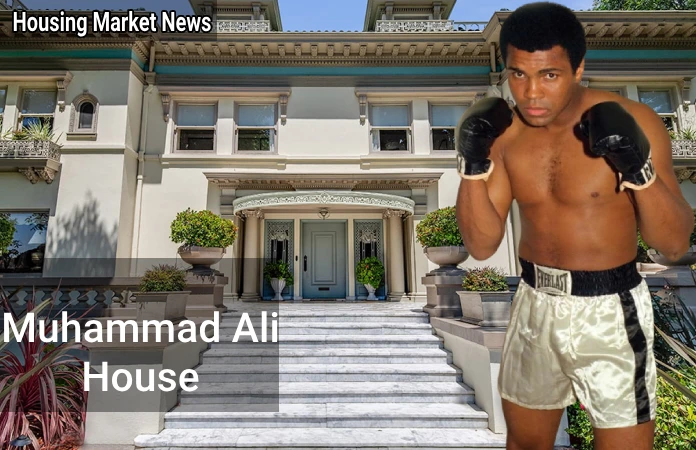
Ali’s grandest home was the Italian Renaissance mansion at 55 Fremont Place in the gated Fremont Place community of Hancock Park, Los Angeles. Built in 1915 for oil executive Martin Henry Mosier and designed by architect John C. Austin — the man behind Los Angeles City Hall, the Griffith Observatory and the Shrine Auditorium — the house has 10,567 square feet, seven bedrooms and eight bathrooms on about 1.6 acres, according to MLS records. Ali bought it in 1979 with his third wife, Veronica Porché Ali, and lived there until 1986. Its best-known surviving feature is its original Tiffany stained glass.
Long after Ali, the house kept making headlines. Developer Michael R. Kaplan and his wife bought it in 2001 for about $2.5 million (around £1.9 million) and restored it. It was listed in late 2022 for $16.995 million (around £12.7 million), cut to $15 million in early 2023, and when no buyer came forward it was put up for auction with no reserve through Concierge Auctions in May 2024. It sold on 18 July 2024 for $8.5 million (around £6.7 million) — about half its original asking price, or $9.52 million once the buyer’s premium was added.
Paradise Valley, Arizona: The Final Home
Ali spent his final years in Paradise Valley, Arizona, a small exclusive community between Phoenix and Scottsdale. In 2005 he and his fourth wife, Lonnie — Yolanda Williams, whom he married in 1986 — bought a single-storey, six-bedroom home of around 6,000 square feet in a gated community south of the Camelback Golf Club for $1.64 million (around £1.2 million) in cash, according to the Arizona Republic. He had been spending more and more time in Arizona, appearing at charitable events including the Celebrity Fight Night fundraiser for the Muhammad Ali Parkinson Center at Barrow Neurological Institute in Phoenix. He lived in Paradise Valley most of the time before his death on 3 June 2016, of septic shock at HonorHealth Scottsdale Osborn Medical Center, at the age of 74. Lonnie continued to live in the Paradise Valley home after his death.

Other Homes in Ali’s Story
Berrien Springs, Michigan: The 81-Acre Farm
In 1975 Ali bought an 81-acre farm on the St. Joseph River at Berrien Springs, Michigan — about 90 miles from Chicago — for a reported $400,000 (around £300,000). The gated, riverfront estate had around a mile of river frontage, a 3,960-square-foot four-bedroom main house, a carriage house, a pool, a bath house, an outdoor kitchen, two barns, an office and a freestanding gym with a boxing ring, where Ali trained. He used it as a secluded retreat and spent his summers there, and kept it long after moving to Los Angeles and then Arizona. In January 2007 the Alis put the farm up for sale and bought a home in eastern Jefferson County, Kentucky, for $1,875,000 (around £1.4 million), closer to Louisville. After Ali’s death, his widow Lonnie listed the Michigan estate in June 2018 at $2,895,037 — the final $37 a nod to his 37 knockouts — and it sold on 21 December 2018 to the New York-based Turken Foundation for $2.5 million (around £1.9 million). The foundation announced plans to turn it into a summer school and educational camp, with a museum in Ali’s honour.
Chicago: 4944 S. Woodlawn Avenue
In the 1960s Ali bought a large brick mansion at 4944 S. Woodlawn Avenue in Chicago’s Kenwood neighbourhood — a roughly 8,000-square-foot Tudor Revival house — and lived there on and off for more than a decade. He bought it to be close to his mentor, Elijah Muhammad, the leader of the Nation of Islam, whose own home was about two blocks away at 4855 S. Woodlawn. The house is privately owned and not open to the public.
Louisville: The Later Mansion
The eastern Jefferson County home the Alis bought in January 2007 for $1,875,000 became Ali’s later Louisville base, used when travel to the Muhammad Ali Center — the museum and cultural centre he and Lonnie opened in downtown Louisville in November 2005 — grew harder as his Parkinson’s advanced. After his death, Lonnie listed the house in September 2016 at $2.2 million (around £1.7 million); it was later sold after price cuts.
Muhammad Ali House: At a Glance
| Childhood home | 3302 Grand Avenue, Louisville — family lived there 1947–1961; ~1,200 sq ft, 2 bed / 1 bath; museum 2016–2018; listed June 2024 at $1.5M (three properties) |
| Cherry Hill, New Jersey | 1121 Winding Drive — bought 1971 for ~$103,000; 6,688 sq ft, 6 bed / 5 bath; sold 1974 for $175,000; listed 2025–26 at ~$1.7–$1.975M |
| Los Angeles | 55 Fremont Place, Hancock Park — bought 1979, lived there until 1986; 10,567 sq ft, 7 bed / 8 bath; sold at auction July 2024 for $8.5M |
| Paradise Valley, Arizona | Bought 2005 for $1.64M; ~6,000 sq ft, 6 bed; Ali’s final home — he died in Scottsdale on 3 June 2016 |
| Berrien Springs, Michigan | 81-acre farm — bought 1975 for ~$400,000; sold 21 Dec 2018 to the Turken Foundation for $2.5M |
| Chicago | 4944 S. Woodlawn Ave, Kenwood — ~8,000 sq ft Tudor mansion, bought in the 1960s; near Elijah Muhammad’s home |
Frequently Asked Questions
Where did Muhammad Ali grow up?
In a small pink two-bedroom house at 3302 Grand Avenue in Louisville, Kentucky, where the Clay family lived from 1947 to 1961. It was restored as the Muhammad Ali Childhood Home Museum in 2016, but the museum closed less than two years later and the house remains closed to the public.
How much is Muhammad Ali’s childhood home worth?
In June 2024 the house was listed for sale at $1.5 million (around £1.1 million) — but that price covered three properties together: the childhood home, a welcome centre and gift shop next door, and a second neighbouring house intended as a short-term rental.
Where did Muhammad Ali live when he died?
In Paradise Valley, Arizona. He and his wife Lonnie bought a six-bedroom home there in 2005 for $1.64 million. He died on 3 June 2016 at a hospital in Scottsdale, aged 74.
What happened to Muhammad Ali’s Los Angeles mansion?
The 1915 Italian Renaissance mansion at 55 Fremont Place, which Ali owned from 1979 to 1986, was listed for $16.995 million in late 2022 and finally sold at auction on 18 July 2024 for $8.5 million.
Did Muhammad Ali own a farm?
Yes — an 81-acre farm on the St. Joseph River at Berrien Springs, Michigan, bought in 1975 for a reported $400,000, with a gym and boxing ring where he trained. His widow sold it in December 2018 to the Turken Foundation for $2.5 million.
What was Muhammad Ali’s boxing record?
56 wins (37 by knockout) and 5 losses. He was the first boxer to win the world heavyweight title three times, and he successfully defended the title 19 times.
Conclusion
From a 1,200-square-foot pink bungalow in Louisville to a 10,000-square-foot mansion in Los Angeles and an 81-acre farm in Michigan, Muhammad Ali’s homes trace the full arc of his life: a poor kid from the West End who became the most famous athlete on earth, then spent his final years quietly in the Arizona desert. The childhood home on Grand Avenue remains the most important of them all — the place where a stolen bicycle set a 12-year-old on the road to becoming “The Greatest” — even as its future as a museum remains unresolved. What is certain is the scale of the story those addresses tell, from Grand Avenue to Paradise Valley.

