
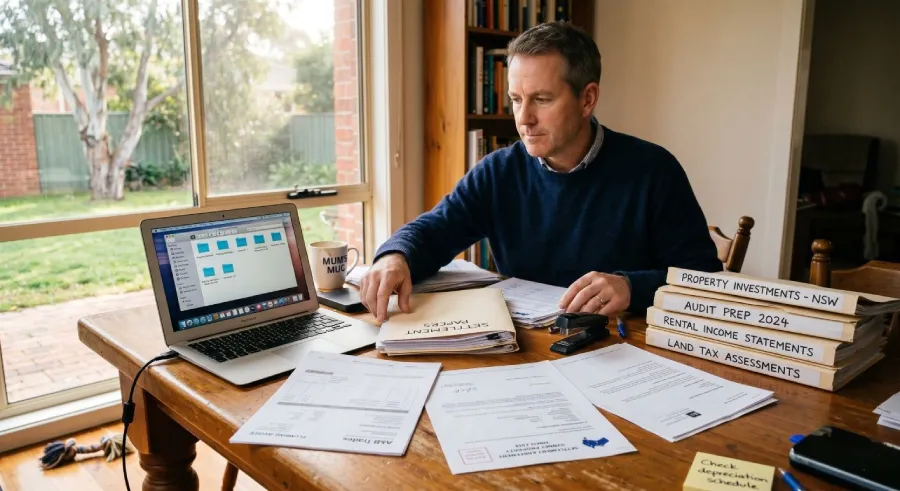
Keep one home for every record
If your property records live across inboxes, kitchen drawers, old laptops, and a folder called “misc stuff”, you’re asking for trouble.
Use one master location. That’s the rule.
I tell clients to keep every property document in one cloud folder, not five half-baked systems they swear they’ll “sort out later”. Use Google Drive, OneDrive, Dropbox, whatever you’ll actually open. The platform matters less than the habit. If you can’t find a document in under two minutes, your system is bad.
Set up one folder per property. Inside that, split it by year and category. Simple. Clean. Boring. Good.
Know what the ATO actually cares about
A lot of investors keep the wrong paperwork and bin the useful stuff. Then an audit lands and suddenly everyone turns into an amateur archaeologist.
Keep records for:
- Purchase contract and settlement statement.
- Loan documents and refinance paperwork.
- Council rates, water rates, strata levies, and land tax notices.
- Property management statements and rent summaries.
- Repairs, maintenance, and improvement invoices.
- Insurance, legal fees, and quantity surveyor reports.
- Emails or written approvals tied to major works.
- Sale contract, agent fees, and settlement documents when you dispose of the property.
You also need to know the timeframes. Most rental property records should stay on file for at least five years after you lodge the relevant tax return. Capital gains records need longer. Keep those for at least five years after you sell the property, because the cost base trail matters right up to the end.
People love to keep screenshots and forget invoices. Don’t do that. A screenshot of a bank transaction tells me money left the account. It doesn’t prove what you bought or whether the claim stands up.
Paper is fine until it gets wet, lost, or “filed” in the car
Scan everything.
Yes, even the paper stuff your agent hands you. Yes, even the ugly invoice from the plumber who still uses a template from 2009. Scan it, label it, save it.
I learned this the hard way with a client who brought me a stack of faded thermal receipts in a supermarket bag. Half had gone blank. We spent 7 hours rebuilding 146 transactions from bank statements, emails, and pure stubbornness. That kind of mess doesn’t make you look relaxed in front of the ATO. It makes you look careless.
Use file names that say what the document is. Not “invoice1.pdf”. Not “scan0004.jpg”. Use something human:
- 2025-08 Plumbing repair kitchen tap
- 2025-09 Strata levy Q1
- 2026-06 Property manager EOFY statement
That naming system sounds painfully obvious. Good. Obvious systems survive real life.
Depreciation records deserve their own folder
This is where people get lazy and start guessing. Bad move.
If you claim depreciation, keep the report, the invoice, and any updates tied to renovations or new assets. Don’t rely on memory. Don’t rely on “my accountant should have that somewhere”. You should have it too.
For a WA property, I want a proper tax depreciation schedule Perth investors can hand over without explanation, apology, or detective work. A decent schedule should clearly separate capital works from plant and equipment, show effective life assumptions, and line up with the property details you actually own.
And if you renovate, update your records straight away. New flooring, hot water system, air con, bathroom fit-out, all of it. If you wait until tax time, you’ll forget dates, values, and what counted as a repair versus an improvement. Then the whole thing gets messy fast.
Your accountant should not play detective

A clean record system saves accountant time, reduces errors, and gives you better advice. Funny how that works.
If you already use Bargo taxation services, send your property records through regularly instead of dumping twelve months of chaos into one email at the end of October. The same rule applies with any tax agent worth paying. We can only work with what you give us. If your records arrive incomplete, late, and unlabeled, don’t act shocked when the process drags.
I prefer quarterly uploads. Monthly is even better if you’ve got multiple properties or renovation work happening. That way, issues show up early. Missing invoice? Easy fix. Wrong loan split? Still fixable. Dodgy categorisation? We sort it before it grows teeth.
The clients who stay organised usually spend less on cleanup and make fewer claim mistakes.
Use a folder structure that still makes sense at 11 pm
You don’t need a fancy system. You need one you’ll still understand when you’re tired, cranky, and trying to find an invoice before a deadline.
Here’s the folder setup I push:
- Property address.
- Purchase and sale.
- Loan and finance.
- Rental income statements.
- Rates, strata, and utilities.
- Repairs and maintenance.
- Capital improvements.
- Insurance and legal.
- Tax and depreciation.
- Year-by-year archive.
Inside each folder, sort files by date using YYYY-MM at the start of the filename. That keeps everything in order without effort.
Also, keep one running spreadsheet. Nothing fancy. Track the date, supplier, amount, what the expense was for, and whether it looked like a repair or capital item. That spreadsheet won’t replace invoices, but it will stop you from staring at a pile of charges and wondering why Bunnings got $1,287 out of you in March.
We both know how that happens.
Keep records longer than feels necessary
Most people stop caring once the tax return gets lodged. That’s a mistake.
Hold onto records for ownership costs, stamp duty, legal fees, and capital improvements for the full life of the investment, then for the required period after sale. Those numbers feed straight into capital gains tax. Lose them, and you may pay more tax than you should. Nobody enjoys donating money because they got sloppy with folders.
I also tell clients to back up their property folder in two places. One cloud copy. One local or secondary backup. Tech fails. People delete things. Accounts get locked. A single backup is not a backup.
If you want the blunt version, here it is. Keep every property record in one digital home, label it properly, update it regularly, and stop assuming in the future-you will remember anything useful. Future-you won’t. Future-you will be tired and annoyed, same as the rest of us.
Do the admin once. Do it properly. Then an audit becomes paperwork, not panic.


Comments are closed.