
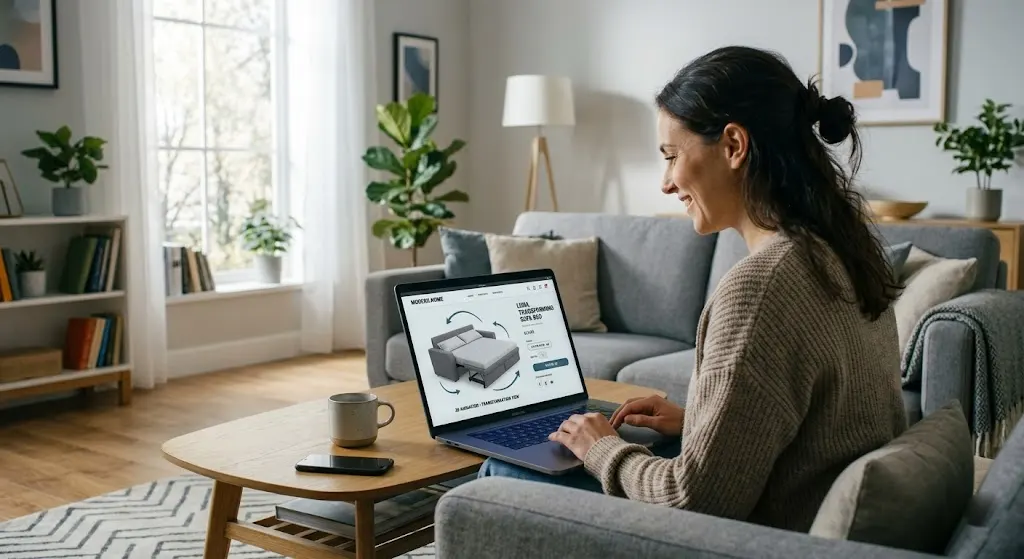
Buying something for a home is not like buying a book or a phone case. The stakes are higher, the return process is more painful, and the product usually has to live alongside other things in a specific space for a long time. Getting it wrong tends to be expensive in ways that go beyond the purchase price.
Most home products are still sold primarily through photographs. And photographs, however well-composed, have a fixed limitation: they show you what something looks like from one angle at one moment. They do not show you what it does.
Why Home Products Are Easy to Misjudge Online
Scale is the first problem. A sideboard that looks mid-sized in a product listing can read quite differently in a room with lower ceilings or a narrower floor plan than the one used for the shoot. A kitchen island that photographs as a focal feature can dominate a galley kitchen in a way the image never hinted at.
Function is harder to see than appearance. A storage ottoman might look practical from the outside and be surprisingly awkward to open in a real room. A pull-out sofa bed might have a mechanism that requires clearing significant floor space before it can be deployed. A kitchen appliance might have a door that swings in a direction that creates a problem depending on where it sits relative to other units.
The listing description might mention these things. But reading that a gas-lift storage bed requires 60cm of headroom above the mattress is different from seeing how the mechanism actually works — seeing what happens when you push the bed base up, where it stops, how much space the opened platform occupies.
What You Need to Know Before You Commit
Size and proportions
Measure the room before browsing. Not just the floor area — the ceiling height, the door clearances, the distance from where a piece will sit to the nearest wall or architectural feature. Proportions that read well in photographs taken with wide-angle lenses in generous spaces can behave very differently in a standard-sized British living room or bedroom.
Storage and functionality
For any product where storage is part of the value proposition, the question is whether the storage is practical for actual use, not just technically present. How deep is it? How accessible? Does accessing it require moving other things? Storage that requires two steps tends to become storage that nothing goes back into.
Assembly and setup
Self-assembly furniture and flat-pack products vary enormously in how straightforward the build process is. Products with unusual mechanisms — fold-down desk surfaces, convertible beds, extendable dining tables — are particularly difficult to assess from a box photograph and a piece count.
Material and finish expectations
Product photography is taken under conditions that tend to flatter the material. Real light in real rooms at various times of day behaves differently. An oak veneer that reads as warm and rich in a studio setting can look noticeably different under the ceiling lights in a north-facing bedroom. Requesting samples where possible and looking for lifestyle images shot in real homes rather than studio sets tends to give a more accurate impression.
Why Animated Product Visuals Close the Gap
For buyers trying to understand how a product works before ordering, learning about the 3d animation process helps explain why modern digital product demos can feel clearer than static images alone. An animated walkthrough of a product can show it from multiple angles in sequence, demonstrate how a mechanism operates, illustrate how storage compartments are accessed, and communicate proportions in ways that photographs simply cannot — all without requiring a physical sample to be shipped to a studio.
This kind of visual is increasingly common on product listing pages for home furniture, appliances, and storage systems. When you see a rotating view or a step-through animation on a product page, it is doing the work of the showroom visit that many buyers no longer make before purchasing online.
The advantage over a written description is that it does not require the reader to translate words into spatial understanding. You watch the bed platform lift. You see how far the dining table extends and how the extra leaf slides in. You observe where the hinges sit on a fold-down desk and how much clearance the open surface requires. The ambiguity that a description leaves is usually resolved in the first few seconds of a well-made animation.
Where This Matters Most
Storage furniture and modular pieces
Ottomans with lift lids, storage beds with gas-lift platforms, modular shelving that can be reconfigured — all of these have functional characteristics that only make sense in motion. A storage bed image shows the closed state. An animation shows the open state, the lift mechanism, and the depth of the storage area relative to a recognisable object.
Appliances and kitchen upgrades
Fridge door swing direction, oven door drop-down vs. side-opening, extractor hood raising and lowering — these are all function questions that photographs cannot answer. For kitchen appliances especially, where installation is involved and returns are complicated, getting the function right before ordering matters considerably.
Fold-out and multifunctional furniture
Sofa beds, fold-away wall desks, dining tables that extend for guests — the transformation itself is the product. Seeing a piece that is designed to change configuration actually go through that change is much more informative than the before-and-after pair of photographs.
Fixtures and installation products
Shower systems, ceiling light fittings, built-in storage units — these require understanding clearances, load-bearing considerations, and installation steps that static images rarely communicate well. An animated breakdown of how a product installs can prevent costly errors.
How Brands Create These Visuals
When brands want to show movement, assembly, hidden storage, or changing configurations, product animation services can help create those demonstrations. Working from the product’s digital model rather than a physical sample, the animation can be produced ahead of the physical product being available, can show any configuration or finish variation, and can be delivered in formats suited to both desktop product pages and mobile product listings.
From a buyer’s perspective, the existence of a product animation tends to be a positive indicator. It suggests the manufacturer has thought about how buyers need to understand the product — not just how it needs to be photographed.
Better Visuals Lead to Better Buying Decisions
The most frustrating home-product mistakes tend to involve function rather than appearance. Something that looked right and turned out not to work the way the buyer expected. A mechanism that was harder to use than anticipated. A product that technically fit the space but not the way the space was actually used.
More information before the purchase — particularly information about how something works and moves and transforms — narrows the gap between expectation and reality. It does not eliminate all uncertainty. But it changes the basis of the buying decision from hope to a clearer understanding of what is being ordered.
For anything significant in a home — furniture you will live with for years, appliances that shape daily routines, fixtures that affect the feel of a room — it is worth taking the time to find that clearer understanding before you commit.


Comments are closed.