
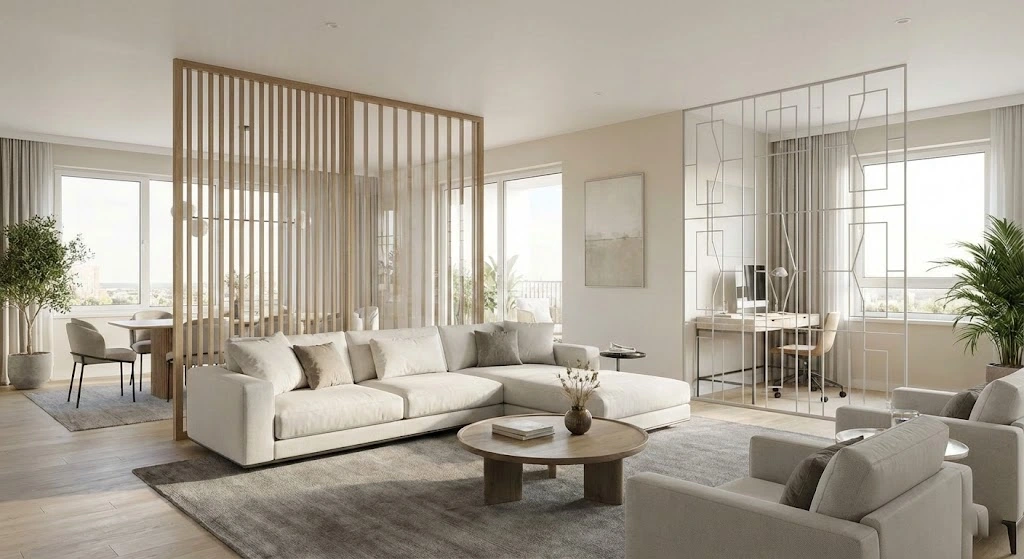
Room dividers split open spaces into functional zones without permanent walls. From folding screens to bookshelf units, these solutions add privacy, define areas, and enhance your home’s style—perfect for apartments, studios, and open-concept layouts.
Living in an open-concept home has its perks. Natural light flows freely, spaces feel larger, and the whole place breathes. But sometimes you need boundaries. Maybe you want a private spot for your home office, a cozy reading nook, or just a way to hide the laundry pile from guests.
That’s where room dividers come in. They split spaces without hammering nails or hiring contractors. You get privacy, storage, and style—all in one piece.
Whether you rent a 400-square-foot studio or own a sprawling five-bedroom house, room dividers work. They’re temporary, flexible, and way cheaper than building walls. Let’s walk through the best ways to divide your space and make every square foot count.
Folding Screens Give You Instant Privacy

Folding screens have roots in 7th-century China, where royalty used heavy, ornate versions. By the 8th century, the Japanese created lighter, portable designs for tea ceremonies and religious events. Today’s folding screens blend that ancient wisdom with modern needs.
These dividers come in woven fibers, bamboo, plastic, wood, fabric, and metal. Wood and metal versions are heavier, while bamboo and plastic options work better if you move the divider often.
You’ll find screens with three, four, six, or even eight panels. More panels mean more coverage, but they also take up more floor space when folded. Think about your room size before buying.
Shoji rice paper screens deserve special mention. This natural material provides privacy while letting ambient light pass through, creating a soft glow in any room. The translucent panels keep spaces from feeling dark or closed off.
Pick a screen that matches your color scheme for a subtle look, or go bold with a contrasting print to make it a focal point. Either way, you’re getting a quick fix that folds flat when you don’t need it.
Bookshelves Double as Smart Storage Dividers
Here’s where function meets form. Bookshelf dividers act as room separators while providing clever storage solutions. Instead of buying separate shelves or cabinets, you get both in one piece of furniture.
Half-wall bookcases, roughly 3 to 4.5 feet high, work well in smaller spaces because they allow natural light to flow and may permit a line of sight for supervising kids if angles work right. You can see over them, which keeps the room feeling open while still marking different zones.
Full-height bookcases create more defined areas. The trade-off? Less light passes through. To keep airiness, use open shelving units called étagères—fancy French for straight-edged, open-shelved units with flush edges and no ornamental molding.
Place two tall bookcases back-to-back for double-sided storage. One side faces your living room, the other faces your dining area. Both spaces get shelves for books, plants, or decorative items. You can even hang framed photos on the sides.
IKEA’s KALLAX units (which replaced the discontinued EXPEDIT) are popular choices for this purpose. In a 400-square-foot Chicago studio, two BILLY bookcases serve as dividers between the bedroom and living area, giving extra storage for colorful books and personal objects.
For renters, this solution is perfect. No drilling into walls, no permanent changes, and you can take it with you when you move. Just make sure tall bookcases are anchored to walls for safety.
Curtains Offer Budget-Friendly Flexibility
Hanging a curtain from top to bottom provides a simple solution for dividing space. Draw it closed for privacy whenever needed, or pull it open to let spaces flow together again.
The beauty of curtains lies in their flexibility. Light, sheer fabrics keep spaces feeling open and airy. They filter sunlight while marking boundaries. Heavier materials like velvet or thick cotton give you real privacy and even help with soundproofing.
Designer Dane Austin used strategically placed drapes to separate areas in an open-concept floor plan. “I love the privacy it gives you, especially in the evening after a large party when people are winding down,” he notes. “It’s like: We can get to the dishes tomorrow.”
Hang curtains on a rod suspended from the ceiling, or use a track system if you want smooth gliding action. You can find curtain hardware at any home store, and installation takes about an hour.
Choose colors and patterns that complement your existing decor. Solid neutrals blend seamlessly, while bold prints make a statement. Either way, you’re getting maximum impact for minimum money.
Wooden Slats Create Modern Visual Interest
Wooden slats placed vertically with half-inch or full-inch spacing create division between spaces while determining how much transparency you want between areas. The narrow gaps let light filter through while still defining separate zones.
This option works great between stairways and living rooms, or between kitchens and dining areas. The wood brings warmth to modern spaces, and the vertical lines add height to rooms with lower ceilings.
One issue with solid dividers is they block natural light on one side. Thin wooden slats solve this problem by acting as makeshift barriers while ensuring you can still see where you’re going at all times.
You can DIY this project with 2×4 boards from your local hardware store. Space them six inches apart, or adjust based on how much privacy you want. Paint them white for a clean look, or stain them to match your existing woodwork.
Glass Partitions Keep Spaces Open
A glass partition ensures seamless flow from kitchen to dining area while creating a sense of separation and keeping rooms connected. You get the best of both worlds—defined spaces without losing that open feeling.
Glass works especially well in smaller homes where every ray of natural light counts. Nothing blocks the sunshine from reaching darker corners, yet each area maintains its own identity.
Consider frosted or textured glass if you want more privacy. Frosted panels block direct views while still letting light pass through. They’re perfect for home offices or bedroom areas in studio apartments.
Installation requires professional help unless you’re experienced with glass. The panels need proper framing and secure mounting, but the investment pays off in both function and style.
Plants Bring Life to Your Dividing Lines
Introducing plants as dividers brings a natural and refreshing element into your space. Use potted plants on high stands or create green walls to separate zones while making your interior feel fresh.
Tall plants like fiddle-leaf figs, bamboo, or snake plants work beautifully as living screens. Line them up on plant stands at varying heights to create a layered look. The greenery softens hard edges and improves air quality at the same time.
Hanging planters offer another option. Suspend them from the ceiling at different heights to form a vertical garden that defines spaces without touching the floor. This approach works great in small apartments where floor space is precious.
Green walls take this idea further. Mount a grid system on your wall and fill it with small potted plants, creating a lush divider that doubles as artwork. You’ll need to water regularly, but the visual impact is worth the effort.
Sliding Barn Doors Add Rustic Charm
Sliding barn doors glide across a track to close off a wardrobe, home gym, or guest room, or leave them open for an airy flow. These barn-style dividers bring rustic charm and modern convenience into one sleek solution.
The hardware mounts to your ceiling or wall, and the door slides smoothly on a track system. When you want privacy, slide the door closed. When you want openness, push it to the side. Simple as that.
Barn doors come in various finishes—weathered wood for farmhouse vibes, painted panels for modern looks, or even metal-framed versions with glass inserts. Pick the style that matches your home’s personality.
This option requires more installation work than folding screens or curtains, but it delivers a permanent-looking solution that’s actually still movable. You’re adding value and style to your space.
Furniture Placement Can Define Zones
Sometimes the simplest solutions work best. A strategically placed round table, grounded with a rug, turns a floating open space into a casual entryway. Add a bench to further define areas of the space.
Your sofa can act as a divider too. Place it perpendicular to a wall rather than against it, and suddenly you’ve created two distinct areas. The seating faces one direction, while the space behind it becomes something else entirely—a reading nook, a play area, or a mini home office.
In open-concept living spaces, area rugs clearly divide large rooms into different zones. Each rug anchors its own furniture grouping, making the boundaries obvious without blocking movement or light.
Console tables work the same way. A long, narrow table behind your sofa provides a natural divider plus extra surface space for lamps, photos, or decorative items. You’re splitting the room while adding function.
Two-Way Fireplaces Make Bold Statements
A dual-sided fireplace serves as a seamless divider or even connects indoor and outdoor spaces. Whether wood-burning or electric, it provides warmth and visual interest to both sides.
This option requires serious planning and professional installation, especially for wood-burning models. You’ll need proper venting, framing, and clearances on both sides.
Electric fireplaces offer an easier route. Many models simply plug into standard outlets and mount between walls or in custom-built frames. They don’t provide real heat like wood-burning versions, but they create ambiance and mark boundaries effectively.
The investment is significant, but so is the impact. A two-way fireplace becomes the focal point of both spaces it touches, adding luxury and warmth throughout your home.
DIY Options Let You Customize Everything
Macrame room dividers break up small spaces when hung from the ceiling. Made from coarse textile created by knotting threads or cords, these dividers make rooms feel cozy. With cotton cord and a wooden dowel, you can create your own knotted divider in a weekend.
Repurpose old window frames or shutters as dividers. Paint or stain them, add hinges, and you’ve got a unique divider that adds vintage charm. You can achieve a similar look with salvaged closet doors.
Build your own wooden frame and stretch fabric across it. Choose any pattern you love—bold prints, subtle textures, or solid colors. This approach lets you match your exact decor while keeping costs down.
One DIYer built a floating wall of copper pipes to separate sleeping quarters from an entryway in a tiny Chicago studio. The divider offers a place to hang photos, clothing items, or other decor without making the bed area feel too closed off.
The beauty of DIY dividers is complete control over size, color, and style. You’re not limited to what stores sell. Make exactly what your space needs.
Choosing Your Perfect Room Divider
Start by measuring your space. Know the ceiling height, the width you need to cover, and how much floor space you can spare. These numbers guide every decision that follows.
Think about your main goal. Do you need privacy? Storage? Just a visual boundary? Sliding dividers work well in spas or meditation rooms, offering calm and serene atmospheres by creating secluded spaces for relaxation. Meanwhile, bookshelf dividers excel in living rooms where you need both separation and storage.
Consider how permanent you want this solution. Renters need portable options like folding screens or curtains. Homeowners can explore built-in solutions like glass partitions or sliding doors.
Your budget matters too. Curtains and basic folding screens start under $100. Custom wooden installations or glass partitions run into thousands. Pick what fits your wallet while meeting your needs.
Don’t forget style. Your divider shouldn’t clash with your existing decor—unless you want it to stand out as a bold accent piece. Either approach works, as long as you’re making the choice deliberately.
Making Your Divided Space Work
Once you’ve installed your divider, think about both sides. Each area needs proper lighting, so add lamps or sconces where natural light gets blocked. Floor lamps work great because you can move them as needed.
Keep traffic flow in mind. You want an opening of at least 3 feet wide to pass through between bookshelves and any other walls or furniture. Standard interior doors are 32 inches wide, so aim for slightly wider openings.
Decorate both sides of your divider. Even the back of a bookshelf deserves attention if people see it. Add art, paint it a complementary color, or style it with decorative items.
Use your divider to enhance acoustics too. Fabric dividers, heavy curtains, and solid bookcases help absorb sound, making spaces quieter and more peaceful. This matters especially in studio apartments where bedroom and living room share one space.
Room Dividers Transform Any Space
The right room divider changes how you live in your home. That open-concept space that felt too big suddenly has cozy corners. Your studio apartment gains a real bedroom instead of just a bed in the corner. Your home office gets actual privacy instead of working in the middle of everything.
You don’t need construction permits, expensive contractors, or permanent walls. You just need the right divider for your space and needs. Whether that’s a folding screen you bought online, a bookshelf from IKEA, or a custom wooden slat wall you built yourself, the result is the same—a space that works better for how you actually live.
Start with one area. See how it feels. Adjust as needed. That’s the beauty of room dividers—they’re flexible, temporary, and completely reversible. Your space, your rules, your way.
Transform your open spaces into functional zones today. Pick a divider that fits your style and budget, then watch as your home becomes more organized, private, and intentionally designed. No walls required.


Comments are closed.