
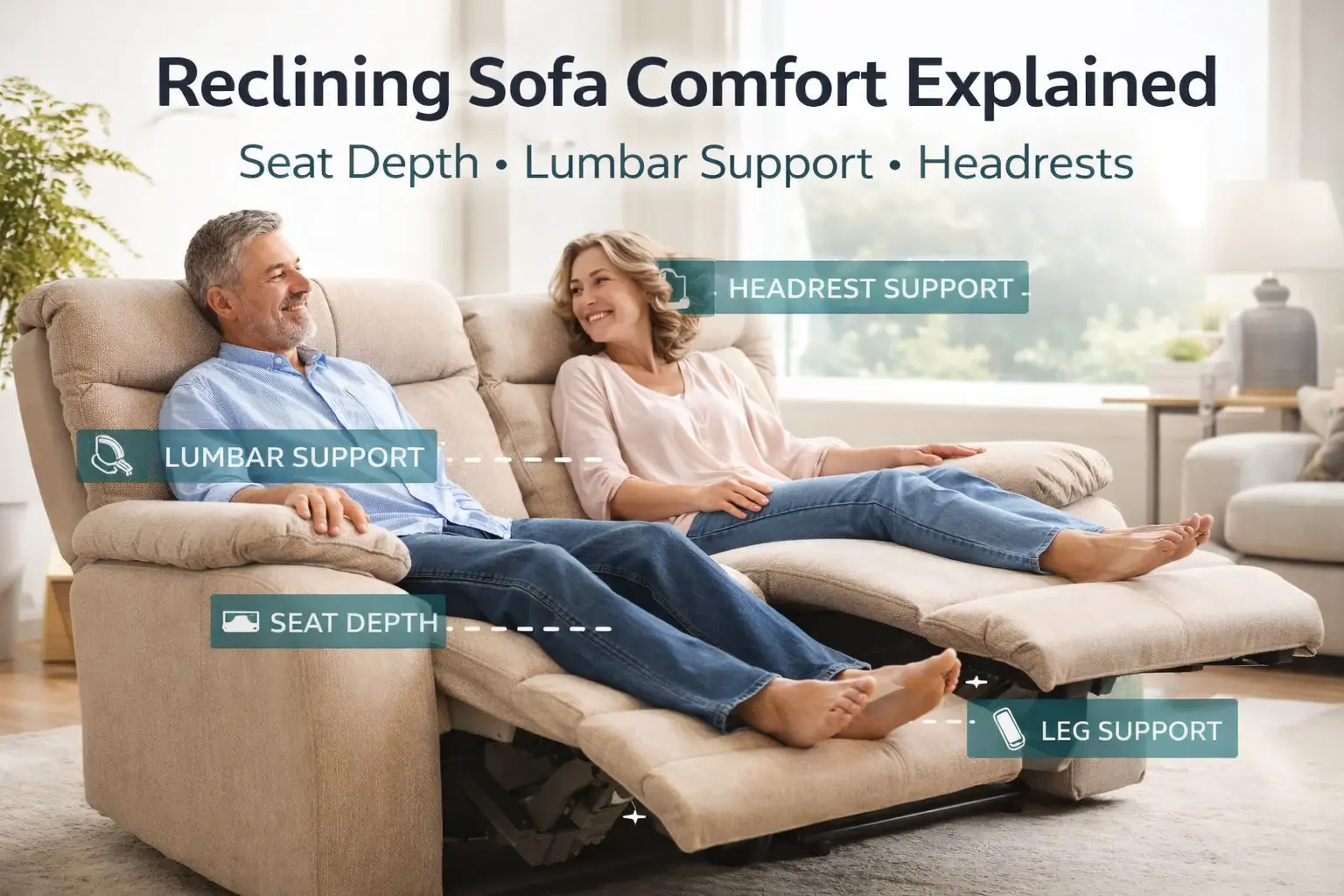
Deciding on a reclining sofa is primarily about the comfort of the long run. You are not expected to just feel it on the fabric alone after the first few minutes of sitting on it. The true nature of comfort is proportional and structural; seat depth, seat height, backrest angle, lumbar support, and headrest support must all function together to ensure posture and spine alignment are healthy. With a focus on lounging, structured sitting, or extended movie marathons, all these points are fundamental in your choice of furniture that will remain comfortable for more than just a few months.
Recliners that have fixed seating are different. When reclining, body weight is shifted from the hips, lumbar, shoulders, and neck. The comfort level is maintained if these points are in the right position this is because the pressure point is decreased and the body is balanced. When the proportions are incorrect, the discomfort begins to appear gradually even if the sofa initially had an attractive and perfect look.
Home Health Through Ergonomics

Ergonomic seating, though initially associated with office spaces, is also essential in the home where sofas are mostly used. Design problems that are not apparent at first, as the time goes, they become more pronounced. Reclining that is well-designed protects posture, even if a person is very relaxed.
The main factors that compose comfort are:
- Seat grade deep enough.
- The correct height of the seat.
- A backrest that stays stable.
- lumbar support that is effective.
- A headrest that is reliable and a neck support that is adjustable.
- An armrest that is at an appropriate height.
- A footrest that is properly controlled at the angle of support.
- Foam that is the correct density for the level of seating.
- A strong base that is stable (either pocket springs or sinuous springs)
Being comfortable is not just about being soft. It is more on how this combination of elements works to let the body be in a natural position. Modern households rely on sofas for far more than occasional seating. They become reading corners, cinema seats, work-from-home stations and everyday relaxation zones. Because of this, long-term ergonomic performance matters more than first impressions. A seat that feels comfortable for five minutes may not provide adequate support after an hour. Subtle imbalances in seat depth or lumbar positioning can gradually increase pressure points and muscular tension. Over time, this affects posture and overall comfort. A well-designed recliner supports natural movement rather than restricting it, allowing the spine to remain aligned whether you are sitting upright or fully reclined.
Seat Depth: The Foundation of Proper Support
The seat depth is responsible for how much your lumbar support meets your lower back. It is the distance from the front of the cushion to the backrest.
Recommended Seat Depth by Body Height Fit
|
Height Range |
Ideal Seat Depth |
Comfort Outcome |
| Under 165 cm | 50–55 cm | Feet grounded, back fully supported |
| 165–180 cm | 55–60 cm | Balanced thigh support |
| Over 180 cm | 60–65+ cm | Full leg support without knee lift |
If you sit too deeply, the lumbar support will be less if you slide forward due to your knees not being well positioned. For just too shallow to get the full support, you will have to let your knees up.
Generally, a tall person’s couch should have a deeper seat to prevent the person from sitting away from the cushion.
A shallower seat works better for shorter users, helping maintain proper lumbar alignment without forcing the knees upward.
A short people sofa should prioritise moderate seat depth and slightly lower seat height to maintain full lumbar contact without forcing the knees upward.
A tall people sofa should offer deeper seat depth and higher back support to ensure full thigh contact and proper neck support during recline.
Seat Height: Maintaining Natural Leg Alignment
Seat height is important for blood circulation, ease of getting up and pelvic arrangement.
Seat Height Guidance
|
Seat Height |
Suitable For |
Effect |
| 43–45 cm | Shorter users | Feet flat, reduced thigh pressure |
| 45–47 cm | Most households | Neutral knee angle |
| 47–50 cm | Taller users | Improved standing ease |
The primary goal is to position your knees at a 90-degree angle approximatively. If it is too low, the pelvis tilts backward; if it is too high, the pressure gets into the back of the thighs.
The Backrest Angle and Recline Positions
Backrest angle affects the spine by redistributing the weight across the different segments.
Recline Position Comparison
|
Position |
Backrest Angle |
Typical Use |
| Upright | 95–105° | Conversation, reading |
| Relaxed | 110–120° | Television |
| Deep recline | 120–130° | Movie nights |
| Zero gravity position | 125–135° with leg elevation | Reduced spinal compression |
The zero gravity position fosters the excellent turnover of the knees which lays them slightly above the heart level and this helps to distribute the body weight and create a sense of weightlessness. This is not simply about being comfortable, the implication is to decrease the lower back strain too.

This principle applies particularly when the elements are in perfect alignment as the person moves in the seating-reclining mechanisms.
Lumbar Support: The Shield of the Lower Spine
Lumbar support fosters the normal concave of the lower back. Without it, the spinal position is gradually weakened.
Underneath are the signs that the lumbar support is not enough:
- Lower back discomfort progresses over a short period of time
- Frequent movements
- Shoulders leaning forward when reclining
- More cushions needed
A lumbar support that is effective:
- It connects the surface of your back in both upright and reclined positions.
- It feels pleasant but does not have a hard edge.
- It reduces pressure points instead of adding them.
Foam density matters a lot. The high-density foam density keeps the material from sagging and therefore provides structural integrity which would have been lost and the seat depth and seat height would have been altered in the due course.
Headrest Support and Neck Support
The deeper recline positions are a place where headrest support is vital. Neck support is very important too. Without the support of the neck, the head is tilted either forward or backwards and it is not in the correct position which is going to cause shoulder tension.
High Back vs Low Back Comparison
|
Feature |
High Back |
Low Back |
| Neck support | Strong | Limited |
| Best for tall users | Yes | Often insufficient |
| Visual profile | Traditional presence | Contemporary appearance |
The adjustable headrest allows you to get the precise alignment you seek for watching television programs as well as for relaxing. It prevents the head from tilting forward and thus it also provides help to the normal position of the spine.
Internal Construction: The Hidden Factor
The long-term comfort of the seating does not only depend on what you see on the outside but it also revolves around what is inside.
Spring System Comparison
|
Spring Type |
Comfort Feel |
Benefit |
| Pocket springs | Responsive and contouring | Reduces motion transfer |
| Sinuous springs | Firm and stable | Durable support base |
Cushion Filling and Foam Density
|
Filling Type |
Feel |
Suitability |
| High-density foam | Structured | Daily lounging |
| Fibre wrap | Soft surface | Casual seating |
| Feather blend | Relaxed sink-in | Informal comfort |
The more the foam is dense the more long-lasting the item will be. The soft initially but lower density materials will compromise the posture over time.
Armrest Height and Upper Body Comfort
Armrest height affects shoulder positioning.
Ideal armrest height allows:
- Elbows to rest naturally
- Shoulders to remain relaxed
- Wrists to stay neutral
Poorly positioned armrests can cause shoulder tension, particularly during reading or device use.
Footrest Angle and Leg Support
Footrest angle determines how comfortably the lower body is supported.
Footrest Position Guide
|
Footrest Angle |
Result |
| Too steep | Knee strain |
| Too flat | Inadequate leg elevation |
| Balanced | Even calf support |
Proper elevation supports calves rather than concentrating pressure on heels. This reduces pressure points during extended daily lounging. When selecting a reclining sofa, always consider how the proportions support your height and posture rather than focusing only on softness or appearance.
Comfort Checklist
Evaluate the following before you purchase:
- Find out if the seat depth matches your leg length
- Check if the seat height keeps your feet flat
- Test the lumbar support when sitting upright
- Recline fully and test headrest support
- Make sure neck support is aligned
- Evaluate foam density recovery
- Ask about pocket springs or sinuous springs
- Examine armrest height
- Experiment with multiple recline positions
How to choose a RECLINER SOFA | A Furniture Buyer’s Guide
Try-Before-Buy Tips
- Sit for at least ten minutes.
- Change the recline position gradually.
- Simulate real habits such as watching tele.
- Contrast the high weel a low back designs side by side.
- Check whether any pressure points arise.
You can explore variety of models here: reclining sofa
Comfort and Lifestyle
|
Use Case |
Priority Feature |
| Daily lounging | Balanced seat depth and lumbar support |
| Movie nights | Stable recline and headrest support |
| Mixed-height household | Adjustable headrest and moderate seat height |
| Tall users | Deeper seat depth and higher back |
| Short users | Controlled seat depth and lower seat height |
The selection of body height fit should be a guiding factor before choosing aesthetics.
FAQ
What matters most in recliner comfort?
Seat depth paired with lumbar support is the decider for correct posture.
Is the zero gravity position a must?
Not really, but it can help lessen your spinal compression when you do a deep recline.
Are pocket springs better than sinuous springs?
While both systems provide great support if built correctly they differ in how they feel and how they contour.
Does foam density have an impact on long-term comfort?
Yes. A higher foam density is much more effective at holding its shape and thus preserving the spine’s alignment through time.
Should tall people go for high back designs?
Yes, generally because the high back designs give a better neck support.
Final Thoughts
The reclining seating is designed for comfort. The elements of the seat depth, seat height, backrest angle, lumbar support, headrest support, neck support, foam density, cushion filling, armrest height, footrest angle and recline positions must work as a cohesive unit.
A well-thought-out reclining sofa not only supports the posture but also prevents it from collapsing. The respect for ergonomic seating principles together with avoided pressure points make daily lounging restorative and not tiring. Thus the comfort remains long and after the first impression you will not even notice the time you spent sitting on it.


Comments are closed.