
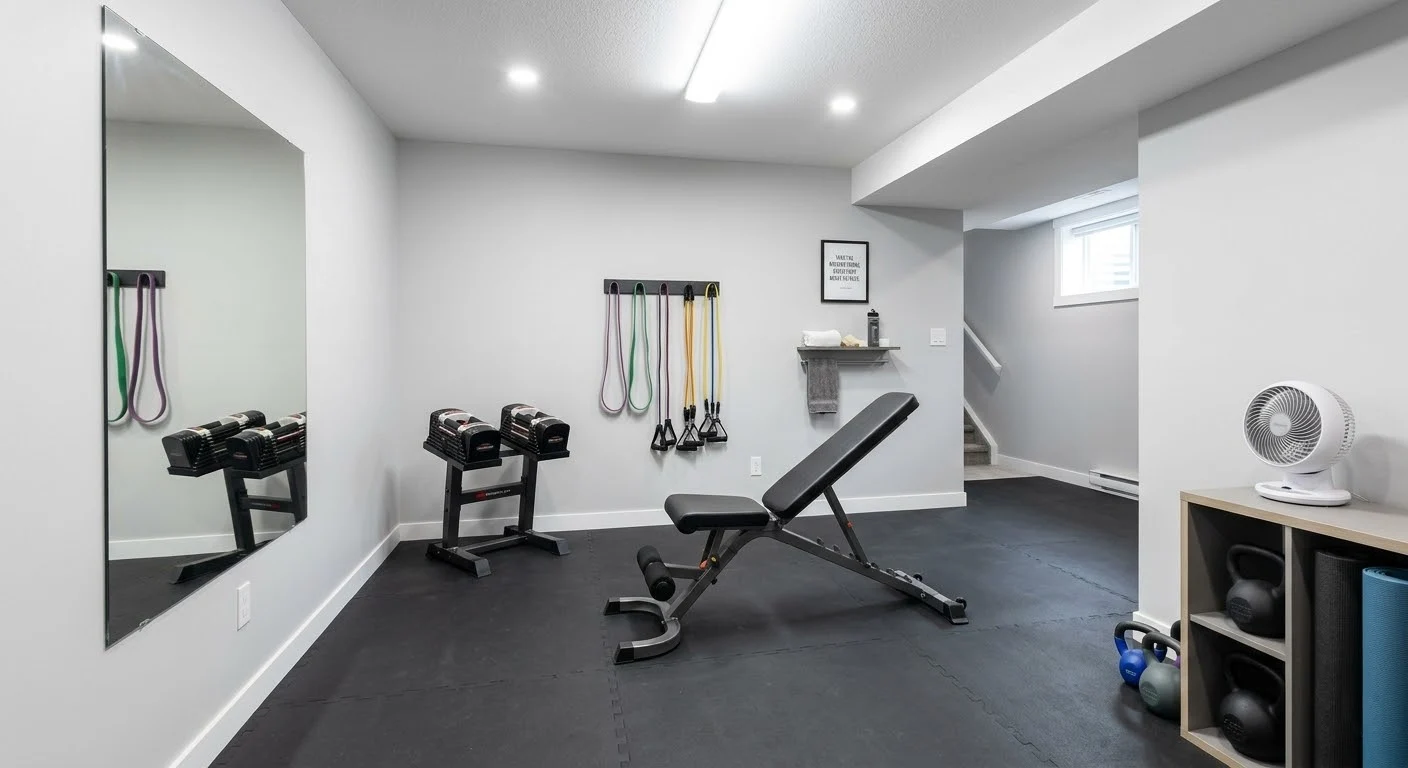
To create a basement home gym on a budget, start by clearing and cleaning the space, then add affordable rubber or foam flooring. Pick multi-use equipment like adjustable dumbbells and resistance bands. Improve lighting, control moisture, and build up your gear over time.
You don’t need a fancy space or a big budget to build a home gym. Your basement — that dark, underused room collecting old boxes — can become the workout spot you actually use. And no, you don’t have to spend thousands to make it happen.
The average gym membership costs around $50 a month, or $600 a year. Over five years, that’s $3,000 out of your pocket — and that doesn’t count gas, time, or waiting around for machines. A well-planned basement gym can pay for itself faster than you think.
This guide walks you through every step, from prepping the space to picking the right gear, so you can build a basement gym that works for your body and your wallet.
Start By Assessing Your Basement Space

Before you spend a single dollar, spend thirty minutes really looking at your basement. Measure the room carefully — the American Council on Exercise says you only need 50 to 200 square feet for a solid multi-purpose workout area. That’s less space than you probably think.
Check your ceiling height next. Building code for a basement requires only 7 feet of ceiling height, but 8 feet is ideal — especially if you plan on lifting a barbell overhead. A lower ceiling isn’t a dealbreaker, but it does affect which exercises and equipment will work for you.
Look for moisture problems too. Basements can be damp, and that’s a real issue for both your health and your equipment. Check the walls and floor for water stains or a musty smell. Fixing moisture issues before you set anything up will save you a lot of headache later.
Clear the Clutter First

This step costs nothing but time, and it makes a bigger difference than people expect. A cluttered basement feels oppressive. A clean one feels like a place where something good can happen. Donate what you don’t need, toss what’s broken, and move the items you want to keep somewhere else in the house.
You’ll be less likely to actually use the space if it’s cluttered or feels uninviting. That’s just the truth. Even the best equipment won’t help if you dread walking into the room.
Once the space is clear, do a good clean — sweep, mop, and wipe down the walls. If your walls are bare concrete or cinderblock, a fresh coat of paint makes a dramatic difference. Paint is the best way to update a space when you have a tight budget. A light gray or white will brighten the room considerably without costing much at all.
Choose the Right Flooring
Bare concrete is rough on your joints and slippery when you sweat. It’s one of the first things you should address. The good news is that quality gym flooring doesn’t have to be expensive.
Foam tiles are affordable and easy to install. They’re soft, making them a good choice for low-impact activities like yoga and stretching. They lock together like puzzle pieces and can be cut with a utility knife to fit around poles or walls. For heavier lifting, rubber mats are a better choice — they’re more durable and can handle dropped weights without cracking.
Here’s a money-saving tip that actual home gym owners swear by: you can save money by using horse stall mats rather than mats marketed for gyms. They’re made from the same dense rubber, cost significantly less per square foot, and hold up just as well under heavy use. You can find them at farm supply stores like Tractor Supply for about $50 per 4×6 foot mat.
Fix the Lighting and Ventilation
Most basements are dim, and working out in bad light is no fun. Overhead lighting is a huge factor in making a space feel livable when there is little to no natural light. If your budget allows it, adding a few recessed can lights connected to a wall switch is worth every penny. If hiring an electrician isn’t in the cards right now, string lights across the ceiling are a cheap and surprisingly effective option.
Ventilation matters just as much. Basements don’t get much airflow, and when you’re sweating through a workout, stale air gets old fast. A portable fan costs under $30 and makes the space feel ten times better. If humidity is a problem — and in many basements it is — a dehumidifier will protect both your equipment and your lungs. You can often find used ones on Facebook Marketplace for well under $100.
Handle Moisture Before It Handles You
A dehumidifier can help control moisture levels. Rubber gym mats can also prevent the concrete floor from collecting moisture, while giving your joints a softer surface to train on. Keeping humidity below 50% will stop mold from growing and prevent metal equipment from rusting.
If you notice water seeping in after heavy rain, address that before anything else. A waterproofing sealant on the walls costs around $30 to $50 for a standard basement and can make a real difference. This isn’t a fun expense, but it protects everything else you invest in down the line.
Pick Equipment That Earns Its Space
This is where a lot of people overspend. They buy a treadmill, a rack, a bench, and a full dumbbell set all at once — and then feel overwhelmed or run out of space. A smarter approach is to start with a few versatile pieces and add more as your routine gets clearer.
If you’re on a tighter budget, focus on essentials like dumbbells, resistance bands, and an exercise mat. These versatile items can support a wide range of exercises without taking up much space or costing a lot. A set of adjustable dumbbells, for example, can replace an entire rack of fixed weights and costs a fraction of the price. Resistance bands run $10 to $30 and work for both strength training and stretching.
Bodyweight exercises can also take you a long way if you’re not ready to splurge on equipment yet. A pull-up bar that fits in a doorframe costs about $25 and opens up a whole range of upper-body movements. A jump rope for cardio runs about $15. You can get an effective full-body workout with just these two items.
Find Great Gear at a Fraction of the Price
New gym equipment is expensive. Used gym equipment is everywhere, and most of it is in great shape because people buy things with good intentions and then stop using them. Facebook Marketplace, Craigslist, and OfferUp are goldmines for home gym gear. You can often find barely-used dumbbells, benches, and even power racks for 50% to 70% off retail price.
You can look for second-hand equipment or browse through local garage sales for pocket-friendly items for your gym. Garage sales in the spring are especially good for this. Weight sets and cardio machines show up constantly, and sellers are usually motivated to get them gone.
Another place people overlook is their own home. When a kitchen was renovated, large mirrors were saved and reused in the home basement gym. The two large mirrors were a great addition to the workout room and it cost zero dollars to reuse them. Mirrors help you check your form, make the room look bigger, and give the space a real gym feel.
Add Mirrors to Improve the Space and Your Form
Mirrors do two things in a basement gym. First, they bounce light around a dark room and make it feel much less like a cave. Second, they let you watch your form during exercises — which matters a lot if you’re training without a coach.
You don’t need custom gym mirrors. Large bathroom mirrors or wardrobe mirrors from IKEA or a thrift store work just fine. Lean them against the wall or mount them securely, and the effect is the same. A couple of large mirrors can completely change how a basement gym feels.
Make It a Space You Want to Use
The technical stuff — flooring, lighting, equipment — gets your gym functional. But the details make it somewhere you actually want to show up every day. Paint a motivational phrase on one wall. Put a small Bluetooth speaker on a shelf. Add a cheap fan, a water bottle holder, and a towel rack.
With your own creative touches and the right equipment, whatever costs you put into this project will make it worthwhile. A space that feels personal and intentional is one you’ll return to. The goal isn’t to copy a commercial gym — it’s to build something that fits your life and your fitness goals.
You don’t have to do this all at once. Start with clean walls, proper flooring, and two or three pieces of equipment. Work out in the space for a few weeks. Then decide what you actually need before spending more. That approach keeps costs low and makes sure every dollar goes toward something you’ll truly use.
Set a Realistic Budget and Stick To It
A basic but fully functional basement gym can come together for $200 to $500 if you’re smart about it. That covers foam or rubber flooring for a small area, a set of resistance bands, adjustable dumbbells or a pull-up bar, and a fan. It’s not glamorous, but it gets you moving.
A mid-range setup with used equipment — a bench, a barbell set, rubber mats, and a mirror — usually runs $500 to $1,500 depending on what you find and where. That’s still less than three years of a gym membership. And unlike a membership, you own everything. It stays with you as long as you want it.
The key is to buy based on how you actually work out, not how you imagine you will. If you’ve never touched a barbell, don’t start by buying a power rack. Buy a jump rope and some dumbbells, build the habit first, and then invest in bigger gear when you know you’ll use it.
Building a basement home gym on a budget is completely doable. The space is already there — you just have to claim it. Start small, stay consistent, and build up over time. The best gym is the one you show up to every day, and that one is right downstairs.


Comments are closed.