
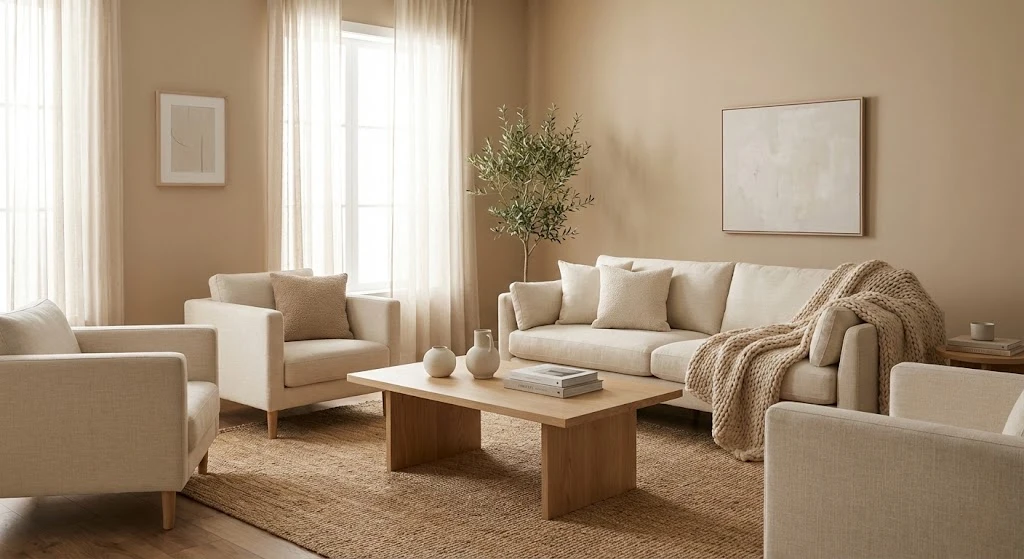
Balanced Beige vs Accessible Beige: Balanced Beige (SW 7037) and Accessible Beige (SW 7036) are both warm neutral paint colors by Sherwin Williams. Accessible Beige has an LRV of 58, making it lighter and more flexible. Balanced Beige has an LRV of 46, giving it more depth and a richer, earthier feel. Your room’s light levels decide which one wins.
Picking a beige paint color sounds simple until you’re staring at 12 swatches that all look the same under the store lights. Then you get home, hold them up to your wall, and suddenly nothing makes sense anymore. That’s the beige trap — and it gets most of us at least once.
Two colors that constantly end up in the final round are Sherwin Williams Balanced Beige (SW 7037) and Sherwin Williams Accessible Beige (SW 7036). They live right next to each other on the same color strip. They’re both warm. They’re both neutral. And yet they can look completely different once they’re on your walls.
This guide breaks down everything you need to know about both colors — their undertones, their LRV numbers, how they behave in different rooms, and which one actually fits your space.
What Is Accessible Beige SW 7036?

Accessible Beige is one of the most popular paint colors Sherwin Williams has ever released. It’s not hard to see why. It sits in that perfect sweet spot between beige and gray — what designers call “greige” — and it works in almost any room, any style, and any light condition.
The color has an LRV (Light Reflectance Value) of 58. That number tells you how much light bounces off the wall. On a scale of 0 to 100, where 0 is pure black and 100 is pure white, a 58 puts Accessible Beige solidly in the medium-light zone. It’s light enough to keep a room feeling open, but it has enough depth to actually read as a color rather than an almost-white.
The undertones in Accessible Beige are where things get interesting. It carries a mix of soft gray and very subtle green, which is why it reads as greige rather than a traditional warm beige. In a room with lots of natural light, it can look almost taupe. In a room with warmer artificial lighting, it leans more golden. That flexibility is exactly what makes it so popular for whole-home use.
What Is Balanced Beige SW 7037?
Balanced Beige sits one step darker than Accessible Beige on the same Sherwin Williams color strip. That single step makes a real difference in how it feels in a room.
With an LRV of 46, Balanced Beige absorbs more light. That gives it more presence and depth compared to its lighter neighbor. Where Accessible Beige can look soft and airy, Balanced Beige feels grounded and earthy. Some people describe it as a beige-greige mix that leans slightly toward brown in certain lighting conditions.
The undertones in Balanced Beige are more taupe-forward than Accessible Beige, with a passive warmth that doesn’t push too far into yellow or orange territory. The name really does say it all — it’s balanced, sitting right between warm and cool without committing hard to either direction. That said, because of its lower LRV, the color can shift depending on your light source. In a north-facing room with cool, flat light, it may look darker and more brown. In a south-facing room with warm afternoon sun, it can glow in a really beautiful way.
LRV and Undertones: The Numbers That Actually Matter
When you’re comparing two colors this close to each other, the LRV and undertones are the two things that really separate them. Everything else — price, finish options, application — is essentially the same.
Accessible Beige sits at LRV 58. Balanced Beige sits at LRV 46. That 12-point gap is significant. It’s not subtle. If you paint two adjacent rooms — one in each color — you’ll see the difference clearly when you stand in the doorway.
The undertone story is equally important. Accessible Beige carries gray and green undertones, which explains why it looks so clean and modern despite being a beige. Balanced Beige carries taupe undertones that feel warmer and more traditional. This means the two colors actually pair beautifully together in the same space — Accessible Beige on a main wall and Balanced Beige on an accent wall or trim creates a layered, intentional look that feels pulled together.
How Each Color Behaves in Natural Light
Light is the single biggest factor in how paint colors look in real life — more than the color itself sometimes. Both of these colors shift based on the light in your room, and knowing what to expect will save you from painting a room twice.
Accessible Beige is more forgiving across different light conditions. It adapts well in rooms facing north, south, east, or west because its gray undertones balance out the warmth. It tends to stay consistent from morning to evening, which is why designers often recommend it for open-concept spaces where multiple rooms flow together.
Balanced Beige is a bit more sensitive to light. In rooms with strong natural light, it looks rich and warm — think cozy living room or sunroom. In darker rooms or spaces that rely heavily on artificial light, it can read more brown and feel heavier than you expected. This doesn’t make it a bad choice for low-light rooms. It just means you should absolutely test a large swatch before committing.
Best Rooms for Accessible Beige
Accessible Beige shines in large, open spaces. If you have an open-concept floor plan where your kitchen, dining room, and living room all flow into each other, this is the safer choice of the two. Its lighter LRV keeps big spaces from feeling closed in, and its neutral undertones mean it plays well with a wide range of furniture colors and flooring materials.
It works beautifully on kitchen cabinets too — especially if your countertops have cool-toned stone or your backsplash leans gray or white. Paired with a crisp white trim like Sherwin Williams Pure White or Alabaster, Accessible Beige looks clean and current without feeling trendy.
On the exterior, Accessible Beige handles itself well on siding and trim. It reads as a traditional, warm neutral from the street, and it coordinates with brick, stone, and most roof colors.
Best Rooms for Balanced Beige
Balanced Beige earns its place in rooms where you want a little more drama and depth. Bedrooms are a natural fit. The color wraps a bedroom in warmth without making it feel dark or heavy, especially if you pair it with soft white bedding and light-colored wood furniture.
Accent walls are another great use for Balanced Beige. If your main walls are painted in Accessible Beige, adding Balanced Beige to a fireplace wall or a reading nook creates contrast without breaking the color story. It’s a subtle shift that feels intentional.
It also works in basements. Many basements feel cold and cave-like because they lack natural light. Balanced Beige brings warmth into those spaces, and its earthy depth can actually make a basement feel intentionally cozy rather than accidentally dim.
Coordinating Colors for Both Shades
Both colors share similar coordination needs, which makes it easy to build a palette around either one.
For trim, Sherwin Williams Alabaster (SW 7008) works with both colors. It’s a soft warm white that doesn’t create harsh contrast. Pure White is a slightly cooler option that adds a bit more crispness — great if you want your trim to stand out more.
For accent colors, both beiges love a good blue. Sherwin Williams Naval (SW 6244) pairs with Accessible Beige for a classic coastal or traditional look. Upward (SW 6239) — which was Sherwin Williams’ 2024 Color of the Year — also works as a soft, modern complement.
If you want a deeper accent, Sherwin Williams Urbane Bronze (SW 7048) pairs exceptionally well with Balanced Beige. The rich, dark bronze tone makes Balanced Beige’s warmth pop in a way that feels sophisticated and grounded.
So Which One Should You Choose?
The answer really comes down to two things: how much light your room gets, and how much depth you want the color to have.
Choose Accessible Beige if your space is large or open-concept, if you want a color that stays consistent throughout the day, or if you’re nervous about going too dark. It’s the more flexible of the two, and it earns its reputation as a go-with-everything neutral.
Choose Balanced Beige if you want more warmth and earthy richness, if your room gets good natural light, or if you specifically want a color with more presence. It’s the better choice for bedrooms, accent walls, and spaces where you want the room to feel cozy rather than airy.
Either way — and this is worth saying clearly — test both colors on your actual walls before buying a full gallon. A 12-point LRV difference can look significant or subtle depending entirely on your specific space. Get peel-and-stick samples, put them up in large patches, and live with them for a day or two. Morning light, afternoon sun, and evening lamps will each tell you something different about which color belongs in your home.
Both colors are genuinely beautiful. The right one is simply the one that works best with your light.


Comments are closed.