
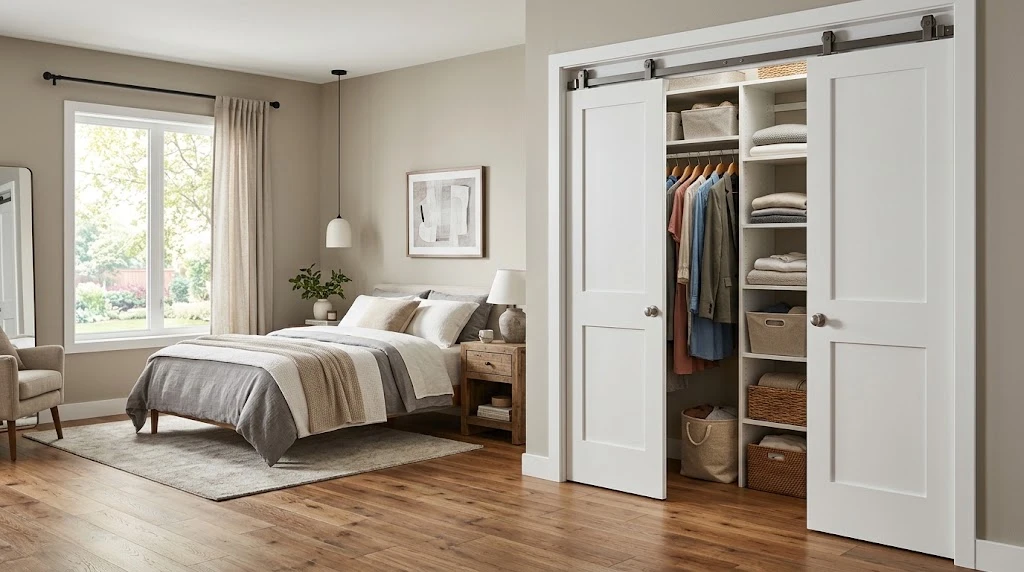
Bifold closet doors are hinged panels that fold in half and slide along a top track as you open them. They need very little swing space, so they suit small rooms. Standard widths run from 18 to 36 inches, and most fit an 80-inch-tall opening.
What Are Bifold Closet Doors?
Bifold closet doors are made of two or more panels joined by hinges. When you pull the knob, the panels fold against each other and stack to one side of the opening. A track at the top and a pivot at the bottom guide the movement. You will find them in bedrooms, hallways, laundry rooms, and pantries in homes of every age.
Builders have used them for decades because they solve a common problem. A regular hinged door needs a wide arc of open floor to swing. A bifold door needs only a few inches. If your closet sits beside a bed or a dresser, that small difference matters every morning.
How Bifold Doors Work

A basic bifold set has two panels hinged together. One panel pivots on a bracket at the edge of the opening. The other panel carries a small guide wheel that rides inside the top track. When you pull the knob, the wheel slides along the track while the hinge folds the panels flat.
Wider closets use four panels, which come as two pairs. Each pair folds toward its own side of the opening, and the two pairs meet in the middle when closed. The set ships with a kit that includes the track, pivots, brackets, and screws. The quality of that hardware decides how smoothly the doors run for years, so check it before you buy.
Why People Choose Bifold Closet Doors

Space is the main reason. Imagine a small bedroom with a bed three feet from the closet. A swing door would hit the mattress, but a bifold door folds back without touching it. You get the closet back without moving any furniture.
Access is another reason. A sliding door lets you reach only half of the closet at a time, because the other half stays behind the second panel. A four-panel bifold set opens most of the width, so you can see all your shoes and shelves at once.
Price and ease of installation also help. Bifold doors usually cost less than custom sliding systems or pre-hung hinged doors. A handy homeowner can hang a set in an afternoon with a drill, a level, and a tape measure. They also come in many looks, from plain white panels to wood slats to full mirrors.
Drawbacks to Know Before You Buy
Bifold doors have limits, and you should know them. The folded panels stay inside the opening, so they cut the clear width by several inches. In a narrow closet, that can make it harder to pull out a large box. Also, the top track is the weak point. If a child yanks the door or someone slams it, the guide wheel can jump out of the track.
Cheap hollow-core panels dent and scuff easily. Low-grade hardware wears out faster, and the doors begin to stick or sag. A bifold door also does not seal sound or light the way a solid hinged door does. If you want a closet that stays quiet or dark, a standard door works better.
Types and Materials

Hollow-core doors are the most common and the cheapest. They have a thin skin over a light inner structure, so they weigh little and put less strain on the track. The downside is that they dent when bumped. They work well in kids’ rooms, guest rooms, and rental units.
Solid wood doors cost more, but they feel sturdy and last longer. Pine, oak, and other woods take paint or stain well. They weigh more, so they need good hardware. Louvered doors have angled slats that let air move through the closet. They suit laundry rooms, pantries, and any closet where clothes or towels need to stay fresh.
Mirrored bifold doors place glass on a frame, which gives you a full-length mirror and makes a bedroom feel bigger. They are heavy, so use a strong track and mount it into solid framing. Frosted or clear glass panels let light pass through, and they fit modern rooms. Vinyl and composite doors resist moisture and wipe clean, which makes them a good fit for laundry areas and basements.
Standard Bifold Closet Door Sizes
Common widths run from 18 to 36 inches for a single pair, in steps such as 24, 28, 30, 32, and 36. Four-panel sets cover wider openings and often come in 48, 60, and 72 inches. Standard heights are 80 inches and 96 inches. Stores sell most doors in these sizes, so you rarely need to special order.
Watch the difference between nominal and actual size. A door labeled 36 by 80 inches may measure about 35½ by 79 inches in real life. That small gap leaves room for hardware and lets the door move without rubbing. If your opening is not standard, many makers build custom sizes, though the price goes up.
How to Measure for Bifold Closet Doors
Start by checking that the opening is level and square. Measure the width at the top, middle, and bottom of the opening. Use the smallest number. Then measure the height on the left, in the center, and on the right, and again use the smallest number.
Write the numbers down and compare them with the door sizes in the store. If you measure 35¾ inches wide, a 36-inch door will usually work. Check the floor too. A thick carpet or new flooring can change the height you need, so measure with the final floor in place. If you plan to add trim or a frame, subtract that space first. When your numbers fall between standard sizes, buy the next size down and plan to adjust the hardware, or order a custom set.
What Bifold Closet Doors Cost
Prices depend on the material, size, and hardware. One source puts hollow-core bifold doors at about $25 to $150 each. Solid wood bifold doors run from about $100 to $500 each, depending on the wood and size. Complete door kits for a pair can range from roughly $120 to $900.
Installation adds to the total. Estimates for hiring a pro, including the door and labor, range from about $75 to $1,500 per opening, which is a wide spread. Prices vary by region, so get two or three local quotes. You can save money by choosing standard sizes, picking hollow-core or composite panels, and installing the doors yourself.
How to Install Bifold Closet Doors
Gather a drill, a level, a tape measure, a pencil, and a screwdriver. Start by laying the door set flat and checking that you have every part. Fit the top track into the opening and mark where it should sit. The track should be centered, so measure from each side. Screw it into the header, which is the framing above the opening.
Next, attach the bottom pivot bracket to the floor or the bottom of the jamb, in line with the track. Slide the top pivot pin of the first panel into the track, then set the bottom pivot into its bracket. Do the same on the other side if you have a four-panel set. Then hang the sliding panels so the guide wheels sit in the track.
Close the doors and look at the gaps. They should be even from top to bottom. Most kits let you turn the pivots to raise, lower, or shift the door. Make small turns and check after each one. If the doors are too tall, trim a little from the bottom edge of each panel, and keep the cut straight.
Fixing Common Problems
Most bifold troubles come from small issues you can fix in minutes. If a door sticks, check the track for dust, paint, or pet hair. Wipe it clean and rub a little silicone spray or candle wax along the track. Avoid heavy grease, because it collects dirt.
If a door sags or leaves a gap at the top, tighten the pivot screws and adjust the pivots. If the guide wheel pops out, lift the panel, set the wheel back into the track, and check that the wheel is not cracked. Replacement wheels and pivots cost a few dollars at any hardware store. A quick check twice a year keeps the doors running well.
Style Ideas for Your Closet
Paint is the cheapest way to change the look. A white door suits most rooms, while a deep green or navy gives a bedroom some character. Use a good primer first, especially on wood, and lightly sand between coats so the finish stays smooth.
New hardware makes a big difference too. Swap the small default knobs for brushed brass, black metal, or wood pulls. Add trim around the opening so it looks built in. In a laundry room, use louvered doors for airflow. In a bedroom with little light, mirrored doors bounce light around the room and save you from buying a separate mirror.
Is a Bifold Closet Door Right for You?
If you have a tight space and a modest budget, bifold doors are a smart choice. They fold out of the way, they cost less than most other door types, and you can install them yourself. Measure carefully, pick hardware you trust, and choose a material that fits the room.
If you want the best sound blocking or a very wide closet opening with no panels in the way, consider other styles. For most homes, though, a good bifold set does the job well. Take your measurements this weekend, compare a few kits, and pick the one that suits your closet.


Comments are closed.