
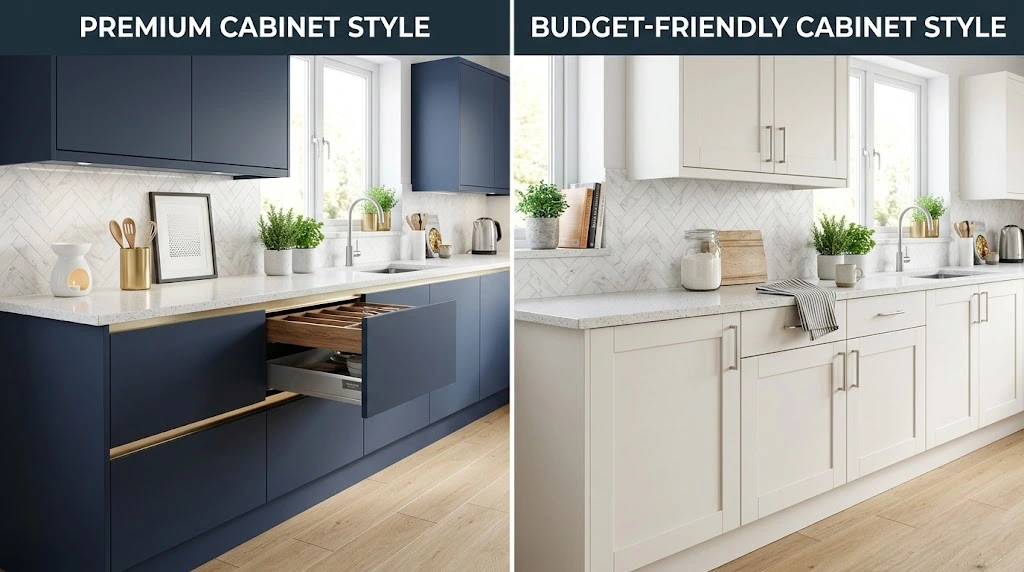
Cubitac and Fabuwood are both mid-range kitchen cabinet brands known for plywood construction, soft-close features, and solid warranties. Cubitac costs less and offers more custom color options. Fabuwood delivers faster lead times, Blum hardware as standard, and a limited lifetime warranty on most of its lines.
Picking kitchen cabinets should be straightforward. You browse some styles, check the price, and place your order. But once you start comparing brands like Cubitac and Fabuwood, the details start to pile up fast — construction methods, warranty tiers, hardware upgrades, lead times. It gets overwhelming quickly.
Both brands show up on every contractor’s shortlist for a reason. They sit in that sweet spot between cheap flat-pack cabinets and expensive custom lines. But they are not the same product. Each one has real strengths and real trade-offs, and knowing those differences can save you thousands of dollars and a lot of headaches during your remodel.
This article walks you through everything that matters — construction, style, price, warranty, and delivery. By the end, you will know exactly which one fits your project.
Where These Two Brands Come From
Cubitac has nearly three decades of industry experience and operates out of Ridgefield, New Jersey. The company built its name by sourcing materials globally and using that buying power to keep prices competitive. They focus on serving contractors and homeowners who want a quality cabinet without paying custom prices.
<Fabuwood launched in 2009 and operates out of Newark, New Jersey. Despite being the newer brand, it grew fast and now runs a million-square-foot facility that handles most of its assembly and storage in one place. That size gives Fabuwood a real operational edge, especially when it comes to lead times and inventory. Fabuwood also won the KBB Readers Choice Award for Kitchen Cabinets in 2021, which helped cement its reputation nationally.
Both brands distribute through authorized dealer networks across the U.S., mainly concentrated in the Northeast. If you are outside that region, availability might affect which one you can realistically access.
How They Are Built: Materials and Construction Quality

This is where most homeowners start, and rightfully so. A cabinet that looks great on day one but falls apart in five years is not a deal — it is a waste.
Both Cubitac and Fabuwood use all-plywood construction for their cabinet boxes. You get solid hardwood face frames and dovetail drawer boxes in both lines. Neither brand relies on particleboard for the main structure, which is a significant quality marker. For painted cabinet doors, both brands use MDF center panels — a smart move that prevents cracking caused by humidity changes.
The meaningful difference comes in the hardware. Fabuwood includes Blum soft-close hinges and full-extension drawer slides as standard across most of its collections. Blum is considered some of the best hardware on the market, rated for over 200,000 open-and-close cycles. With Cubitac, soft-close functionality is available, but Blum hardware often comes as a paid upgrade rather than a default feature. If you want premium hardware without the upcharge, Fabuwood has the edge here.
Fabuwood also holds FSC certification and CARB2 compliance, meaning its materials meet strict environmental and low-emission standards. Cubitac uses responsibly sourced materials as well, but does not publicize the same level of third-party certifications. For families focused on indoor air quality or eco-conscious sourcing, that transparency matters.

Style and Design Options
You want cabinets that actually look good in your kitchen — so style matters just as much as specs.
Fabuwood offers a wide range of door styles, from traditional raised-panel looks to sleek modern profiles. Their collections — including the Allure, Illume, and Quest series — cover everything from farmhouse kitchens to minimalist city lofts. One standout feature is their custom color capability, where certain lines can be ordered in any Benjamin Moore color. That level of color flexibility is rare at this price point.

Cubitac also delivers strong design variety with multiple door styles and finish options. Where Cubitac particularly shines is in custom paint and finish options across its lineup. Contractors who have worked with both brands often point to Cubitac’s unique finish choices as a real differentiator — especially for clients who want something specific and non-standard.
If you are after a trendy, on-trend look with broad style options and semi-custom sizing for unusual kitchen layouts, Fabuwood has a slight advantage in flexibility. If you have a very specific color vision, Cubitac’s custom paint options could be the deciding factor.
What You Will Actually Pay
Budget is always part of the conversation, and these two brands land in different spots on the pricing scale.
Cubitac is generally the more affordable option. Its per-linear-foot cost can dip below $300, making it one of the better-value options among assembled cabinet brands. Fabuwood runs higher — their semi-custom cabinet units typically range from $300 to $700 per unit, with a full kitchen installation running anywhere from $20,000 to $40,000 before countertops and appliances. Their economy lines start closer to $150 per unit, but the mid-tier collections are where most buyers land.
Fabuwood does run seasonal promotions and dealer discounts that can close that gap. So the price difference is not always as wide in practice as it looks on paper. Still, if your budget is tight and you need to stretch every dollar, Cubitac will give you more room to work with.
One thing worth factoring into your budget beyond the sticker price is lead time. Fabuwood’s faster turnaround can actually save money if you are paying a contractor by the day. Delays cost real money during a remodel.
Warranty: What Each Brand Covers
Warranty coverage tells you how much confidence a brand has in its own product. Both brands have improved their coverage in recent years, but the details still differ.
Cubitac offers a limited lifetime warranty that applies to the original residential purchaser. This upgrade from their earlier 5-year warranty puts Cubitac in a stronger position than many brands in this price category. The warranty covers manufacturing defects in materials and workmanship, though it does not include labor costs or damage from wear and tear.
Fabuwood updated its warranty structure in October 2024. Their Allure, Illume, Value Premium, Quest, and Valencia series now all carry a limited lifetime warranty for the original purchaser. Cabinets purchased before that date fall under the previous 5-year terms. Like Cubitac, Fabuwood’s warranty excludes wear and tear, improper installation, and exposure to extreme conditions.
One practical note on Fabuwood’s warranty process: dealers report that Fabuwood sometimes requires damaged parts to be returned before sending replacements. That can slow things down compared to other brands, including Cubitac, which tends to handle claims more quickly.
Lead Times and Getting Your Cabinets Delivered
If you are working on a tight renovation schedule, lead time can be the deciding factor.
Fabuwood wins this category. Most of their standard stock cabinets ship within 7 to 10 days, and even their semi-custom options typically arrive within two weeks. That speed comes directly from their centralized, million-square-foot New Jersey facility. Contractors on tight timelines consistently name Fabuwood as their preferred option for this reason.
Cubitac’s lead times run longer — generally 2 to 8 weeks depending on the order and your local dealer. For a large, custom-heavy order, that wait could stretch further. If your project can absorb a longer lead time, this is not a dealbreaker. But if your kitchen is torn apart and your contractor is on the clock, Fabuwood’s speed advantage becomes very real, very fast.
Customer Service and Support
Both brands work through authorized dealer networks, which means your first line of support is your local dealer rather than the manufacturer directly.
Fabuwood’s larger size gives it an infrastructure advantage for handling claims and replacements at scale. However, some customers report that communication can require follow-up across multiple channels, and the replacement process for shipping damage sometimes takes more time than expected.
Cubitac, being a smaller company, often delivers a more personal customer service experience. Contractors who work with both brands frequently mention that Cubitac is easier to reach and faster to resolve individual issues. That personalized attention is worth something, especially on a complex or large-scale kitchen project.
Which One Should You Choose?
There is no wrong answer here — only the answer that fits your project.
Choose Cubitac if your budget is the top priority, you want custom color or finish options, and you are comfortable with a longer lead time. It is a strong performer at a lower price point, with a lifetime warranty that punches above its tier.
Choose Fabuwood if you want Blum hardware as a standard feature, eco-certified materials with documented compliance, faster delivery, and the reliability of a brand with a strong national reputation. The slight premium in price is often justified by what you get out of the box.
Both brands build quality cabinets for the money. The difference is in the details — and now you know them.

Comments are closed.