
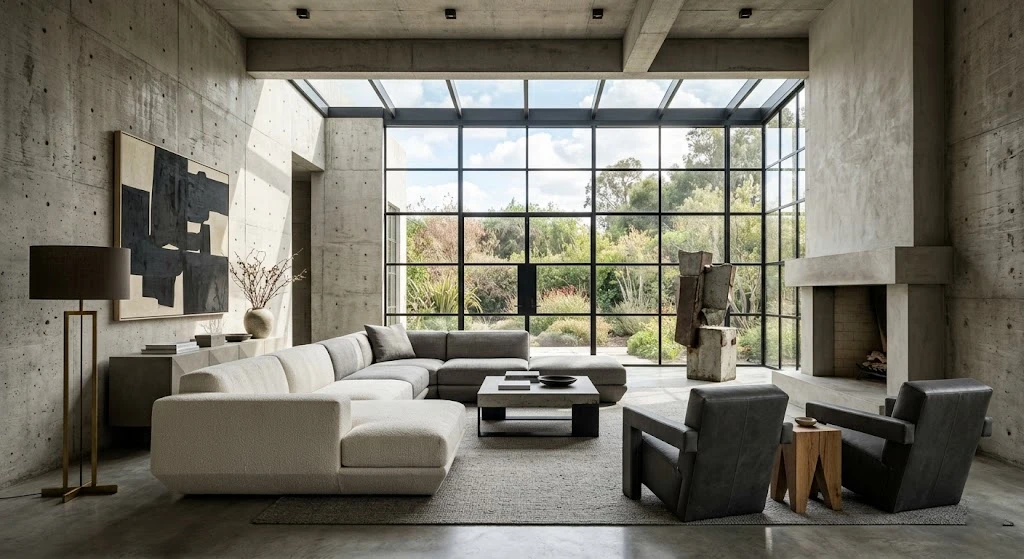
Brutalist interior design is a style rooted in raw materials, exposed concrete, and bold geometric forms. Originating in the 1950s, it celebrates honesty in construction — leaving surfaces unfinished and structures visible. Today, designers use it to create spaces that feel powerful, intentional, and anything but ordinary.
When you walk into a brutalist interior, you feel it immediately. The air is different. The walls don’t pretend to be anything they’re not. There’s raw concrete, heavy geometry, and a kind of quiet confidence that doesn’t need decoration to make a statement. It’s the design equivalent of a firm handshake.
Brutalist interior design isn’t for everyone — and that’s exactly the point. It’s a style that values honesty over prettiness, function over fuss, and materials in their most natural state. If you’ve ever stood in a space that felt genuinely powerful without a single throw pillow in sight, you’ve probably been in a brutalist room.
This article breaks down what brutalism is, where it came from, what makes it work, and how you can bring it into your home — even if you’re not ready to pour concrete countertops just yet.
Where Brutalism Actually Came From

The word “brutalism” comes from the French phrase béton brut, which simply means “raw concrete.” Architects like Le Corbusier, Louis Kahn, and Paul Rudolph popularized this approach in the mid-20th century, believing that functional spaces needed no extra ornamentation to be beautiful.
The style emerged during the post-war era of the 1950s, and architectural historian Reyner Banham was among the first to give it a name. From the start, brutalism built its identity on raw industrial materials — and concrete was the star.
Britain embraced the style heavily through the 1960s and ’70s. Iconic buildings like London’s Barbican Centre and Boston City Hall became defining examples — massive concrete blocks, angular shapes, and fortress-like exteriors that divided opinion almost immediately.
By the 1980s, brutalism lost its audience. Concrete exteriors cracked and discolored. People found the buildings cold and tied them to urban decay. The style quietly stepped aside while the design world moved toward bright colors and soft, suburban warmth.
But design has a long memory. By the late 2010s, brutalism was back. When Kim Kardashian and Kanye West overhauled their Calabasas home in a raw, concrete-heavy style, the internet took notice — and so did designers across the country. Americans began embracing minimalism seriously, and brutalism came along for the ride.
The Core Materials That Define the Look

Concrete walls, concrete floors, exposed pipes, exposed beams, unpainted surfaces, and rough textures — these are the building blocks of brutalist interiors. The key is that these features are often left unfinished or deliberately distressed, which adds authenticity rather than taking away from it.
Alongside concrete, metal plays a major role. Chosen for its inherent simplicity and perceived strength, metal gives brutalist interiors their strong industrial character. More recently, sculptural metal furniture and decor — angular vases, wall sculptures, and geometric objects — have become signature elements of the style.
The beauty of brutalism is that it doesn’t cover anything up. What you see is exactly what’s there — and that’s the whole point.
Patinated finishes add another layer of texture. As metals and stone age, they develop a thin surface layer through oxidation — and brutalist designers love that process. It makes spaces feel lived-in and honest, not polished or manufactured.
Because the industrial materials can feel heavy on their own, brutalist interiors often contrast them with wood, linen fabrics in soft beige tones, and metallic lighting. These additions give the space a lighter personality without stripping away its core character.
Shapes, Forms, and What Makes Brutalism Geometric
Brutalist furniture looks like it was carved from a single block of material. Tables, chairs, and cabinets appear massive and weighty. These pieces often lack traditional joinery details — instead, they showcase continuous surfaces and solid construction. Think coffee tables that seem cut from stone, or wooden benches with no visible seams.
Repetition also plays a major role. Identical shelving units lined in rows, square or rectangular modules across walls — this repetition builds visual strength while keeping a sense of order. It’s structured without being rigid, and bold without being chaotic.
Beyond furniture, strong sculptural elements define brutalist spaces. The forms are bulky, unfinished, stark, and monolithic — but they’re arranged with intention. Nothing is accidental. The heaviness of each piece is part of the design language.
A note on color: Brutalist interiors typically stick to a monochromatic palette — grey, beige, off-white, and charcoal. This restraint lets the textures and forms do the talking. Color accents, when they appear, are usually earthy and deliberate rather than decorative.
Brutalism vs. Industrial Design — They’re Not the Same
People often mix up brutalist and industrial design. They share some DNA, but they’re genuinely different styles with different intentions.
Industrial interiors draw from old factories and warehouses. That style brings in weathered elements, earthy tones of grey, brown, and black, along with reclaimed materials and vintage pieces. The overall feel is utilitarian — like a space that once had a job to do and still remembers it.
Brutalist interiors, on the other hand, come from the architectural movement. They carry a sense of geometric grammar, monumentality, and sculptural intention. The look is bold and massive, with neutral and monochrome shades, but the goal is artistic expression — not just raw function.
Think of industrial design as the worn, working-class cousin. Brutalism is the architect who studied in Paris and came back with strong opinions about concrete.
How to Build a Brutalist Interior in Your Home
You don’t need to gut your walls to pull off this style. Brutalism works in degrees — and starting small is completely valid.
Start with your surfaces. If you have the option to expose a brick or concrete wall, do it. If not, concrete-effect tiles and panels are widely available and give you the same visual weight without major renovation. Most large-scale concrete walls and flooring in modern interiors are actually concrete tiles — the raw material is difficult to refine enough for residential use, so tiles are the practical alternative.
Next, look at your furniture. Swap out overstuffed, rounded pieces for something with hard edges and visual mass. A solid stone coffee table, a steel-frame shelving unit, or a chunky wooden bench all move you in the right direction. You want pieces that look like they mean it.
From there, your lighting becomes a key connector. Metallic pendant lights and architectural floor lamps tie the brutalist pieces together while adding some refinement to the rawness. Silver or warm gold metal finishes work well — they contrast the grey palette without fighting it.
Textiles and plants are also welcome in a brutalist space. Linen throws, wool rugs, and simple greenery soften the harder elements and make the space feel livable. The goal is powerful, not punishing.
Why Brutalism Still Matters in 2025
There’s a growing appreciation for this style today, and it’s not just nostalgia. Concrete has become genuinely popular as a design material — and with it, the brutalist approach has found a new generation of designers and homeowners who want something real.
Modern designers appreciate brutalism’s honest approach to materials. What you see in a brutalist room is exactly what’s there — no veneers, no paint over problems, no decorative tricks to distract from a weak structure. In an age of curated everything, that kind of honesty is genuinely striking.
The style dominated design conversations in 2023 and continued strong into 2024. Beyond basic concrete aesthetics, designers are now layering in geometric shapes, statement furniture, bold textures, and occasional flashes of deep color — making the style more approachable without losing its edge.
Brutalism endures because it asks a real question: what happens when you stop hiding your materials and start celebrating them? The answer, as it turns out, is a space that feels more considered and more confident than almost anything else you can design.
If you’re tired of spaces that try too hard and say too little, brutalism offers a straightforward alternative. Show the structure. Trust the material. Let the room speak at full volume — without saying a single word.

Comments are closed.