
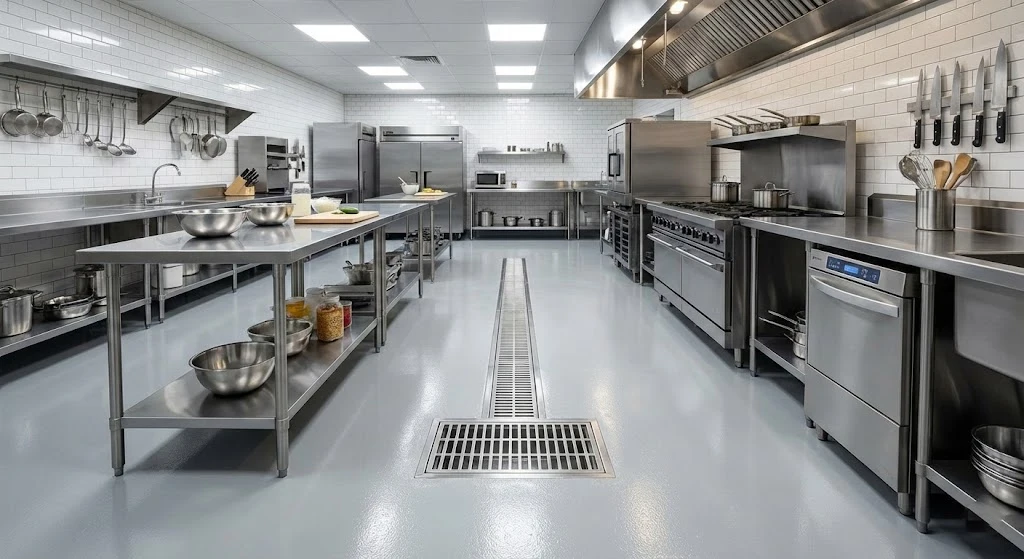
All flooring in food prep areas must be smooth, non-absorbent, slip-resistant, and easy to clean. The FDA Food Code requires durable, non-porous materials—like epoxy, quarry tile, or commercial vinyl—that resist moisture, grease, and heavy foot traffic while allowing quick, thorough sanitation between uses.
If you run a restaurant, a commercial kitchen, or any food service operation, your floors matter more than you might think. Health inspectors look at them closely. The FDA has specific rules about them. And the wrong choice can cost you your operating license.
The short answer to “all flooring in food prep areas must be” is this: non-absorbent, smooth, slip-resistant, and easy to clean. But there’s a lot more to understand behind that answer — from which materials actually pass inspection to how your floor should connect to the walls. This guide breaks all of it down in plain language.
Why Flooring Rules in Food Prep Areas Exist

Think about what happens on a commercial kitchen floor every single day. Raw meat juices drip from counters. Grease splatters from fryers. Water pools near sinks and dishwashers. Staff walk across it hundreds of times during a single shift. Now imagine that floor has tiny cracks, porous grout, or rough patches that trap all of that residue.
That’s not just a cleaning problem — it’s a food safety problem. Bacteria like Salmonella and E. coli can live in flooring cracks and re-contaminate food, equipment, or hands. Non-porous surfaces resist stains, spills, and chemicals, making them easier to clean and reducing the time required for maintenance tasks.
The regulations exist to stop contamination before it starts. The FDA Food Code, OSHA, and HACCP (Hazard Analysis and Critical Control Points) all have clear standards that food service operators must follow. Most state and local health departments adopt these federal guidelines as the baseline for their own inspections.
The Core Requirements: What the FDA Food Code Says

The FDA Food Code establishes that floors shall be designed, constructed, and installed so they are smooth and easily cleanable. Beyond that basic rule, floors shall be constructed of smooth, durable, nonabsorbent, grease-resistant, and easily cleanable materials for food preparation, open food handling, or dishwashing areas.
Let’s look at each of those properties and why they matter.
Smooth means no rough textures that trap food particles or moisture. A smooth surface lets cleaning tools do their job completely.
Durable means the floor can handle constant foot traffic, heavy equipment, dropped objects, and the daily stress of a working kitchen without cracking or deteriorating.
Non-absorbent means liquids sit on the surface rather than soaking in. Any porous material — like unsealed concrete, untreated wood, or standard grout — will absorb moisture and become a breeding ground for bacteria over time.
Grease-resistant is especially important near cooking stations where oil and fat regularly contact the floor. A floor that grease seeps into is nearly impossible to clean properly.
Easily cleanable ties all of these together. If the floor can’t be fully cleaned and sanitized during regular operations, it poses a consistent hygiene risk.
What Flooring Materials Actually Pass Inspection
Not every material works in a food prep environment. Here’s a breakdown of the most common options that meet FDA and HACCP standards.
Epoxy Flooring
Epoxy is a popular choice for FDA-approved flooring due to its seamless nature and resistance to chemicals, stains, and moisture. A proper epoxy floor is poured and troweled on at a minimum thickness of 1/4 inch. It creates a single continuous surface with no seams or joints where bacteria can hide.
Epoxy works well in most kitchen areas, but it has one weakness: thermal shock. If your kitchen uses high-temperature steam cleaning or sees frequent hot water spills, epoxy can crack over time. For kitchens with frequent hot spills or steam cleaning, urethane cement or polyurethane systems are more appropriate. Urethane cement floors can last 15 to 25 years in demanding environments, while standard epoxy may only last 5 to 10 years under heavy use.
Quarry Tile
Quarry tile is a go-to choice for wet areas like sculleries, dishwashing stations, meat and fish prep areas, and anywhere that gets power-washed. It’s extremely durable and handles moisture well. The key is the grout. Grout between tiles must be sealed to be impervious to water, grease, and acid — epoxy grout is the required standard for tile floors.
Grout spacing matters too. Gaps wider than 1/4 inch collect debris and become nearly impossible to sanitize. Always use an experienced installer who understands food safety requirements.
Commercial Vinyl Flooring
Commercial-grade sheet vinyl is another widely accepted option, particularly for full-service kitchens and limited food prep areas. The seams must be heat-welded or chemically welded — not simply laid side by side — to prevent moisture from getting underneath. 100% homogenous vinyl flooring recommended by the manufacturer for use in commercial kitchens must have heat-welded seams a minimum of 4 inches high with a 3/8-inch self-coved base.
Standard vinyl composition tile (VCT) — the kind you’d see in a grocery store aisle — is generally not acceptable in active food prep zones. It’s porous enough to absorb moisture and is difficult to fully sanitize.
Poured Flooring Systems
A poured flooring system is a multi-layered flooring product installed in a specific manner and designed for use in a retail food facility. This type of flooring is not a sealant or a coating. These systems, offered by manufacturers like Sherwin Williams, BASF, and Florock, go through regulatory review and are approved for specific commercial uses. They require a factory-trained installer and provide a durable, seamless surface ideal for high-demand kitchens.
The Cove Base Requirement Most People Miss
One detail that surprises many first-time kitchen owners is the cove base rule. Floor surfaces shall be coved at the juncture of the floor and wall with a 3/8-inch minimum radius coving extending up the wall at least 4 inches.
Why does this matter? A standard 90-degree corner between a floor and a wall is nearly impossible to clean completely. Grease, food particles, and moisture collect right in that corner and stay there. A rounded cove base eliminates that corner, creating a smooth, continuous curve that a mop or cleaning brush can fully reach.
The cove base must be made from the same material as the floor or a compatible approved material. Vinyl topset cove base or rubber base is not acceptable in active food prep zones according to many state health codes.
Drainage, Slope, and Standing Water
Standing water is one of the biggest sanitation problems in a commercial kitchen. It creates slip hazards for your staff and a hospitable environment for mold and bacteria. Food prep areas must have adequate floor slope — typically 1/8 inch to 1/4 inch per foot — toward floor drains.
Floor drains need to be positioned near sinks, dishwashers, and walk-in coolers. They must have grates that prevent injury and remain accessible for regular cleaning. If your drain design doesn’t allow for proper drainage, you’ll face both sanitation failures and inspection violations.
Any expansion joints or control joints in the floor must be filled with food-safe sealants. Open joints are direct contamination points and are specifically flagged during health inspections.
What You Cannot Use in Food Prep Areas
Just as important as knowing what works is knowing what fails inspection. Wood flooring absorbs moisture, warps under heat, and harbors bacteria — it has no place in an active food prep zone. Unsealed concrete is porous and nearly impossible to keep sanitary. Standard grout tile without epoxy grout will eventually allow moisture penetration.
Wood and grout tile are both porous in nature. Wood easily absorbs moisture and bacteria, which can lead to mold formation and cross-contamination. Grout tiles, if left unsealed, become impossible to keep fully clean and over time become a breeding ground for germs.
Carpet is obviously out of the question. So are any rough-textured materials that make cleaning difficult. The rule of thumb is simple: if you can’t run a mop across it and know it’s fully clean, it doesn’t belong in your food prep area.
Maintenance Is Part of Compliance
Choosing the right floor is only half the job. Keeping it in compliance requires consistent maintenance. Daily cleaning with the right detergents removes food residue before it hardens or breeds bacteria. Periodic deep cleaning — including sanitizing grout lines, drains, and cove bases — keeps the whole surface safe.
Regular inspections of your own floor matter too. Look for cracks, lifting edges, loose tiles, or damaged cove base. A small crack today becomes a bacteria colony tomorrow. Fix it immediately with food-safe materials and document the repair. Health inspectors look favorably on operations that catch and address issues proactively.
Use of mats or anti-fatigue flooring in workstations can reduce wear and improve worker safety. Just make sure any mats are designed for commercial kitchens, are easy to clean, and don’t create tripping hazards at their edges.
How to Stay Ahead of Health Inspections
The ServSafe exam — used to certify food handlers and managers — specifically tests knowledge of flooring requirements. The correct answer to “all flooring in food prep areas must be” is: non-absorbent, slip-resistant, and easy to clean. That’s not just textbook knowledge; it’s the real standard your kitchen must meet every day.
Before choosing or replacing any flooring, verify the material with your local health department. Many jurisdictions require plan review and material approval before installation begins. Request NSF certification or USDA acceptance letters from your flooring manufacturer to confirm compliance. Keep those documents on file for inspector visits.
Your floor is a foundation — in every sense of the word. Get it right from the start, maintain it consistently, and it will protect your business, your staff, and the people who eat the food you prepare.


Comments are closed.