
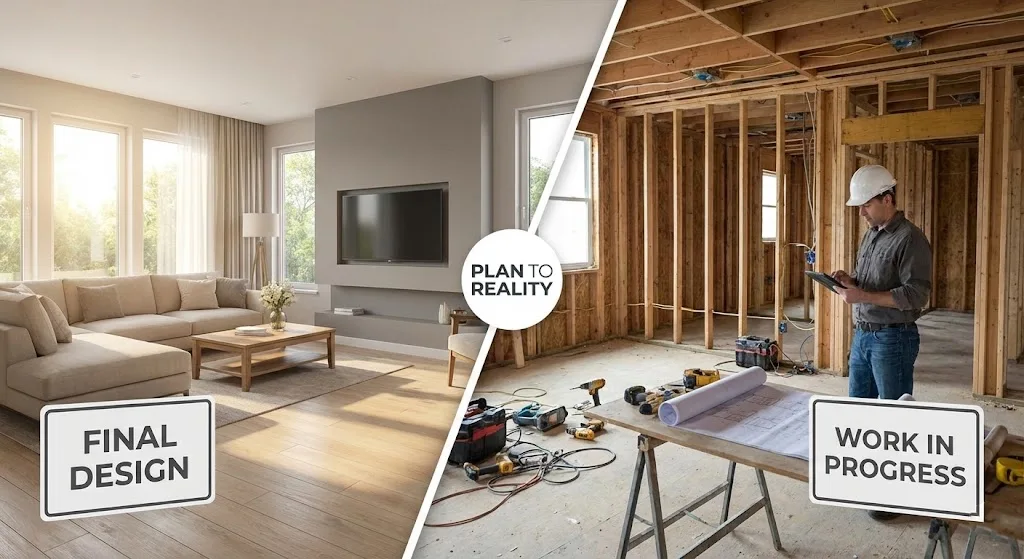
Home improvement projects rarely fail because of poor intentions. They fail because homeowners are forced to make decisions without clearly seeing the result. Floor plans, samples, and verbal explanations can only go so far. At some point, imagination reaches its limit.
This is where visual planning has quietly become one of the most valuable tools in modern home improvement.
From Guesswork to Visual Certainty
Renovation decisions often stack up quickly. Wall colours, finishes, lighting, furniture placement — each choice affects the next. Without a clear picture, homeowners rely on assumptions. Sometimes those assumptions work. Often, they do not.
3D interior visualisation replaces assumption with clarity. Instead of interpreting drawings, homeowners see realistic images of their future space. Scale, proportion, light, and materials are shown together, not in isolation. That shift alone changes how confidently decisions are made.
Fewer Changes, Fewer Delays
Late-stage changes are one of the biggest cost drivers in renovation projects. The layout feels tighter than expected. The finish looks different under real lighting. A space does not function as imagined.
Visualising interiors in advance helps surface these issues early. Layouts can be adjusted. Materials can be swapped. Lighting can be tested. All of this happens before construction begins, when changes are still simple and affordable.
Clear visuals also improve communication with contractors. When everyone looks at the same pictures, it’s easier to understand the instructions and less likely to make mistakes.
Helping people make better design choices
People who own homes generally select materials and fixtures one at a time, without knowing how they will function together. This might make rooms feel uneven or too planned out.
A detailed interior render displays the whole room. You can more easily see if something is balanced, flows well, and is comfortable. Instead of asking “Do I like this tile?” you ask “Does this room feel right?” That difference is important.
This approach is especially useful in kitchens, bathrooms, and smaller homes, where every design choice has a noticeable impact.
Light, Space, and Everyday Comfort
Natural light is one of the most influential elements in any interior, yet it is also one of the hardest to predict. Renovations often change how light moves through a space, sometimes in unexpected ways.
3D visualisation allows homeowners to see how daylight and artificial lighting interact with surfaces, colours, and layouts. This helps avoid dark corners, harsh contrasts, or overreliance on artificial lighting after completion.
A well-lit interior improves daily comfort and can significantly affect how a home is perceived long-term.
Flexibility Without Commitment
One of the best things about digital visual planning is that it gives you freedom. Homeowners can look at their possibilities without making a choice too soon. You may quickly and safely try out different layouts, finishes, and furniture configurations.
Instead of employing generic images, professional 3D interior design rendering services use real dimensions and project-specific details to make this process accurate instead of just an idea.
With that level of accuracy, ideas may be thoroughly examined instead of only imagined.
Value throughout time and appeal in the market
Even if you don’t expect to sell right away, it’s worth it to prepare ahead. Spaces that are well-designed tend to last longer and need fewer fixes later.
Interior visualizations also help show potential for homes that are getting ready to be sold or rented. When buyers and renters can easily see how a space will work and feel, they are more likely to make a decision.
A Practical Planning Tool
3D interior visualisation is not about decoration. It is about reducing uncertainty. It helps homeowners plan smarter, communicate better, and avoid unnecessary costs.
As home improvement projects become more considered and budgets more controlled, visual planning is no longer a luxury. It is becoming part of responsible decision-making.
Conclusion
Good renovations start long before the first tool is used. They start with clear thinking and realistic expectations. By allowing homeowners to see outcomes in advance, 3D interior visualisation removes much of the risk that traditionally comes with home improvement.
Seeing the result first does not just improve design. It improves confidence in every decision that follows.


Comments are closed.